What Is a Diode? The One-Way Valve of Electronics, Explained With Everyday Pictures
A diode is a one-way valve for electricity. What that means in practice, where you already use them, and the three numbers that describe every one of them.
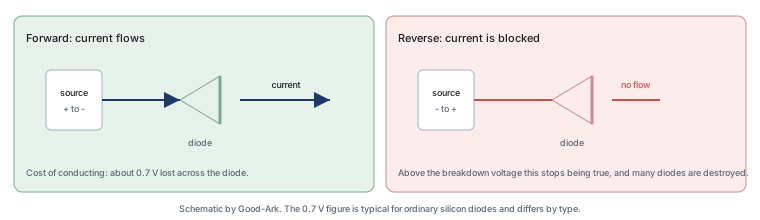
A diode is the simplest interesting component in electronics: it conducts in one direction and blocks in the other. What makes it worth learning first is that almost every power supply, every battery circuit and every electronic device you own depends on that single behaviour, and the rest of the device catalogue is variations on it.
Last updated:
The one-sentence answer
A diode is a two-terminal semiconductor device that allows current to flow from one terminal to the other but not in the reverse direction, which makes it the electronic equivalent of a one-way valve. Under normal operation it drops a small voltage while conducting — around 0.7 volts for an ordinary silicon diode — and blocks almost entirely when the voltage is reversed, up to a defined limit.
Two terminals, two directions, one number to remember. Everything else about diodes is about how well they do those two things, how fast they stop conducting, and how much energy they can survive while doing it.
A water-pipe analogy that actually works
Picture a pipe with a hinged flap inside. Water flowing one way pushes the flap open and passes; water trying to flow the other way presses the flap shut and stops. A diode behaves the same way for electric current, with two useful caveats that the analogy misses.
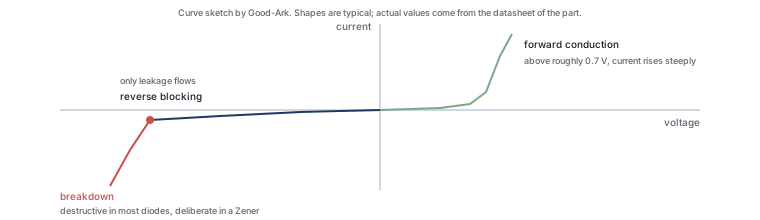
The first caveat is the pressure drop. The flap costs a little pressure even when it is wide open, and a diode costs a little voltage — that 0.7 volts — while conducting. The second is the failure mode. If you push hard enough in the blocked direction, the flap breaks and lets everything through; a diode does the same at a voltage called the breakdown voltage, and in many diodes that event is destructive. So the analogy is useful for the direction and misleading for the limits, which is exactly where beginners get caught.
The diode symbol and what each part means
The standard symbol is a triangle pointing at a vertical bar. The triangle is the anode, the terminal current enters when the diode is conducting; the bar is the cathode, the terminal current leaves. The direction the triangle points is the direction conventional current flows, which is why the symbol is read as an arrow rather than as a shape.
The reason the symbol looks like a valve rather than a component is that it is a behaviour diagram, not a picture. Engineers need to see at a glance which way current may flow, and the triangle does that in a way a drawing of a plastic package never could. Once you have seen the symbol on a schematic and the band on a real part, the two are easy to connect — and that connection is the subject of our article on identifying the anode and cathode.
Forward and reverse: the two directions
Connect a diode so that its anode is toward the positive terminal and the diode conducts. Connect it the other way and it blocks. That is the whole behaviour in one sentence, and the two names for the conditions are forward bias and reverse bias.
Three details matter in practice. Forward conduction is not free: a small voltage is lost across the diode, and that loss appears as heat. Reverse blocking is not perfect: a tiny leakage current flows, and it grows with temperature. And the blocking has a limit: exceed the reverse voltage rating and the diode either breaks down in a controlled way, as a Zener does deliberately, or is destroyed.
It is worth separating two meanings of the word that cause confusion later. A diode’s direction of easy flow is a property of the part, but which way it faces in a circuit is a design decision: the same component can be fitted to conduct during normal operation, as a rectifier does, or to conduct only during a fault, as a protection diode does. Both are the same device doing the same thing. The difference is the designer’s intent and where the current is expected to come from. Beginners who hold that distinction separately find protection circuits much easier to read.
Where you already use diodes
You are surrounded by them. A phone charger rectifies alternating current into direct current using diodes, and the bridge rectifier at its input is four of them in one package. Solar panels use bypass diodes so that a shaded cell does not overheat. A car’s electrical system uses them to protect control units from the transients that inductive loads create. A battery-powered device uses them to stop the battery discharging into the charger or the wrong way round.
The scale is worth pausing on. Rectifier diodes are among the highest-volume electronic components manufactured, because almost anything that plugs into a wall socket converts power at some point. That is why a device class this simple supports an entire industry.
What a diode is not
Clearing this up prevents most early confusion. A diode is not a resistor: its resistance depends on the direction and the current, not on a fixed value. It is not a switch you operate: it decides for itself based on the voltage across it. It is not a fuse: it does not disconnect a circuit, and a failed diode often fails short, which creates a fault rather than clearing one. And it is not a one-way gate for power only — the same component appears in signal paths, where it steers or blocks small currents rather than large ones.
For external background, three references are useful. The general behaviour is described under diodes, the ordinary rectifier circuit under rectifiers, and the light-emitting member of the family under light-emitting diodes. Device test methods come from JEDEC, board assembly expectations from IPC, and sector-level context from the Semiconductor Industry Association. Device and assembly background is published by ISO, NIST and IEC.
Three numbers that describe every diode
Every diode datasheet is a long document, and three numbers do most of the work for a beginner.
| Rating | What it means | Typical value | What happens if you exceed it |
|---|---|---|---|
| Forward voltage | The voltage lost across the diode while conducting | Around 0.7 V for ordinary silicon; lower for Schottky | Not exceeded as such — but higher current means more heat |
| Forward current | The current it can carry continuously, at a stated temperature | Depends entirely on the part | Overheating, then failure |
| Reverse voltage | The voltage it can block in the reverse direction | Depends entirely on the part | Breakdown, which is destructive in most diodes |
Those three are enough to reason about a simple circuit, and they map onto the three questions beginners ask: how much voltage does it cost me, how much current can it carry, and how much voltage can it hold off. Everything else on the datasheet refines those answers with conditions.
Bridging to the next topic
The next useful steps are practical rather than theoretical. Learning to identify which end is which prevents the most common beginner mistake, and learning what the printed codes mean lets you work with parts you already have. Both are covered in this cluster: start with anode and cathode identification, then move to how the junction actually works.
FAQ
What is a diode in simple words?
A diode is a component that lets electricity flow in one direction and blocks it in the other, like a one-way valve in a pipe. It costs a small amount of voltage — about 0.7 volts in an ordinary silicon diode — while it is conducting, and it blocks almost completely when the voltage is reversed. Two terminals, one direction of easy flow, and a limit on how much reverse voltage it can hold off.
Is an LED a diode?
Yes. LED stands for light-emitting diode, and it is the same one-way device with one extra behaviour: when current flows, the material emits light. An LED has a higher forward voltage than an ordinary silicon diode because it is made from different materials, and it is much more sensitive to excessive current, which is why it is normally driven through a resistor or a constant-current circuit rather than connected directly to a supply.
How does a diode work, in plain terms?
Inside the device there is a boundary between two differently treated regions of silicon. Near that boundary, a zone forms that has very few free charge carriers, and it is that zone that decides everything. Push the voltage one way and it collapses, so current flows; push it the other way and it widens, so current is blocked. Our article on the PN junction takes the description one level deeper without equations.
What happens when a diode is bad?
Three failure modes cover almost every case. An open diode conducts in neither direction, so no current flows at all. A shorted diode conducts in both, which usually shows up as a rail that will not come up, a fuse that blows repeatedly, or something else in the circuit overheating. A leaky diode still blocks but lets more current through than it should, which causes unexpected heat and can bias a circuit into misbehaving. The first two are easy to detect with a multimeter; the third usually needs a comparison against a known-good part.
Are diodes still used, given that chips do everything now?
They are used in enormous quantities, and the two facts are not in conflict. Integrated circuits handle information, while diodes handle power: converting alternating current to direct current, protecting inputs, and steering current in battery and charging circuits. Anything that plugs into a wall socket rectifies at some point, and that keeps the volumes high. The devices are simple; the demand is not.
What to do next
If you have a multimeter, take any diode out of a drawer and find its band. Then check that the band marks the bar in the symbol, not the triangle. Getting that one relationship right prevents the single most common beginner mistake, and the rest of the family follows from it. The wider picture of the device classes is in the product family learning centre.
Tell Good-Ark the voltage, the current and how the diode will be used — rectifying, protecting, or steering — and we can point to the family that fits and the ratings that decide it.
Email sales@goodark.com, or start from the product family learning centre.
This article is published by Good-Ark, a manufacturer of diodes and other discrete devices. Typical values quoted here are given for orientation; the ratings for any specific part come from its current official datasheet.
Continue through this engineering topic
For the complete selection, design, verification, and troubleshooting path, explore the Rectifier Selection and Ratings.
- Practical guide: Inside a Diode Factory: How Diodes Are Manufactured, Explained Without Jargon
- Practical guide: Power Rectifiers: How AC-to-DC Conversion Works and How to Choose
- Practical guide: Server Power at 48 V: Rectification and the Efficiency-Margin Race in Data Centers
- Ask Good-Ark technical support about this application
Recommended
 Why Do Diodes Get Hot? Conduction and Switching Losses ExplainedInfoStandard, Fast Recovery, and Schottky Diodes: What’s the Difference?Info
 What Is a Fast Recovery Diode? Understanding “Fast Recovery”Knowledge
 What Is a Diode? A Beginner’s Guide to How It WorksKnowledge
 Component Lead Times in 2026: What Is Actually Normal NowKnowledge