SiC vs Silicon: Why Some Electric Cars Charge Faster
SiC vs silicon: silicon carbide helps an electric car charge faster, but it is not the whole story. What changes, and when the premium is worth paying.
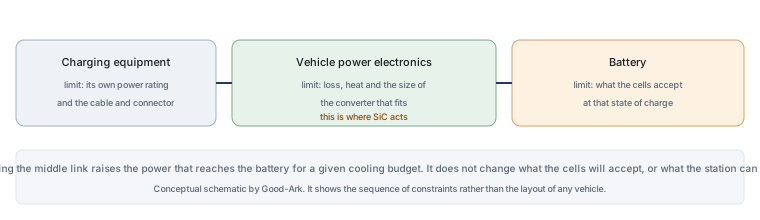
Two cars with similar batteries can charge at noticeably different rates, and part of the difference sits in the power electronics rather than in the cells. Silicon carbide is one reason a converter can handle more power in a smaller, cooler box — but it is an enabler rather than the cause, and understanding where it helps makes the rest of the charging story easier to read.
Last updated:
Two materials, one job
Both materials are used to build the same function: a switch that blocks a high voltage when it is off and conducts with as little loss as possible when it is on. Silicon does this well up to a point. As the voltage rises, the device needs a thicker blocking region, and thicker means more resistance and more heat for the same current.
Silicon carbide blocks the same voltage with a much thinner region because it withstands a higher electric field, so the switch wastes less energy. The comparison that makes it concrete: in a high-voltage converter, replacing silicon devices with SiC reduces the energy lost per switching event, and that reduction is what allows the converter to be smaller, lighter or more powerful within the same cooling budget.
What limits a charger
It is worth separating the two charging paths, because they have different constraints. Alternating-current charging uses a converter inside the car — the on-board charger — to turn mains power into something the battery accepts. Direct-current fast charging uses a large converter in the charging station, delivering current straight to the pack.
In both cases there are three limits in series: what the charging equipment can deliver, what the car’s electronics can pass through, and what the battery will accept at that moment. Silicon carbide acts on the middle link. It reduces the losses in the conversion stages, which means more of the delivered power reaches the battery and less is shed as heat — but it cannot raise the ceiling set by the cell chemistry or by the charger’s rating.
Why less loss means faster charging
A converter that loses less energy per watt delivered can handle more power without exceeding its thermal limits. In an on-board charger, that can mean the same physical box accepts a higher input power, or the same power in a lighter enclosure — which matters because weight is range. In a fast-charging station, it means a cabinet that delivers more current without a larger cooling system.
The mechanism is worth stating precisely, because it is often described loosely. Silicon carbide does not charge the battery faster by itself. It reduces the amount of energy that would otherwise be converted into heat inside the electronics, so the electronics stop being the limiting factor. Once they stop limiting, the next constraint — usually the battery — takes over.
Heat: the hidden bottleneck
Heat is the reason efficiency matters more in a car than on a bench. Cooling equipment adds weight, cost and packaging volume, and a vehicle has a fixed budget for all three. A converter that produces less heat allows a smaller cooling loop, which allows a lighter car, which extends range.
There is a second-order effect that often decides the design: semiconductors degrade faster when they run hot, and the temperature of a device depends on how much heat it produces and how well that heat escapes. Reducing the loss improves reliability at the same time as it improves efficiency, which is one reason the premium is easier to justify on an expensive vehicle than on a cheap appliance.
What it means for your driving range
Range and charging speed are connected through efficiency, but the effect is smaller than marketing suggests. A traction inverter that is a few per cent more efficient saves a few per cent of the energy that passes through it, which translates into a modest range improvement — measurable over a year of driving, not transformative in a single journey.
The larger benefit is usually in what the efficiency allows rather than in the efficiency itself: a smaller inverter, a lighter cooling system, or a higher charging power for the same hardware. For a driver, that shows up as a car that charges quickly on a long journey, not as a dramatically different consumption figure at home.
| Function | Typical choice | Why |
|---|---|---|
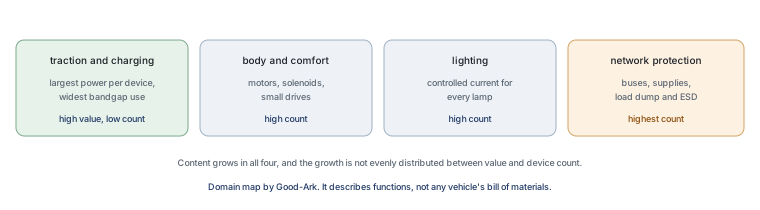
| Traction inverter | Silicon carbide MOSFETs in higher-voltage designs | High current, continuous duty, efficiency directly affects range |
| On-board charger | Silicon or silicon carbide depending on power level | SiC pays at higher power and where the box has to stay small |
| Low-voltage DC-DC conversion | Silicon MOSFETs, increasingly with wide-bandgap options | The voltage is low, so the material advantage is smaller |
| Protection and clamping | Silicon devices, including automotive-qualified families | The job is energy absorption, not low conduction loss |
| Auxiliary and body electronics | Silicon | Cost matters more than efficiency at these power levels |
There is a second reason the premium is easier to justify in a vehicle than in a household appliance: the consequences of a design change are different. In a car, a lighter converter or a smaller cooling circuit feeds back into range, packaging and cost across the whole platform, so a component decision made once pays back in several places. In a cheap appliance, the only place the saving can appear is the energy bill, and the product may be thrown away before that accumulates to anything.
What it costs to use SiC
Three costs sit on top of the device price. The first is the driver and layout: SiC switches faster, so gate loops have to be tighter and the design work is less forgiving. The second is electromagnetic behaviour, because faster edges generate more high-frequency noise that has to be filtered. The third is qualification, since a new material means new test evidence and sometimes new package and mounting requirements.
None of those is a reason to avoid the technology, but they explain why a team cannot simply drop a SiC device into a silicon design and expect the same result. The systems around the switch have to move with it.
Where silicon still wins
Silicon remains the right answer in most of the car. Low-voltage rails, body electronics, protection devices and anything where cost dominates do not benefit enough from a wide-bandgap switch to justify the premium. Silicon has also improved continuously — modern silicon MOSFETs and IGBTs are not the devices of twenty years ago — and in many positions the practical difference is now small.
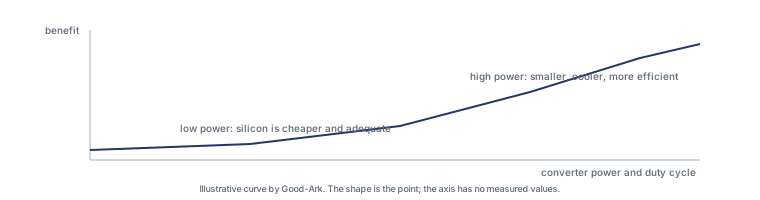
The honest summary is that SiC won where the voltage, the current and the duty cycle are all high, and it is extending into lower power as prices fall. Elsewhere it is a technology waiting for a reason.
When a product claims to use silicon carbide, the useful question is not whether it does but what the material was used for. A charger that uses a SiC diode in the rectification stage but silicon switches in the conversion stage has taken only part of the benefit, and a claim that mentions the material without saying where it sits tells you very little. The same applies in reverse: some of the most efficient designs use silicon where silicon is adequate and wide-bandgap devices only in the two or three positions where the voltage and duty cycle justify them.
For external background, three sources are useful. The material is described under silicon carbide, and the device class that does the switching under power MOSFETs. Device measurement methods come from JEDEC, the vehicle-level test expectations that shape automotive designs from the ISO automotive standards series, system-level electrical safety and testing from the International Electrotechnical Commission, and charging and efficiency programmes for vehicles and equipment from the US Department of Energy. Sector-level reporting is published by the Semiconductor Industry Association. Wide bandgap and sector background is published by NIST.
Plain summary table
| Question | Short answer |
|---|---|
| Does SiC make a car charge faster? | It removes a limit inside the car’s electronics, so more of the delivered power reaches the battery. The battery and the charger still set the ceiling |
| Does it increase range? | Modestly, through lower losses, and more through the weight saved by smaller cooling and converter hardware |
| Is it always better than silicon? | No. Below a certain power level, silicon is cheaper and good enough |
| Can a SiC part drop into a silicon design? | Rarely without changes to the gate drive, layout and filtering |
| Where is the material used most? | Traction inverters and high-power charging hardware, where voltage, current and duty cycle are all high |
FAQ
Why is SiC better than silicon?
For high-voltage switching, because it can block the same voltage with a thinner, lower-resistance region and it wastes less energy per switching event. That advantage is conditional rather than absolute: at low voltage and low power, silicon is cheaper and its losses are small enough that the difference does not pay for itself. The honest statement is that silicon carbide is better in a defined operating range.
Does silicon carbide dissolve in water?
It is chemically inert and effectively insoluble, which is part of why it is used in harsh environments as an abrasive and refractory material. That inertness is also relevant to disposal and to why a packaged device is not a chemical hazard in normal use.
Is SiC a carbide, and is it a ceramic?
Yes to both. It is a carbide by chemistry — a compound of carbon with a less electronegative element — and it is classed as a technical ceramic by materials science. For a fuller treatment of the material itself, including its non-electronic uses and the hazard question, see our introduction to what silicon carbide is.
Do all electric vehicles use silicon carbide?
No, and adoption varies by manufacturer, model and year. The decision turns on the system economics: a high-voltage platform with a large inverter and a strong efficiency requirement makes the case, while a smaller or lower-voltage design may not. Because specifications change with each model year, check the manufacturer’s current technical material rather than relying on a general statement.
What else has to change when a design moves to SiC?
The gate drive, the layout and the filtering, at minimum. Faster switching means tighter gate loops because stray inductance produces voltage spikes, and it means more high-frequency noise to manage. The qualification evidence also changes, since the device is different and the existing test results do not carry over. Starting from a silicon design and swapping the switch is the most common way to be disappointed by a wide-bandgap part.
What to do next
If you are evaluating silicon carbide for a vehicle or charger design, start from the system: the voltage class, the switching frequency, the cooling budget and the hours of operation per year. Those four answers tell you whether the premium is justified before you choose a device. The design-side comparison of the two SiC device types is in our guide to choosing between a SiC SBD and a SiC MOSFET.
Give Good-Ark the voltage class, the switching frequency and the thermal budget, and we can point to the SiC families that fit — or confirm that silicon remains the better choice.
Email sales@goodark.com, or start from the SiC portfolio page.
This article is published by Good-Ark, a manufacturer of silicon carbide devices. It describes the general role of the material in vehicle charging rather than the design of any specific vehicle, and no car manufacturer or supplier relationship is claimed.
Continue through this engineering topic
For the complete selection, design, verification, and troubleshooting path, explore the Silicon Carbide and Wide Bandgap Hub.
- Practical guide: What Is Silicon Carbide (SiC)? A Beginner’s Introduction
- Practical guide: Good-Ark SiC Devices in Plain Language: Silicon Carbide for People Outside the Industry
- Practical guide: The Silicon Carbide Market in 2026: Capacity, Prices and Adoption
- Ask Good-Ark technical support about this application
Recommended
 Why Do Diodes Get Hot? Conduction and Switching Losses ExplainedInfoStandard, Fast Recovery, and Schottky Diodes: What’s the Difference?Info
 What Is a Fast Recovery Diode? Understanding “Fast Recovery”Info
 What Is a Diode? A Beginner’s Guide to How It WorksInfo
 Automotive Semiconductor Report 2026: Chips Per Car Keep RisingKnowledge