Good-Ark TVS Diodes in Plain Language: The Shock Absorbers of Your Circuit
What a Good-Ark TVS diode actually does, the two ratings that decide whether it helps, and how it differs from a fuse in circuit protection.
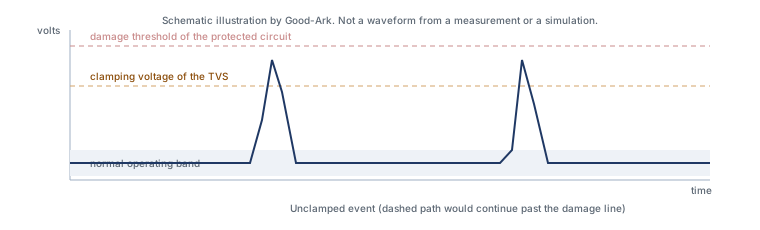
A TVS diode sits on a board doing nothing for years, and then has to absorb an event that lasts a few millionths of a second. Getting it right is a matter of matching two numbers to the threat, and getting it wrong is usually invisible until a batch of products comes back. This article explains the part’s job without assuming you have read a datasheet before.
Last updated:
A shock absorber for electricity
A transient voltage suppressor is a component that stays electrically invisible at normal operating voltage and becomes a low-resistance path the instant the voltage across it rises above a threshold. In that sense it behaves like a suspension unit: it does not stop the road from being rough, it absorbs the roughness so the rest of the structure does not have to.
The comparison is worth stretching, because it explains the two ways these parts fail to protect a circuit. A suspension that is too stiff passes the shock straight through; a TVS with too high a clamping voltage lets the spike reach the chip. A suspension that is mounted in the wrong place protects the wrong corner of the car; a TVS placed electrically far from the connector leaves the connector exposed. In both cases the part is present, working, and not doing its job.
What a spike actually is
The word “surge” covers several events that differ by orders of magnitude in both voltage and duration, and the same component cannot be optimal for all of them. Static discharge from a person is the fastest and smallest in energy: a few kilovolts, delivered in tens of nanoseconds, with a peak current that is painful to a finger but modest to a circuit. A lightning-induced surge on a mains line is slower and far more energetic, arriving over microseconds to milliseconds. Switching events — a motor stopping, a relay releasing, a load being disconnected from a charging alternator in a car — sit between the two, and they are the ones that repeat.
Two consequences follow. First, a protection component is specified for a waveform, not just a voltage, which is why datasheets show a pulse shape alongside a peak rating. Second, repetition matters: an event that a part survives once may still degrade it over thousands of cycles, and a degradation path that never announces itself is the most expensive kind.
Where TVS diodes sit in real products
Protection is placed at boundaries, because boundaries are where the outside world arrives. On a board, that means the connector, the cable entry, the antenna feed, the sensor harness — anywhere a person, a long wire or a vehicle harness can inject energy that the circuit did not generate itself.
In a phone, the boundary is the USB port and the headphone or accessory contacts. In a car, it is every wire that leaves the body control module. In an industrial cabinet, it is the field wiring terminals. In a power supply, it is the mains input and, on the output side, anything a user can touch. The parts differ in size, voltage class and package, but the placement logic is identical and it is the part of the design most often got wrong.
Voltage and energy: the two ratings
Two numbers do most of the work when choosing a TVS. The first is the standoff voltage, the maximum continuous voltage at which the part must remain effectively open — it has to sit above your normal rail, including tolerance, and below the breakdown point where it starts to conduct. The second is the energy or peak pulse power the part can absorb for a specified waveform, which is what determines whether it survives the event or becomes the failure.
| Rating you meet on a datasheet | What it controls | What happens if you get it wrong |
|---|---|---|
| Standoff voltage | Whether the part stays off during normal operation, including supply tolerance | Too low: continuous leakage and heat. Too high: it never engages in time |
| Breakdown voltage | The point at which conduction begins | Misread as the protection level, when it is only the start of conduction |
| Clamping voltage at a stated current | The voltage your circuit actually sees during the event | Too close to the circuit’s limit: the spike passes with the TVS working correctly |
| Peak pulse power or energy for a waveform | Whether the part survives the event at all | Too small: the TVS fails, often as a short circuit |
| Capacitance | Whether it disturbs a high-speed signal | Too high: the protection works and the data link stops working |
Notice that only one of those rows is about surviving. The others are about not interfering with normal operation — which is where most beginner designs lose, because a protection part that damages the signal is usually discovered before the surge arrives, and the part gets removed rather than resized.
Where you find Good-Ark TVS parts
The company’s protection portfolio is organised by series, power class and package, which reflects the fact that a TVS for a USB port and a TVS for a vehicle input have almost nothing in common except the principle. The TVS portfolio page lists the families; the selection method behind them is in the TVS selection guide. If you are starting from a specific connector or line rather than from a part, the application design centre is the better entry point.
How a TVS differs from a fuse
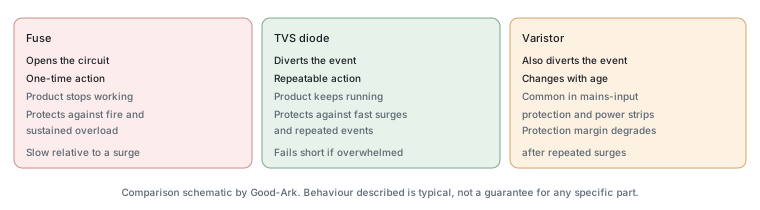
A fuse and a TVS are often drawn next to each other on the same schematic, and they are not alternatives. A fuse is a one-time disconnect: it opens when current exceeds a threshold for long enough, and the product stops working until somebody replaces it. Its job is to prevent fire and further damage, not to keep the circuit running.
A TVS is a repeatable shunt: it absorbs energy and returns to its off state, and the product carries on. Its job is to keep the protected node inside its limits, not to break the circuit. Some designs need both, because the TVS handles the fast event and the fuse handles the sustained fault. A third relative, the varistor, also clamps but with different ageing behaviour, and the comparison between the three is worth understanding before you choose.
Two external references are worth having open while you think about protection. The device class as a whole is described in the transient voltage suppressors, and the older, cheaper alternative often found at mains inputs is explained under varistors. On the standards side, the pulse waveforms that protection devices are tested against come from bodies such as the International Electrotechnical Commission, discrete device test methods from JEDEC, and the assembly expectations that apply once the part is on a board from IPC. Sector-level context is published by the Semiconductor Industry Association. Standards and measurement background is published by NIST and ISO.
What happens when a TVS fails
Most TVS failures are shorts rather than opens, which is deliberate: a part that fails short continues to protect the circuit, at the cost of loading the supply. That is why a failed TVS often presents as a product that will not power on, or a rail that collapses, rather than as a product that is suddenly unprotected. In a repair context, a shorted protection diode is one of the first things worth checking on a dead rail.
The failure mode also explains why placement matters more than headline ratings. If the part is electrically distant from the connector, the surge creates a voltage difference across the trace inductance before the TVS can respond, and the protected circuit sees a spike that the TVS never had a chance to clamp. Move the part to the connector, give the return path a short and wide route, and the same device behaves far better.
FAQ
Is a TVS diode the same as a Zener diode?
They are close relatives that are specified for different jobs. A Zener is designed to regulate or reference a voltage continuously, so its datasheet emphasises tolerance and steady power dissipation. A TVS is designed to absorb short events, so its datasheet emphasises peak pulse power, response time and the clamping voltage at a high current. Using one in the other’s role is possible on a bench and unreliable in a product; our comparison of TVS and Zener behaviour goes through the differences.
Can one TVS protect a whole board?
Only if every threat enters through one point and every protected node is close to it. In practice, a board with several connectors, a long power cable and a high-speed data line needs protection at each boundary, with the device chosen for that line’s voltage class and capacitance. A single large part at the power input is a reasonable start, not a complete answer.
Why does a protection part make my signal stop working?
Because capacitance loads the line. A TVS or ESD diode adds capacitance in parallel with the signal, and on a fast interface that is enough to round off the edges and close the eye. The fix is a part with lower capacitance for that line, or a different protection topology — not removing the protection. Low-capacitance device classes exist precisely for this reason.
How can I tell whether a TVS has already been stressed?
A part that has failed short can be found with a continuity or diode test once the board is isolated. A part that has degraded without failing is much harder to detect, because its clamping behaviour changes rather than its conduction state. That is one reason repeated high-energy events are handled by specifying margin at design time rather than by inspecting parts later.
What should I read next?
If you are choosing a part, the selection guide covers the voltage definitions in order. If you are wondering why a correctly rated part still let a chip fail, start with the article on board-level ESD protection.
What to do next
Before choosing a part, write down what you are protecting and from what: the node, its normal voltage range, the maximum voltage it survives, and the event you expect to arrive. Those four lines decide almost everything about the selection, and they are also the four lines a supplier will ask you for. The general background on the impulse-suppression family is covered in the introduction to transient voltage suppression, and the wider component context in the product family learning centre.
Tell Good-Ark the node, the normal voltage range and the event you expect, and we can point to the family, package and rating class that fits — or explain why the conditions need re-checking first.
Email sales@goodark.com, or start from the TVS portfolio page.
This article is published by Good-Ark, a manufacturer of the protection devices described. Ratings, series names and package options should always be taken from the current official datasheet; nothing here replaces a specification.
Continue through this engineering topic
For the complete selection, design, verification, and troubleshooting path, explore the TVS ESD and Surge Protection Hub.
Recommended
 Why Do Diodes Get Hot? Conduction and Switching Losses ExplainedInfoStandard, Fast Recovery, and Schottky Diodes: What’s the Difference?Info
 What Is a Fast Recovery Diode? Understanding “Fast Recovery”Info
 What Is a Diode? A Beginner’s Guide to How It WorksInfo
 Automotive Semiconductor Report 2026: Chips Per Car Keep RisingKnowledge