AEC-Q101 Explained: What Automotive Grade Really Means
“Automotive grade” is one of the most misused phrases in component buying. It does not mean better quality in general, it does…
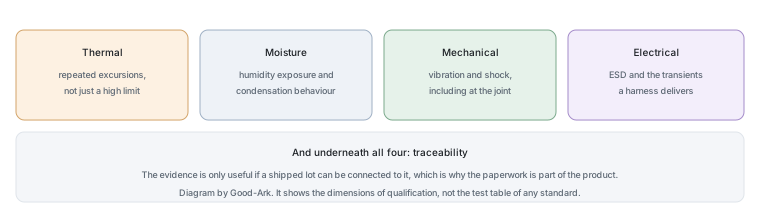
“Automotive grade” is one of the most misused phrases in component buying. It does not mean better quality in general, it does not mean the part is more accurate, and it does not describe a single test. It describes a qualification programme: a set of stress tests, and a traceability chain that connects a shipped part to evidence.
The phrase people misuse
Four separate ideas get folded into the phrase, and keeping them apart is most of the work. It can mean the part was qualified against an automotive standard. It can mean the part has a wider operating temperature range. It can mean it carries traceability and change-notification obligations. Or it can mean nothing at all, if it was applied by a seller as a marketing adjective.
So the useful question is never “is it automotive grade” but “qualified against what, with what evidence, and covering which conditions”. That question has an answer, and the answer is a document rather than an adjective.
What the tests actually simulate
Automotive qualification tests reproduce the stresses a vehicle imposes over a service life. They include repeated temperature excursions, moisture and humidity exposure, mechanical vibration and shock, and electrical stress including electrostatic discharge. For discrete semiconductors, the framework commonly referred to as AEC-Q101 groups these into a family of tests with defined conditions and acceptance criteria.
The word “simulate” is doing real work here. The tests are accelerated proxies for years of use, not a demonstration that the part will survive every real vehicle. That is why the tests are specified with conditions and sample sizes: the claim being made is statistical and conditional rather than absolute, and it is only meaningful when read alongside the standard.
Temperature cycling in plain words
The stress that matters most for a discrete device is thermal cycling. Each time a device heats and cools, its internal parts expand and contract at slightly different rates, and the joints between them are where the fatigue accumulates. Over thousands of cycles a solder layer or a bond wire can develop a crack, and the failure appears as an intermittent fault rather than a clean break.
Temperature cycling tests shorten this by applying large, rapid excursions repeatedly. A part that survives them has demonstrated a certain fatigue resistance, which is a different property from surviving high temperature continuously. A component rated for a high maximum temperature but not qualified for cycling is not an automotive part, because the vehicle’s stress is repetitive rather than steady.
Why traceability matters as much as performance
A qualified part whose provenance is unknown is not usable in a vehicle programme, because the claim being made is about the parts as shipped rather than about the design. Traceability is what connects a specific date-coded batch to the qualification evidence, the process controls and the change history that produced it.
That is also why change notification matters. If a manufacturer alters a process or a die revision, the previous qualification evidence no longer describes the parts being supplied, and the customer needs to know before the change reaches production rather than afterwards. A supplier that cannot offer change notification cannot support a vehicle programme properly, however good its parts are.
Commercial versus industrial versus automotive
The three tiers describe different qualification and operating expectations rather than a quality ranking. Commercial parts are qualified for benign indoor conditions and are the cheapest. Industrial parts extend the temperature range and often the robustness. Automotive parts add the full qualification programme, the traceability and the change-notification obligations.
The misleading part of that description is any implication that an automotive part is “better” in an absolute sense. It is qualified for a harsher environment and documented more thoroughly, at a higher price. In a consumer product those extra obligations buy nothing, which is why the same die may be sold in both forms with different paperwork and different test limits.
| Dimension | Commercial | Industrial | Automotive |
|---|---|---|---|
| Temperature range | Narrow, typical indoor conditions | Wider | Widest, against a defined profile |
| Stress qualification | Basic | Extended | Full programme including cycling and vibration |
| Traceability | Usually not required | Often partial | Required, from lot to evidence |
| Change notification | Rare | Sometimes | Expected as part of the agreement |
| Cost | Lowest | Middle | Highest, because the price includes evidence |
| Electrical performance | May be identical, since the same die can be sold in more than one tier | ||
Why the same chip costs more
Five things sit in the price difference. Testing, because qualification runs consume parts and time. Yield, because devices that fail a tighter screen are not sold into the tier. Documentation, because evidence has to be generated, maintained and traceable. Supply commitments, because automotive customers require availability over a product’s life. And liability, because the consequence of a defect is different and the supplier takes on obligations that a consumer part does not carry.
None of that makes the silicon different. It is entirely possible for two tiers to contain the same die, with the automotive part having been screened and documented more thoroughly — or, in some cases, selected from a tighter portion of the distribution.
Two practical points follow from that sequence. The first is that the qualification conversation is a document conversation, and it is worth having before a part is designed in rather than after. The second is that a change-notification arrangement protects the customer over the life of the product, not just at the start, which is why it is part of the agreement rather than a courtesy.
It also helps to know what the verification is not. It is not a guarantee that the part will never fail, and it is not a comparison of two suppliers’ quality. It is evidence that a defined set of stresses was applied to a defined set of samples under stated conditions, and that the parts being shipped can be connected to that evidence. Everything a buyer can reasonably ask rests on those two things being available.
How to verify a claim
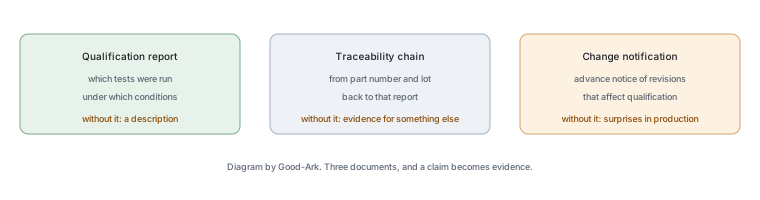
Ask for three things. The qualification report or a summary of it, covering the tests and the conditions applied. The documentation that connects the part number you are buying to that evidence. And the change-notification arrangement for the part in production.
If the first is missing, the claim is a description rather than a demonstration. If the second is missing, the evidence applies to something other than the parts you will receive. If the third is missing, you will find out about revisions from a failure rather than from an email. Our article on verifying an automotive part beyond the datasheet walks through that in more detail.
There is a second reason the documentation matters commercially, and it is worth stating plainly. A qualified part that cannot be traced to its evidence cannot be defended in a warranty dispute, however good it is.
Summary table
The phrase describes a programme rather than a grade: a defined set of stress tests, a traceability chain and a change-notification arrangement. It is worth paying for in a vehicle because the environment is harsher and the consequences of failure are greater. It is not a synonym for better performance, and a commercial part with matching electrical ratings has not been demonstrated against the same conditions.
Background written for beginners covers automotive electronics, and the qualification framework referred to here is described by the Automotive Electronics Council. Component test methods come from JEDEC, assembly and workmanship expectations from IPC, quality management system requirements from ISO, electrical safety and testing standards from the International Electrotechnical Commission, and sector-level context from the Semiconductor Industry Association.
AEC-Q101 Test Groups: From TC to H3TRB
AEC-Q101 organizes qualification into test groups that stress the part across the failure mechanisms automotive use exposes:
Last updated:
- Accelerated stress: high-temperature operating life and temperature cycling, which age the die and the package interfaces.
- Environmental and humidity: temperature-humidity-bias testing (including H3TRB) that exposes moisture-driven degradation under bias.
- Electrical verification: ESD, latch-up, and other electrical stress tests that check the part survives the transient environment.
- Early-life and reliability: early-life failure rate and long-term reliability sampling that document the failure population.
The exact test matrix, sample sizes, and conditions are defined by the standard and its revisions; the design takeaway is that qualification is a documented stress program, not a marketing label.
Each test group targets a failure mechanism: temperature cycling stresses the package and solder interfaces, humidity-bias testing exposes moisture and ionic contamination under voltage, and the electrical tests verify the part survives the transient environment. Mapping the mechanism to the test makes the qualification evidence interpretable instead of a list of acronyms.
What the Qualification Wording Means
AEC-Q101 defines the qualification program and its test groups; the wording printed on a datasheet is the supplier’s summary of where the part stands. Read it literally, and remember that “qualified available” is a supplier phrase, not an AEC-defined grade:
- Qualified. The supplier states the part has completed the AEC-Q101 qualification program and the evidence exists. This is the strongest claim, and the qualification report should be requested.
- Qualified available. A supplier phrase meaning the part is designed and offered for automotive qualification and the evidence can be supported, but the qualification has not necessarily been completed; the specific qualification report must be requested and confirmed before project approval. It is a planning input, not a completed status.
- Unstated. No AEC-Q101 claim is made on the datasheet; treat the part as commercial grade until documentation says otherwise.
The difference between the second and first is the difference between a project that starts with evidence and one that starts with a promise. Confirm the documentation, not the label, before freezing the automotive BOM.
The decision guidance follows the wording: for a production automotive program, start with qualified parts or budget the time and cost to complete qualification for a qualified-available part; for a prototype or a low-risk module, qualified available may be enough if the documentation is confirmed. The label is a project-planning input, not a technical verdict on the silicon.
The three wordings appear across the industry, and reading them the same way on every datasheet keeps the review consistent from one supplier to the next.
The wording is the contract, and the document behind it is the evidence.
Good-Ark Automotive Portfolio Status
The Good-Ark portfolio states its status explicitly, and the wording should be read exactly as printed: the ASGC051BS carries AEC-Q101 qualified on its datasheet; the AMBRP10H100, AMBRP5100, and AMBR40250S carry qualified available; and the AWSS series is not marked with AEC-Q101 on the site at this writing. Each claim is confirmed with the supplier before automotive project approval.
Standards note. The description of the AEC-Q101 test groups above is a general outline of the qualification program as published by the AEC; the exact test matrix, conditions, sample sizes, and revision requirements are defined by the current AEC-Q101 document and must be read from it. The part-status statements reflect the datasheet and site wording at the time of writing and should be re-confirmed with the supplier against the current revision.
Sources
- Good-Ark — AMBRP10H100 Product Page
- Good-Ark — ASGC051BS Product Page
- AEC — AEC-Q101 Documents
- Good-Ark — Contact
FAQ
What does “grade 4 car” mean?
That is a different subject, and the question usually refers to vehicle classification or to grading systems used in used-car markets rather than to component qualification. If the intent behind the question is automotive electronics, the relevant idea is the qualification tier described in this article: which tests a component has passed and what traceability accompanies it. The two uses of the word “grade” are unrelated.
What is the difference between automotive and non-automotive components?
Automotive components have been qualified against a defined set of stress tests, carry traceability from the shipped lot to the evidence, and are supplied under a change-notification arrangement. Non-automotive parts are qualified for their own environments and documented accordingly. The electrical ratings may be identical, because the same die can be sold in both forms; the difference is what has been demonstrated and recorded.
What are tier 1 and tier 2 in the automotive supply chain?
A tier-one supplier delivers a complete system or module directly to the vehicle manufacturer. Tier-two suppliers provide components or subassemblies to the tier-one. A semiconductor manufacturer may therefore supply a tier-two integrator rather than the vehicle brand itself, which is why the same component can appear inside modules from several different suppliers and why the qualification conversation happens one or two steps away from the car maker.
What does “automotive quality” mean?
It should mean that the part has passed the qualification programme and that its documentation chain is intact. In practice the phrase is often used loosely by sellers, so the working definition is the one you can verify: ask for the qualification summary, the traceability documentation and the change-notification arrangement. If all three exist, the claim is real; if none do, the phrase was an adjective.
Does a wider temperature range make a part automotive grade?
No. A wider operating temperature range is one dimension of what automotive parts offer, and it is the easiest one to see on a datasheet. The qualification programme also covers repeated cycling, moisture, vibration and electrical stress, and it includes the documentation obligations. A part with a wide temperature range and no qualification evidence is an industrial part with a wide range.
What to do next
If a supplier describes a part as automotive grade, ask which standard the qualification was against and request the documentation. The answer will either be specific or it will not, and that distinction is what the phrase should have told you in the first place. The functional view of the automotive families is in the Good-Ark automotive portfolio article.
Good-Ark can confirm which qualification documentation applies to a part number and what traceability accompanies a shipment.
Email sales@goodark.com, or start from the automotive portfolio page.
This article is published by Good-Ark, a manufacturer of automotive-qualified discrete devices. It describes the qualification framework rather than quoting any standard’s test tables, and it does not claim qualification for any specific part; that evidence comes from the supplier’s documentation.
Continue through this engineering topic
For the complete selection, design, verification, and troubleshooting path, explore the Automotive Power Electronics Hub.
- Practical guide: Automotive-Grade vs Commercial-Grade Semiconductors: A Selection Framework
- Practical guide: OBC Architecture Trends: Bidirectional, High-Voltage, and Power-Dense
- Practical guide: Automotive Lighting Electronics: From Halogen to Matrix LED Power Needs
- Ask Good-Ark technical support about this application
Recommended
 Why Does Your Phone Charger Get Warm?Knowledge
 Energy Efficiency Rules Worldwide: How Regulations Shape Component ChoicesKnowledge
 Wide-Bandgap Semiconductors: Adoption Report 2026Knowledge
 The GaN Charger Market: Why Your Next Adapter Is SmallerKnowledge
 Component Lead Times in 2026: What Is Actually Normal NowKnowledge
 China’s Power Semiconductor Industry: Where It Stands in 2026Knowledge