What Is RoHS? The Rules Behind Lead-Free Electronics, Explained Simply
Good-Ark RoHS documentation explained: what the rule restricts, why lead was the hard part, what a compliance declaration is, and how to check one.
RoHS is a European restriction on hazardous substances in electrical and electronic equipment, and it is the reason lead vanished from solder. Its effect went far beyond Europe, because a manufacturer building one global product tends to build it to the strictest rule it faces rather than maintaining separate versions.
The problem RoHS was written to solve
When electronic equipment is thrown away, some of what it contains does not stay where it was put. Heavy metals and certain flame retardants can leach from landfill, escape from informal recycling and accumulate in soil, water and living things. The rule addresses the composition of the product rather than the disposal method, on the reasoning that a substance that is not there cannot escape later.
The analogy that fits is removing an ingredient rather than installing a filter. Both reduce harm, and only one of them depends on the filter being maintained for the product’s whole life. RoHS takes the removal approach, which is why it changed what components are made of rather than how they are recycled.
The restricted substances at a glance
The list is short and has grown once since the directive began. It covers lead, mercury, cadmium, hexavalent chromium, two classes of brominated flame retardants used in plastics, and four phthalates used as plasticisers. Cadmium is restricted at a tighter threshold than the others, which is why it appears separately in declarations.
The practical significance for a component buyer is that the restriction applies to the materials rather than to the function. A part does not have to be redesigned conceptually to comply; the solders, platings, moulding compounds and coatings have to change. That is why compliance work is largely a supply-chain exercise rather than an electrical one.
| Group | Where it appeared | What replaced it |
|---|---|---|
| Lead | Solder, some platings, some ceramics and glasses | Tin-silver-copper and other lead-free alloys |
| Mercury | Switches, relays and some lamps | Electronic switching and alternative lamp technologies |
| Cadmium | Contacts, platings and some pigments | Silver, tin and other contact materials |
| Hexavalent chromium | Corrosion-protective coatings on metal parts | Trivalent chromium and other passivation systems |
| Brominated flame retardants | Plastic housings and some moulding compounds | Alternative flame-retardant systems |
| Phthalates | Flexible plastics and cable insulation | Other plasticisers |
Who has to comply and when
The restriction applies to electrical and electronic equipment placed on the European market, and it has been introduced in stages by product category. The first stage took effect on 1 July 2006 for most common categories, with medical devices, monitoring instruments and control equipment following later. The scope has been broadened since, and the directive also applies to components and subassemblies sold into the European market for incorporation into equipment.
For a component manufacturer the practical consequence is that compliance is a design and procurement requirement rather than an export formality. A part that will be designed into European equipment has to be makeable without the restricted substances, and the evidence that it is must be available to the customer. That is why the subject appears in component documentation at all.
What a compliance declaration looks like
A declaration is a document, usually on company letterhead, that identifies the parts or product ranges it covers, names the restriction it is being made against, states that the products comply, and gives the date and a responsible signature. It often references the applicable standard for testing and may include the maximum concentration values being claimed against.
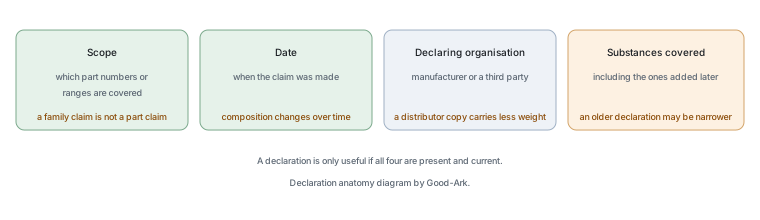
Four details decide whether a declaration is usable. The scope, because a declaration covering a product family does not necessarily cover the specific part number you are buying. The date, because composition changes. The identity of the declaring organisation, because a declaration from a distributor is not the same as one from the manufacturer. And the substances covered, because a declaration issued before the phthalates were added does not cover them.
Is RoHS the same everywhere
No, and the differences matter for a product sold in several regions. The European restriction is the one usually meant by the name. Other jurisdictions have their own instruments with their own scopes, thresholds and exemptions, and some restrict different substances. There are also exemptions inside the European regime, granted where a substitute is not technically available, and those exemptions are reviewed and can expire.
Two consequences follow for anyone building a product. A claim of compliance made against one regime does not automatically satisfy another, so the region of sale has to be part of the specification. And because exemptions change, a design that relied on one may need revisiting, which is a reason to keep the compliance documentation with the design record rather than with the purchasing file.
Two further details are worth knowing before the question is asked of a supplier. First, a restricted substance is measured as a concentration in a homogeneous material rather than in the finished product, which means a compliant assembly can still contain a non-compliant coating on one small part. Second, the exemptions are granted for specific applications and have expiry dates, so a design that is compliant today on the basis of an exemption may need a substitute later. Neither point changes what you ask a supplier for, and both change how you read the answer.
For a buyer, the practical version is a short list. Find out which regimes the destination market applies, ask for evidence against each, and check the date on the evidence so that you know which version of the rules it was assessed against. A supplier who can answer all three is describing a compliance process rather than a certificate, and that distinction is what survives an audit.
How it changed manufacturing
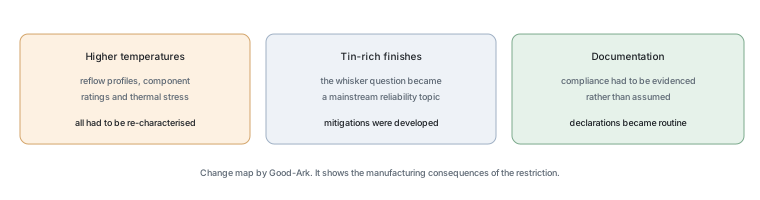
Three changes were large and permanent. Soldering temperatures rose, because the lead-free alloys in common use melt at higher temperatures than the tin-lead alloys they replaced, which changed reflow profiles, component temperature ratings and the thermal stress that assemblies endure. Tin-rich finishes brought the tin whisker question into mainstream reliability engineering. And the documentation burden grew, because compliance had to be evidenced rather than assumed.
There was also an unintended improvement: the need to characterise higher-temperature processes led to better understanding of thermal profiles and joint reliability across the industry. That is not a reason to celebrate the rule, only a note that the technical work it forced produced knowledge that stayed.
How to check a supplier claim
Ask for the declaration, then check four things: that it covers the specific part number rather than a family, that it is dated recently enough to cover current composition, that it comes from the manufacturer rather than a distributor, and that it names the substances covered. If the answer is a certificate image rather than a document naming your part, that is a starting point rather than evidence.
For production, one further step is worth taking: record the declaration with the order, so that the evidence and the shipment are connected. That connection is what an auditor will ask for, and it is the difference between a compliance file and a folder of miscellaneous certificates.
External references are useful for the regulatory detail. The restriction is published by the European Commission, which describes the RoHS Directive and its exemptions. The chemical framework that sits alongside it is explained by ECHA under REACH. Component test methods come from JEDEC, assembly and materials expectations from IPC, and quality management requirements from ISO. Regulatory and quality background is published by NIST.
FAQ
What does RoHS compliant mean?
That the product or part has been assessed against the European restriction on hazardous substances and found to be within the permitted limits, with any applicable exemption identified. In practice it means you can obtain a declaration saying so for the specific part you are buying, dated recently enough to cover the current composition. A logo without a declaration is a claim rather than evidence.
What substances does RoHS restrict?
Lead, mercury, cadmium, hexavalent chromium, two classes of brominated flame retardants and four phthalates. The exact thresholds and the exemptions belong to the directive itself rather than to a summary, and they have been amended since it came into force, so for a regulatory purpose the current text is the reference rather than an article like this one.
Does RoHS apply to components or only to finished products?
It applies to equipment placed on the European market, and components and subassemblies sold for incorporation into that equipment are covered by the same restrictions in practice, because otherwise the finished product could not comply. That is why component manufacturers publish compliance documentation: their customers need it to demonstrate their own compliance.
Why did lead have to go?
Because it was the restricted substance with by far the widest use, appearing in the solder that holds almost every electronic assembly together. Removing it forced a change of alloy, which raised process temperatures and produced the reliability questions that the industry has spent two decades working through. It was the change that made the rule consequential.
Is a compliance certificate the same as a declaration?
Not quite. A declaration is a statement by the manufacturer that the products comply, naming the scope and the restriction. A certificate usually refers to a test report or a management system certificate, which supports a declaration but does not replace it. For a customer’s compliance file, the declaration naming the part number is the document that matters.
What to do next
If you are buying parts for a product sold in Europe, ask for the declaration and check its scope and date before the order is placed rather than afterwards. If you are designing, keep the compliance documents with the design record, because a change of supplier or a change of composition will require them to be re-checked. The adjacent chemical regulation is covered in our article on RoHS versus REACH.
Ask Good-Ark which declarations and certificates apply to a specific part number, and for the version that covers the composition currently being shipped.
Email sales@goodark.com, or start from the quality knowledge section.
This article is published by Good-Ark, a manufacturer of discrete semiconductor devices. It summarises a regulatory framework for a general reader; thresholds, scope and exemptions belong to the current legal text, and no product-specific compliance claim is made here.
Recommended
 Why Do Diodes Get Hot? Conduction and Switching Losses ExplainedInfoStandard, Fast Recovery, and Schottky Diodes: What’s the Difference?Info
 What Is a Fast Recovery Diode? Understanding “Fast Recovery”Info
 What Is a Diode? A Beginner’s Guide to How It WorksInfo
 Automotive Semiconductor Report 2026: Chips Per Car Keep RisingKnowledge