Trench Schottky Diodes: Structure, Losses and Thermal Selection
A trench Schottky diode is a Schottky rectifier that uses a trench-based semiconductor structure to improve the trade-off between forward conduction, reverse…

A trench Schottky diode is a Schottky rectifier that uses a trench-based semiconductor structure to improve the trade-off between forward conduction, reverse blocking and leakage. The important distinction is electric-field management, not a guarantee of zero loss or the smallest forward drop. Its benefit must be assessed at the circuit’s current, reverse voltage, temperature and switching conditions.
This guide focuses on silicon trench Schottky devices in power and support circuits. It explains what the structure changes, how to compare candidates and why a compact package needs an installed thermal assessment. The label does not make a device equivalent to a silicon carbide rectifier, a trench MOSFET or a completed protection system. Hypothetical calculations illustrate the selection method without claiming manufacturer test results.
What does the trench structure actually change?
Trenches can shape the reverse electric field. In the structure described by Nexperia AN90056, Rev. 1.0, oxide-lined, polysilicon-filled trenches act as field plates. Their action depletes the drift region under reverse bias and reduces field concentration near the surface. This is more accurate than saying every trench Schottky simply places its rectifying junction along exposed trench sidewalls.
The exact construction is technology-specific. Different structures can balance conduction resistance, leakage, blocking behavior and termination differently. The word trench alone does not establish dimensions, material interfaces or the performance of a particular part. Use the manufacturer’s supported description and electrical evidence rather than inventing a universal cross-section.
For circuit selection, the result matters more than a simplified drawing: how do forward behavior and leakage change at matching conditions, and what happens during commutation? A technology improvement can create a useful candidate, but a tested parameter comparison is still required. Device geometry is an explanation of a mechanism, not a certificate of application suitability.
Trench vs planar Schottky: compare matched conditions
The technology label is only the first comparison. Use equivalent reverse-voltage classes, forward current, temperature and mounting when assessing candidates. A low-voltage planar device can have a lower forward drop than an unrelated higher-voltage trench device; that does not disprove either structure’s purpose. The voltage and operating requirements must be common before the loss comparison is meaningful.
| Criterion | Useful comparison | What the label does not establish |
|---|---|---|
| Forward loss | VF or conduction model at relevant current and temperature | Lowest VF at every operating point |
| Reverse leakage | IR at relevant voltage and hot conditions | Zero leakage or universal thermal stability |
| Switching | Commutation charge and actual voltage/current event | Zero dynamic loss |
| Package | Installed thermal path and electrical connections | Equal cooling from similar outlines |
| Approval | Exact-part qualification and application evidence | Automotive approval from the word trench |
Nexperia’s explanation of trench trade-offs provides a manufacturer perspective on forward drop, leakage and thermal robustness. Keep product claims confined to the documented examples. A general selection article should not transform one supplier’s demonstrated comparison into a universal ranking of all trench and planar parts.
Where might a trench Schottky diode be useful?
Consider the current path and operating states. A converter freewheel path needs forward conduction and repetitive commutation evidence. A supply OR-ing path may emphasize continuous drop and reverse leakage when another source is active. A bootstrap or charge-pump path adds capacitor-charging pulses, reverse exposure and supply constraints. The same diode class can therefore serve quite different duties.
In each case, identify which part of the cycle carries forward current and which part applies reverse voltage. Include standby and hot conditions. A device that looks favorable during full-load conduction can produce a different result when it spends most of its time blocking at high temperature.
Do not add a trench diode solely because a circuit is described as high density. First establish the function that needs improvement and its present limiting loss or stress. The rectifier selection guide supplies the broader role-first method; the gate-driver guide explains support circuits where charging current and moving references can change the diode requirements.
A loss example where the lowest VF does not win
Assume two hypothetical candidates share the required voltage class. At the hot condition being reviewed, candidate A has 0.40 V forward drop and 20 mA reverse leakage at 40 V; candidate B has 0.50 V forward drop and 2 mA leakage. Let each carry 4 A during half the cycle and block at 40 V during the other half.
Using a simplified constant-value model, A’s forward loss is 0.40 × 4 × 0.5 = 0.80 W, and reverse loss is 40 × 0.020 × 0.5 = 0.40 W. Its combined result is 1.20 W. B’s corresponding terms are 1.00 W and 0.040 W, totaling 1.04 W. The higher-VF candidate has the lower subtotal under these assumed hot conditions.
This is not a measured trench-versus-planar comparison. The assumed leakage and drops must come from supported data in a real review, and dynamic losses are omitted. It demonstrates why the complete duty matters. A different temperature, blocking voltage or conduction fraction can change the result, so do not turn one subtotal into a permanent device ranking.
Reverse loss and thermal stability require a linked assessment
Temperature-dependent leakage can feed back into heating. ST AN4021 explains why reverse-voltage and junction-temperature dependence belong in a power-diode loss calculation. An improved structure may reduce one contribution without removing the need for an operating-point assessment.
The approximate reverse contribution is the time-average of reverse voltage multiplied by leakage. A hot blocking interval may be important even where average load current is low. When generated heat increases faster than the installed cooling can remove it, a stable operating point may be lost. A maximum junction-temperature label is not alone proof against that behavior.
Review startup, transition between operating modes and neighboring heat. Do not treat hot leakage as merely an idle battery-consumption detail if it can affect temperature and survival. An application-specific simulation or measurement can help connect these effects, but it must retain the actual voltage, duty and mounting assumptions. Merely calculating conduction loss and adding a fixed temperature allowance misses the coupled problem.

What remains when ordinary recovery charge is small?
Capacitance still creates a switching current. A Schottky structure can avoid the same minority-carrier storage behavior found in a PN rectifier, but junction capacitance must charge and discharge. That event interacts with the switching transistor and the loop’s inductance. A small recovery contribution does not establish a lossless or disturbance-free transition.
Different structures and operating voltages can produce different charge and waveform behavior. Evaluate the measured or supported charge under matching conditions instead of comparing an isolated recovery-time label. Capacitive current can appear even when a diode’s minority-carrier recovery contribution is negligible.
The recovery and commutation explanation gives the mechanism in more detail. In the installed converter, inspect current and voltage together with suitable measurement methods. A sharper transition can reduce one loss mechanism while making ringing or overshoot more demanding. The desired result is a supported waveform within all relevant device limits, not simply the fastest edge.
Package reduction needs a real cooling route
A smaller body does not make heat disappear. If the selected part reduces total loss, it may create room for a packaging change, but the replacement package’s thermal path must still support the installed dissipation. Copper area, vias, solder and enclosure conditions can dominate that result.
For a hypothetical 1.04 W and an applicable effective junction-to-reference resistance of 30 °C/W, the simplified steady-state rise is 31.2 °C. If another mounting creates 60 °C/W, the same loss implies 62.4 °C. The example omits nonlinear leakage and neighboring heat; it is useful only when the model corresponds to the actual reference and installation.
Nexperia’s thermal-parameter guide explains those reference distinctions. An exposed tab may also be an electrical terminal, which matters when connecting heat-spreading metal or a heatsink. Mechanical similarity cannot substitute for verifying the outline and pin assignment. Validate the closed product configuration rather than only a well-cooled development fixture.
How should a datasheet shortlist be organized?
Preserve conditions next to each parameter. List reverse rating, relevant forward points, hot leakage, pulse conditions, dynamic information and mounting. Mark typical and maximum values separately. A curve can help explore an operating point, while a guarantee or acceptance criterion needs its appropriate supporting limit.
Record unresolved information rather than filling it with values from a neighboring part. If only room-temperature leakage is available, the hot result remains an open selection question. If a switching claim lacks matching conditions, obtain the needed evidence before making a frequency recommendation.
The automotive Schottky guide applies this method to vehicle stress and qualification. In a dual device, also consider per-junction limits and shared heating; the dual common-cathode guide explains those constraints. Keep circuit connection and package duty in the comparison, because a technology label does not establish how two dies can be loaded together.
What should a substitution trial measure?
Target the requirement that motivated the change. If the problem is hot reverse loss, a room-temperature forward-drop measurement does not resolve it. If the aim is lower commutation loss, a DC test misses the relevant event. Compare the original and candidate on the same board conditions before attributing the improvement to structure alone.
Record current and reverse exposure, gate-drive settings where relevant, temperature, mounting and probe setup. Check both semiconductor heat and the stress transferred to the switching device. Include the required load range and relevant standby or transition states. A favorable full-load result is not sufficient evidence for every state.
For procurement, retain exact ordering code, qualification coverage, package connections and document revision with the approval. The sourcing workflow explains how to preserve that evidence across later orders. Evaluate a trench Schottky as a complete candidate whose supported behavior fits the design, rather than an automatic upgrade from a planar part.
Frequently asked questions
Is a trench Schottky diode a type of MOSFET?
Last updated:
No. Both device families can use trench structures, but a Schottky rectifier and a MOSFET have different functions and terminals. The diode rectifies through its supported current–voltage behavior; the MOSFET is a gate-controlled switch. Shared fabrication terminology does not make them interchangeable. Some integrated products can combine functions, so read the exact architecture. Identify the intended circuit role before interpreting the word trench as an electrical specification or a replacement recommendation.
Does every trench Schottky have lower VF than every planar diode?
No. Voltage class, current, temperature, construction and package affect the comparison. A structure can improve a trade-off without being lowest at every operating point or against every unrelated product. Compare candidates that satisfy the same reverse-voltage requirement and use matching forward-current and temperature conditions. Include leakage and dynamic behavior too. A single typical curve or marketing label is not sufficient to establish the best installed result for the complete duty.
Can a trench diode eliminate thermal runaway risk?
It can improve characteristics relevant to thermal stability, but the actual operating point and heat path still need assessment. Hot leakage, reverse exposure and neighboring heat may matter during blocking or transitions. Verify the supported device data and installed cooling rather than assuming that a maximum temperature label guarantees stability in every application. A relevant test or model must preserve the voltage, duty and mounting used to approve the design.
Is a trench Schottky the same as a SiC Schottky?
Trench describes a structural approach; silicon carbide identifies a semiconductor material. They are not interchangeable labels. This article addresses silicon trench Schottky devices, while SiC rectifiers can address different voltage and operating requirements. Compare supported device characteristics and the circuit role rather than assuming one word describes the entire construction. A high-voltage SiC candidate and a low-voltage silicon trench candidate should not be ranked from headline forward drop without matching the required application.
Why can a fast Schottky still produce switching current spikes?
Junction capacitance charges and discharges as voltage changes, and the circuit has inductance and other parasitic elements. Small ordinary stored-charge recovery therefore does not make the transition electrically inactive. The installed waveform depends on the diode, switching device and loop. Compare charge and stress under the actual conditions and measure with an appropriate setup. A faster transition can change ringing and overshoot as well as losses, so the whole commutation event needs review.
Can I substitute a trench part without changing the PCB?
A compatible footprint can simplify the trial, but it does not establish electrical or thermal equivalence. Confirm connections, body clearance, supported ratings and the relevant mounting assumptions. Evaluate the required waveform and heat path on the intended board. If the new part changes commutation behavior, check the switching device’s stress as well. Keep the full ordering code and validation with the approval so procurement does not treat all trench parts in that package as equivalent.
Continue through this engineering topic
For the complete selection, design, verification, and troubleshooting path, explore the Schottky Diode Selection Hub.
- Practical guide: The SMPS Output Rectifier: Fast Recovery, Schottky, or Synchronous
- Practical guide: Silicon, Schottky, or Germanium: Choosing a Low-Drop Diode for 3.3 V and 5 V Rails
- Practical guide: Schottky vs Fast Recovery Diode: Gates, Voltage Range, and Real Tradeoffs
- Ask Good-Ark technical support about this application
Recommended
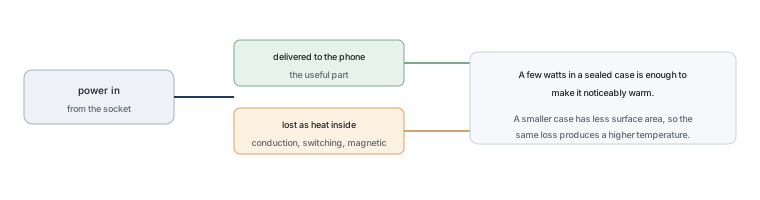 Why Does Your Phone Charger Get Warm?Knowledge
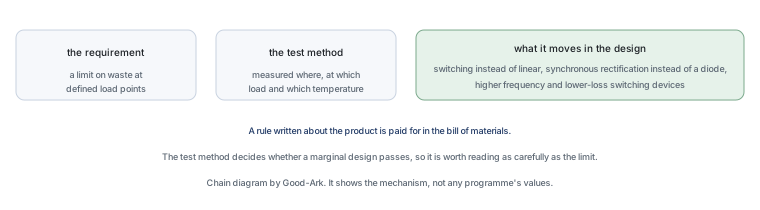 Energy Efficiency Rules Worldwide: How Regulations Shape Component ChoicesKnowledge
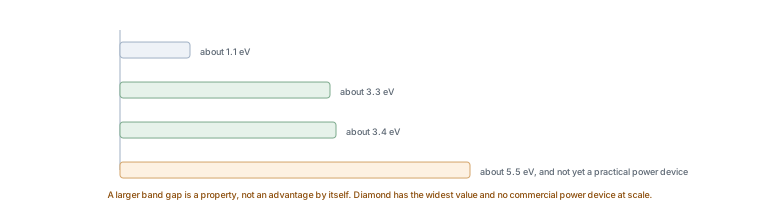 Wide-Bandgap Semiconductors: Adoption Report 2026Knowledge
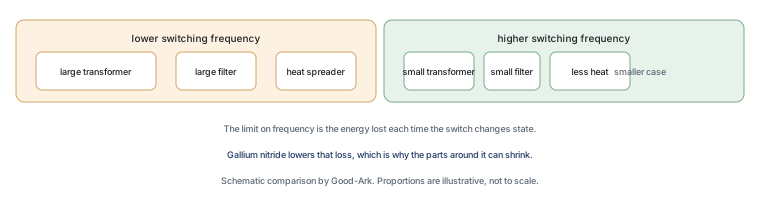 The GaN Charger Market: Why Your Next Adapter Is SmallerKnowledge
 Component Lead Times in 2026: What Is Actually Normal NowKnowledge
 China’s Power Semiconductor Industry: Where It Stands in 2026Knowledge