What the Numbers in a Semiconductor Part Number Actually Mean
Semiconductor part number meaning: a code points at a row in a table. What each segment usually encodes, and how to confirm it for the part in your hand.
Updated: October 27, 2026
Semiconductor part numbers encode family hints, not portable standards—decode, then verify against the official datasheet.
Related reading: how to read a diode datasheet, datasheet terms explained, why not to trust every datasheet.
| Item | Verify | Typical trap |
|---|---|---|
| Conditions | Tj, IF, VR columns | Comparing numbers at different conditions |
| Curves vs tables | Which one your bias uses | Using only the cover headline |
| Absolute max | Never design at ABSMAX | No margin for spikes |
| Revision | Document date / PCN | Old PDF from a reseller |
Part numbers are codes, not names
The reason part numbers are compact codes rather than descriptive names is practical. A name long enough to describe a device’s voltage class, package and grade would be unreadable at the size printed on a component, and impossible to fit in a catalogue column. Codes exist because the alternative does not fit.
The analogy that works is a library shelfmark. A shelfmark tells you exactly which book to fetch, but it tells you nothing about the contents, and you need to know which library’s numbering scheme it follows before it means anything at all. Part numbers are the same: precise, compact, and meaningless without the table they belong to.
The prefix usually names the family
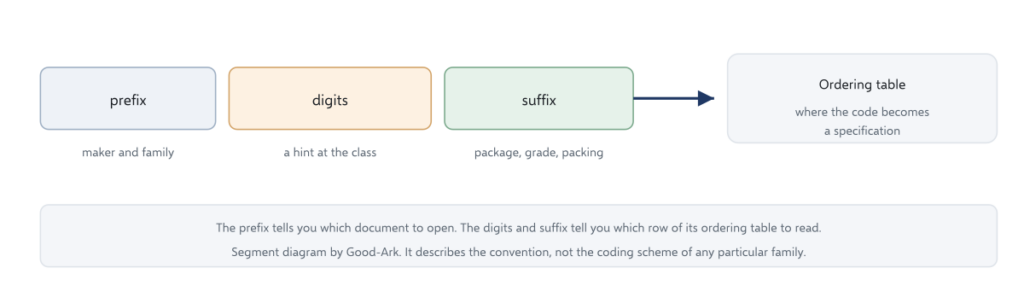
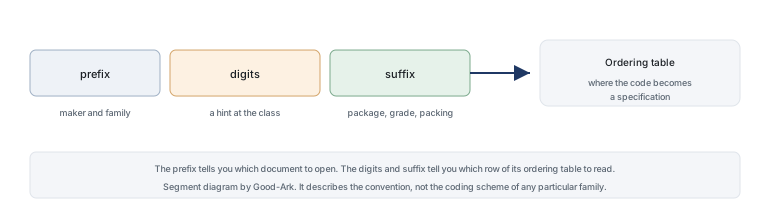
The letters at the front of a part number generally identify the manufacturer and the product family, so that the rest of the string can be resolved against the right document. They carry no rating information. A prefix such as the GS used on Good-Ark device numbers is an identifier of that kind; it tells you which table to look in.
Two consequences follow. Several prefixes may point to the same manufacturer, because a company offers several families. And the same prefix may be used by more than one manufacturer, which is why the manufacturer mark on the package matters as much as the letters in the number.
Digits that encode ratings
The middle of a part number often carries information about the device’s class, and manufacturers frequently choose digits that gesture at a voltage or a current. That convention is useful for recognition and unreliable as a source of specification, for three reasons: the digits may be rounded, different families may use different schemes, and the same pattern can mean something else in another maker’s code.
The working rule is to treat the digits as a hint about which parts you are looking at and to take the ratings from the ordering table and the electrical characteristics. An experienced engineer recognises numbers this way, which is a memory aid rather than a decoding rule.
Suffixes for package and packing
The end of the number is where variants are distinguished, and it is the segment most often responsible for a wrong order. A suffix may indicate a package, a channel polarity, a grade, or the packing format for automated assembly. Two parts can share an electrical core and differ substantially in footprint, thermal path and price.
This is why the complete orderable number matters. Copying a base number into a purchase order leaves the seller to choose the variant, and the variant is often the thing you actually cared about.
| Segment | Tells you | Does not tell you |
|---|---|---|
| Prefix | Which manufacturer and family to look up | Any performance figure |
| Middle digits | A hint about the class, useful for recognition | The guaranteed voltage or current rating |
| Suffix | Which variant: package, grade, channel or packing | Whether that variant suits your circuit |
| The complete number | Which row of the ordering table applies | Whether the part in your hand is genuine |
Why different brands encode differently
There is no industry-wide scheme for part numbers, and the reasons are historical. Some families descend from registration systems that assigned sequence numbers, some were designed internally and encode parameters deliberately, and some encode nothing beyond a sequence that a table maps to a specification. A manufacturer that acquires a product line may keep its numbering, which is why a single company can have several incompatible schemes in its own catalogue.
The practical consequence is that decoding skill is transferable in method but not in detail. Learning the method — find the family, find the table, match the complete number — works across every manufacturer; learning a particular scheme works for one.
Codes that look identical but are not
Two traps recur. The first is a shared prefix: a code that resolves cleanly against one manufacturer’s table may mean something entirely different in another’s. The second is a two- or three-character marking on a small package, which is defined by the maker’s own marking table and is ambiguous without knowing who made the part.
Both traps have the same remedy. Establish the manufacturer from the package marking before resolving the code, and if the manufacturer cannot be established, treat the part as unidentified rather than guessing. Our article on reading component markings covers the package side of that problem.
How to confirm what the code means
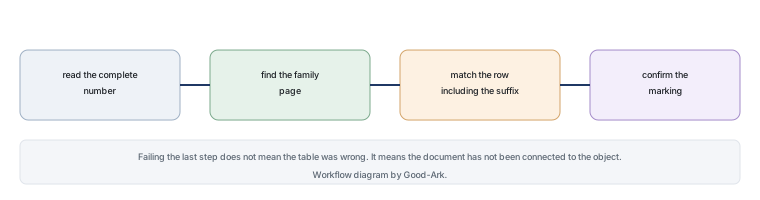
Four steps, and the last one is the one people skip. Read the complete number from the package. Find the manufacturer’s family page for that prefix. Find the matching row in the ordering-information table, including the suffix. Then check the marking specification on that row against the printing on your part. Newcomers to datasheets may find How to Read a Diode Datasheet for the First Time a helpful companion.
If the fourth step fails, you have not identified the part, whatever the table suggested. That comparison is the only thing that connects a document to a physical object.
Three distinctions are worth separating before the decoder table, because confusing them causes most part-number errors. The first is between a registered type and a manufacturer-specific number: a registered type is a widely used designation that several makers may produce with their own guaranteed limits, while a manufacturer-specific number exists only in one catalogue and may encode parameters deliberately. The two behave differently when you try to substitute one for the other.
The second is between the orderable part number and the marking on the package. The orderable number is what you buy; the marking is a shortened form chosen to fit the space available, and it is defined in the datasheet’s marking specification. A purchase order that quotes the marking rather than the orderable number invites the seller to guess, which is how a package or grade substitution happens without anybody intending it.
The third is between a catalogue’s display number and the manufacturer’s number. Catalogues frequently split a part into a base number and separate fields for package or packing, so the string shown in a search result may be shorter than the string on the package. Copying the shorter version into a purchase order or a search box produces a different result set from the one the manufacturer would recognise.
The habit that resolves all three is to work from the physical object. Read what is printed on the part, match it to the family’s ordering table, and then write the complete orderable number into whatever document you are producing. Everything else in this subject is a source of plausible-looking strings that do not correspond to anything orderable.
It is also worth knowing how this looks from the manufacturer’s side. A supplier who publishes an ordering table is telling you which variants exist and which do not, and that table is therefore the boundary of what can legitimately be ordered under their name. A purchase order for a string that does not appear there is not a variant the manufacturer makes, whatever a listing claims.
Decoder table
| What you have | What to do | What to conclude if it fails |
|---|---|---|
| A complete orderable number | Match it in the family’s ordering table | The number may be a seller’s invention or a shortened form |
| A number with a manufacturer mark | Resolve against that maker’s family pages | Check for a misread character before assuming the part is unusual |
| A short code with no mark | Compare package dimensions and measure the device | Treat it as unidentified rather than approximately identified |
| A number that matches two families | Compare the package drawings | One of them is not your part; the drawing decides |
| Nothing legible | Characterise the device on a bench | Keep it out of anything where an error has consequences |
Related reading on our own site covers part numbers, electronic components and integrated circuits. Component test methods come from JEDEC, marking and traceability expectations from IPC, documentation control requirements from ISO, and sector-level context from the Semiconductor Industry Association. Document and standards background is published by NIST and IEC.
Verification checklist
- Download from the official source when possible; record the revision.
- Recompute loss at your hot temperature, not only 25 °C.
- Treat marketplace PDFs without revision control as untrusted.
FAQ
Why do two PDFs for the same MPN disagree?
Revisions, region-specific docs, or altered reseller copies. Prefer the manufacturer repository.
What is the first datasheet section to read?
Absolute maximum ratings and the conditions footnotes—then the electrical table at your temperature.
Are part-number decoders reliable?
They are hints only. Family codes collide across vendors; the datasheet wins.
How does heating relate to datasheet limits?
See why diodes get hot and the thermal design guide.
Continue through this engineering topic
- Good Ark Datasheets Finding Official Documents And Verifying
- How To Read A Diode Datasheet
- Common Diode Part Numbers
- Datasheet Terms Explained
- Diode Markings Decoded
- Documents With A Component Order
- Cross-Reference & Replacement Methods
Topic hub: How to read a diode datasheet — related selection guides and application notes in this cluster.