GSD Series, GSMDJ Series and Their Cousins: A Beginner’s Map of Good-Ark MOSFET Families
A Good-Ark MOSFET series name tells you which shelf to look on, not what is in the box: how to compare families, and what a series label promises.
Updated: October 27, 2026
Use a MOSFET series map to jump from voltage/current/package needs to a shortlist—then finish with RDS(on), gate charge, and SOA at your thermal limit. A map is navigation, not a substitute for the datasheet.
Selection depth: power MOSFET selection guide, N-channel vs P-channel.
| Map axis | Shortlist filter | Next measurement |
|---|---|---|
| VDS | Rail × margin | Avalanche / spike budget |
| RDS(on) | Loss at Iload | Tj rise |
| Package | Copper / height | RthJA reality |
| Polarity | High-side / low-side | Gate-drive voltage |
Why a brand splits parts into series
Manufacturers group devices into families for practical reasons rather than marketing ones. Devices built on the same process and offered in the same package range can share documentation, share a qualification programme and be produced on the same equipment. Grouping them lets a customer who has qualified one family reuse most of that work for another part in it.
Series also mark out a territory. A family aimed at low-voltage battery switching will be specified differently from a family aimed at mains-derived power conversion, because the qualification, the package and the marketing all differ. The name is shorthand for that territory, which is useful — and easy to over-read.
The GSD family in one line
The honest one-line description of any family is the one the manufacturer publishes for it, and it is worth being explicit about why we are not inventing one here. The definitions and member lists of these families are held in Good-Ark’s own product pages, and they change as the portfolio develops. Writing a plausible-sounding definition from memory would be worse than saying where the authoritative version lives. For background on the manufacturer behind these families, see What Is Suzhou Good-Ark Electronics?
So the practical answer is this: the one-line definition of a family is the “applications” or “features” line on its official page, and the member list is the ordering table in its datasheet. Both are short, both are maintained, and both beat any secondary summary — including this one.
The GSMDJ family in one line
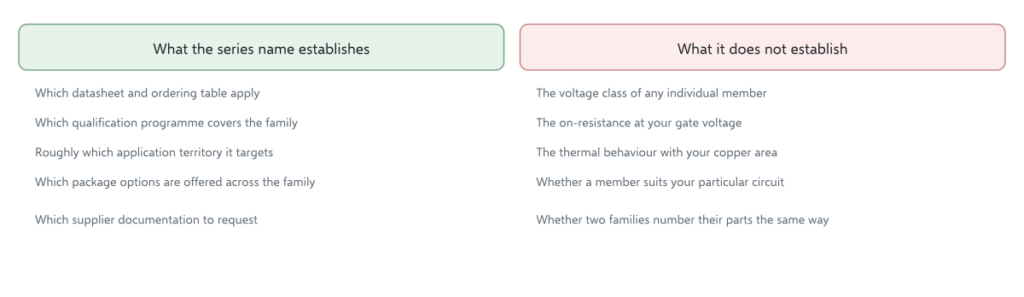
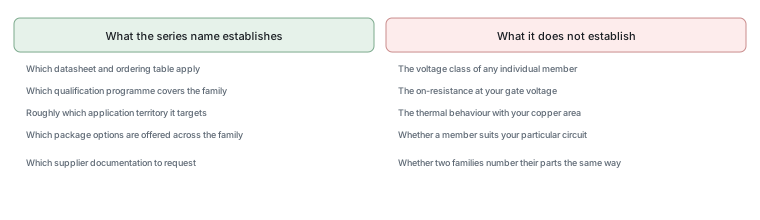
The same reasoning applies to the sibling families. A series label such as this one typically encodes a family rather than a rating, so it tells you where to look and roughly which territory the parts occupy. It does not tell you the voltage, the on-resistance or the package of any individual member.
What you can rely on without a specific document is the logic: if two parts come from different families, their electrical cores were developed separately, so you should not assume that a suffix or a digit means the same thing in both. Compare them on the datasheet parameters rather than on the similarity of their names.
How to compare series at a glance
Comparing families is a four-column exercise once you have the right documents. List the blocking voltage range the family covers, the package options it offers, the application territory it is aimed at, and the qualification evidence available. Those four columns let you see immediately whether two families overlap, and where the boundary between them runs.
What you should not do is compare on the name. Two families with similar labels may be built on different processes and target different markets, and two families with dissimilar labels may overlap almost entirely. The documents decide; the labels only tell you which documents to read.
Series versus package versus voltage
Three different things are often confused when people talk about “types” of MOSFET. The series identifies the family and its documentation. The package identifies the physical form, the footprint and the thermal path. The voltage class identifies what the device can block. A single family typically spans several packages and several voltage classes, so none of the three determines the others. For the wider picture of how these device families relate, browse the MOSFET, IGBT and transistor hub.
| Axis | What it decides | What it does not decide |
|---|---|---|
| Series | Documentation, qualification programme, application territory | Voltage, package or thermal performance of a member |
| Package | Footprint, mounting, and the thermal path off the die | Whether the die inside suits your voltage and current |
| Voltage class | What the device can block, with margin | Which package it comes in or what it costs |
| Your circuit | Whether any of the above is suitable | Nothing — this is the axis that makes the decision |
Choosing between families for a hobby build
For a hobby build the family question is usually answered by the voltage class and the package rather than by the family name. Decide what voltage you need to block, what current you need to switch, and how the part will be cooled; then pick any family that covers those three with margin and whose package you can solder.
That approach has an advantage beyond simplicity: it works even when the exact family you read about is no longer stocked, because you are choosing by requirements rather than by a name you saw somewhere. The four numbers that decide a MOSFET selection are covered in our article on MOSFETs in plain language.
What the series name does not promise
Four things are commonly assumed and none of them is guaranteed by a series label. A series name does not promise a particular voltage class, because a family usually spans several. It does not promise a particular package, because families span packages too. It does not promise interchangeability between members, because two members can differ in grade or package while sharing a name. And it does not promise that a similar number from another manufacturer means anything similar at all.
The last of those is worth restating because it causes real errors. Family prefixes are shared or imitated across the industry, so if a part number resolves cleanly, it resolves against one manufacturer’s table and no other. Our article on decoding the GS prefix explains the method for resolving one.
The method becomes concrete quickly, so it is worth walking through a hypothetical requirement. Suppose you need to switch a 12 volt load at 5 amps, from a board with no heatsink and no forced airflow, driven by a 3.3 volt logic pin. Working through the four columns: the blocking voltage needs margin above 12 volts but not a dramatic amount; the current requirement plus the no-heatsink constraint means the on-resistance has to be low enough that the heat is genuinely small; the logic pin means the device must be specified to reach its rated on-resistance at a gate voltage of about 3.3 volts; and the package has to be one you can solder, with the copper area the datasheet assumes.
None of that requires knowing what a family’s letters stand for. It requires reading a voltage column, a current column, a gate specification and a package drawing, in that order. Any family that satisfies the four becomes a candidate, and the rest of the decision is availability and price.
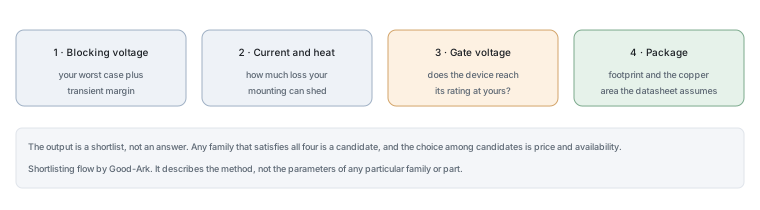
Three further points follow from working this way. The blocking voltage sets a floor rather than a target, so a part rated far above your requirement is not automatically better; it usually has a higher on-resistance for the same die area. The current requirement is really a heat requirement, which is why the no-heatsink constraint dominates the choice. And the gate specification quietly decides whether the device works as intended or merely appears to, which is the single most common reason a hobby build runs hot without an obvious fault.
Two words of caution about applying this to families you have not used before. First, the on-resistance quoted at a low gate voltage is the number that matters, not the headline figure measured at a higher one. Second, the package section states the copper area assumed for the thermal rating, and a part mounted with less copper than that has a lower real capability than its table suggests. Both are visible in the datasheet once you know to look.
Reference table
| If you need… | Where to look | Because |
|---|---|---|
| The definition of a family | The official product page for that family | It states the intended application and the family’s features |
| The member list and their ratings | The ordering table in the family datasheet | It is the only authoritative decoder for the numbers |
| Which package suits your board | The package and outline section | Footprint, mounting and thermal path are package properties |
| Whether the part suits your circuit | Your own voltage, current and thermal numbers | No document can answer this one for you |
| Proof that the part you received is genuine | Channel confirmation and lot traceability | Documentation alone does not verify a shipment |
Our own articles cover how component families are organised: electronic components and part numbers. Device test methods come from JEDEC, traceability and marking expectations in production from IPC, the documentation duties that keep revisions traceable from ISO, and sector-level context from the Semiconductor Industry Association. Device and quality background is published by NIST and IEC.
Practical checklist
- Separate blog orientation from contractual quality docs.
- Keep lot traceability when reliability matters.
- Do not invent certificates or financial claims—ask the supplier for primary documents.
FAQ
Why do similar MPNs differ so much in R_DS(on)?
Die generation, voltage class, and package thermal limits differ. Compare at the same VGS and temperature.
Can I cross to another brand by voltage alone?
No. Match SOA, Qg, body-diode behavior, and qualification status.
Where do logic-level gates fit?
When the controller cannot drive 10 V gates. Confirm RDS(on) at your actual VGS.
Next reading?
Gate drive design guide if linked in cluster, else the MOSFET selection guide.
Continue through this engineering topic
- Is Good-Ark legit
- What is Suzhou Good-Ark Electronics
- Where to buy Good-Ark parts
- Avoiding counterfeit power semiconductors
- Do Semiconductor Brands Matter
- Electronica Visitor Guide How To Plan A Productive
Topic hub: Good-Ark semiconductor sourcing guide — related selection guides and application notes in this cluster.