Good-Ark Bridge Rectifier Families: Matching the Bridge Type to the Input
A buyer replacing a failed bridge in a motor drive and an engineer selecting the input bridge for a 65 W adapter…

A buyer replacing a failed bridge in a motor drive and an engineer selecting the input bridge for a 65 W adapter are looking at the same product family page and need different answers: the drive needs a three-phase module rated for industrial surges, and the adapter needs a compact single-phase bridge that survives capacitor inrush. Good-Ark organizes its bridge products into four families — standard, fast-recovery, Schottky and three-phase — so the search starts from the input waveform. This overview maps each family to its applications, packages and current classes, and shows the path from input to part number.
Last updated:
Good-Ark organizes bridges by junction behavior and input phase
The catalog groups bridges into four families by junction behavior and input phase: standard, fast-recovery, Schottky and three-phase — and the family choice follows the input frequency, voltage and load, not the output label.
A bridge is four (or six, for three-phase) rectifier junctions in one package, and the family name describes what those junctions were optimized for. Standard PN junctions suit line-frequency conduction and surge; fast-recovery junctions add speed for higher-frequency inputs; Schottky junctions lower the forward drop for low-voltage inputs; and three-phase modules integrate six junctions for industrial buses. The organization mirrors the selection logic: define the input, choose the family, then pick the package and current class within it. The product grouping pages keep the four families separate because the datasheets, packages and applications do not overlap.
A standard bridge fits line-frequency mains inputs by default
A standard bridge fits any 50/60 Hz mains input where recovery speed is irrelevant and the requirement is surge capability, current at the case temperature and blocking margin — the default for power supplies, adapters, appliances and industrial controls.
At line frequency the junctions recover slowly but never need to be fast, because the line crosses zero only 100 or 120 times per second. The standard family’s job is to conduct the load current, block the reverse voltage with margin and survive the capacitor inrush and line surges. Good-Ark’s standard bridge grouping covers the BR-style and GBJ-style parts used across the current and voltage range of mains-powered equipment. The selection is a thermal and surge exercise: average and RMS current at the operating case temperature, surge above the measured inrush, and a blocking class above the worst line transient. When those fit, a standard bridge is the correct engineering answer — the other families solve problems this input does not have.
When does the input frequency demand a fast-recovery bridge?
A fast-recovery bridge is demanded when the rectifier commutates at higher frequency — a high-frequency front end, an inverter-fed stage or a source above line frequency — where the standard junction’s slow recovery becomes loss and EMI.
The fast-recovery family appears where the “AC” input is not ordinary mains. In those circuits the diodes must recover quickly at every commutation, and the recovery event would otherwise add loss and noise. Good-Ark’s fast-recovery bridge grouping includes LBR and RMB-style series for power supplies, chargers, office and home appliances and telecom equipment. The trade is a different forward characteristic and a higher cost than a standard part of the same class, so the family should follow the actual frequency of the waveform. When the input is 50/60 Hz, the fast-recovery family is an unnecessary premium; when the frequency rises, it is the difference between a quiet input stage and an EMI problem.
When does a Schottky bridge earn its place?
A Schottky bridge earns its place on low-voltage AC inputs where the forward drop of four PN junctions consumes a meaningful share of the output voltage and the lower voltage ceiling is acceptable.
At low AC input voltages, the four-diode drop of a standard bridge can be a significant fraction of the output. A Schottky bridge replaces the PN junctions with Schottky barriers, lowering the drop and the conduction loss for low-voltage, high-current inputs. The family is not a general replacement: Schottky leakage rises at temperature and the practical voltage ceiling is far lower, so the fit is limited to inputs where the drop is the dominant cost. Low-voltage AC-powered LED and IoT equipment are the classic homes for the family, and the datasheet’s forward-drop and leakage curves decide whether the input voltage and ambient allow it.
Which bridge belongs on a three-phase input?
A three-phase bridge module belongs on a three-phase input — six junctions integrated in one package for motor drives, industrial power stages and UPS — sized by line-to-line voltage, DC bus current and the industrial surge environment.
Three-phase rectification needs six diodes, and the practical form is a module that integrates them with one thermal path. Good-Ark’s three-phase grouping, with series such as SGBJ, serves motor drives, industrial power and UPS where the DC bus is derived from three-phase mains. The selection is dominated by the input line voltage, the DC bus current and the surge environment of industrial installations; the module’s datasheet gives the current at case temperature, the surge rating at the defined waveform and the thermal resistance. The module simplifies assembly and thermal design compared with building the same circuit from discretes, which is why it dominates the industrial input stage.

Package and current class complete the selection through the thermal path
Package and current class complete the selection because the package defines the thermal path — small SMD bodies for low current, through-hole and module bodies for higher current — and the rating only means something at the mounting’s case temperature.
Bridge packages span small surface-mount bodies, through-hole bridges and bolted modules, and the same electrical rating carries different current in each because the thermal path differs. The product pages show the package outline for each part, which is worth checking early because it decides the board area, the assembly process and the heat path. Two selection mistakes dominate: choosing by average current alone while ignoring the narrow-pulse current of a capacitor-input load, and ignoring the case-temperature condition on the headline rating. The derating curve at the real case temperature is the decision, and the package that fits the board and thermal design is the one that survives production. ST’s rectifier thermal note documents the thermal side of that package decision.
Five steps move a design from bridge family to part number
Move from family to part number in five steps: confirm the input phase and frequency, choose the family, calculate the average and surge current, select the voltage class with margin, and verify the part’s current at your case temperature on the datasheet.
The sequence starts with the input — single-phase or three-phase, line frequency or high frequency — which selects the family. This page’s job is the family map and the part-number path: which series exist, which packages they ship in, and where each datasheet lives. The engineering sizing itself — average and RMS current, capacitor inrush, voltage margin, surge and thermal checks — belongs to the general bridge-selection guide on this blog rather than being duplicated here; that guide links back to the family pages when a specific series is chosen. The catalog pages and product pages are the map; the datasheet PDF is the contract. ROHM’s diode technology comparison explains the junction-level differences behind the family choice.
| Family | Input | Key selection factor | Typical fit |
|---|---|---|---|
| Standard | 50/60 Hz single-phase | Surge, current at case temp | PSUs, adapters, appliances |
| Fast-recovery | High-frequency AC | Recovery loss and EMI | High-frequency front ends |
| Schottky | Low-voltage AC | Forward drop | LED, IoT low-voltage inputs |
| Three-phase | Three-phase mains | Line voltage, bus current, surge | Motor drives, UPS, industrial |
Frequently asked questions
Can I use a standard bridge at 400 Hz?
Check the frequency first. A standard bridge at 400 Hz (common in aircraft equipment) operates at eight times the line frequency of ordinary mains, which changes the thermal duty and can make the slow recovery a loss source. Verify the recovery behavior at the actual frequency and consider the fast-recovery family if the standard junction becomes a problem.
Is a bridge module better than four discrete diodes?
Not universally. A module gives one thermal body, one qualification history and fewer solder joints, which simplifies assembly and traceability. Four discretes give layout flexibility and substitution options. Choose by the current class, the thermal path and the assembly model — the electrical function is identical.
Why does my bridge overheat below its current rating?
Because a capacitor-input load draws current in narrow pulses whose RMS value exceeds the average DC current, and RMS current heats the die. Check the RMS current and the case temperature at your load and ambient, then compare with the derating curve — the headline average current is not the thermal rating.
How do I know the right voltage class?
Start from the peak of the highest legal line voltage, add the transients the product must survive, and select the next standard class with margin. For a 230 V nominal input, the peak alone is about 325 V at nominal and higher with tolerance; the surge environment then decides whether the class needs another step.
What the bridge family choice comes down to
The choice comes down to the input waveform: standard for line-frequency mains, fast-recovery for high-frequency inputs, Schottky for low-voltage drop-sensitive inputs, and a three-phase module for three-phase buses — then sized by current, surge, voltage margin and the package’s thermal path.
Pick the family from the input frequency and voltage, size the part from the load current, inrush and surge at the real case temperature, and confirm on the current datasheet. The bridge that survives the input it actually sees is the one selected from the input — not from the label.
The standard bridge category, the fast-recovery bridge category, the Schottky bridge category and the three-phase bridge category group each family with its datasheets. Send the input voltage, frequency, load current and surge standard to the engineering team, and the family and part-number recommendation follows from the same selection sequence this article describes.
Continue through this engineering topic
For the complete selection, design, verification, and troubleshooting path, explore the Bridge Rectifier Design Hub.
- Practical guide: Bridge Rectifier Failures in Motor Drives: Field Patterns and Fixes
- Practical guide: Three-Phase Bridge Rectifier Guide: Six-Pulse Operation and Industrial Sizing
- Practical guide: Fast Recovery Bridge Rectifier Guide: High-Frequency Input Rectification
- Ask Good-Ark technical support about this application
Recommended
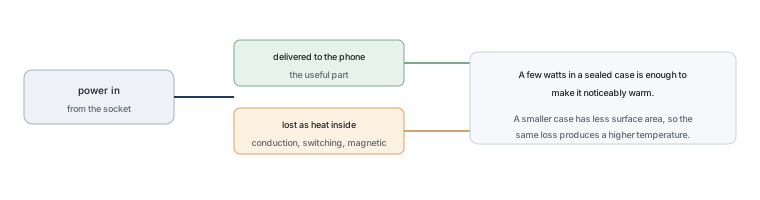 Why Does Your Phone Charger Get Warm?Knowledge
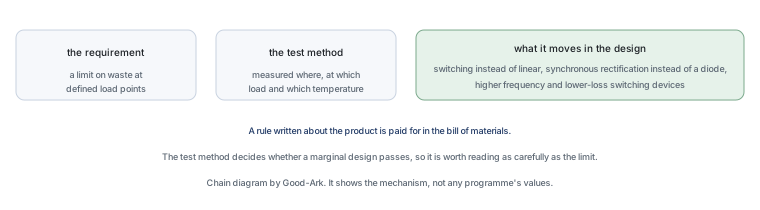 Energy Efficiency Rules Worldwide: How Regulations Shape Component ChoicesKnowledge
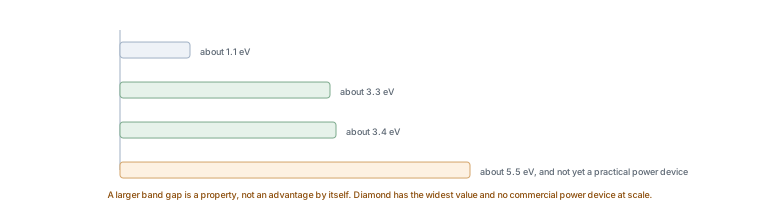 Wide-Bandgap Semiconductors: Adoption Report 2026Knowledge
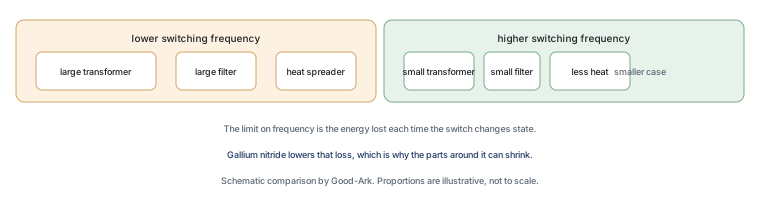 The GaN Charger Market: Why Your Next Adapter Is SmallerKnowledge
 Component Lead Times in 2026: What Is Actually Normal NowKnowledge
 China’s Power Semiconductor Industry: Where It Stands in 2026Knowledge