Dual Common Anode Schottky: Reliable Power Switching for Modern Electronics
A dual common anode Schottky diode puts two diodes on one shared anode. How pin configuration, forward drop and thermal limits decide the right part.

A dual common anode Schottky diode contains two Schottky diodes whose anodes are tied together inside one package, with both cathodes brought out separately — and it is chosen almost entirely by where the shared node sits in your circuit, not by which part is cheapest. If you are OR-ing two input rails into one load, the shared node belongs on the load side and you need the complementary common-cathode device; if one rail has to feed two independently switched paths, the shared node is the rail and the common-anode configuration is the right one.
Last updated:
Key Takeaways
- Dual common anode means one shared anode, two separate cathodes (for example BAT54A / BAT54AW in SOT-23 and SOT-323). The complementary part is the common-cathode type, BAT54C.
- Pin configuration follows the circuit, not the price list: a shared node at the supply rail points to common anode, a shared node at the load points to common cathode.
- Forward voltage is a curve, not a number. On the ST BAT54 datasheet the maximum forward drop moves from 240 mV at 0.1 mA to 900 mV at 100 mA, so comparing parts at the wrong current proves nothing.
- Reverse leakage is the trade-off that gets ignored: at VR = 30 V the same part is specified at 1 µA maximum at 25 °C and 100 µA maximum at 100 °C.
- Thermal resistance, not the current rating, decides whether a compact package survives: junction-to-ambient is 500 °C/W for SOT-23 and SOD-123 in this family.
What a Dual Common Anode Schottky Actually Is
It is two Schottky diodes in one package that share a single anode connection, so the package can steer, clamp or switch two paths that both originate from the same node. The paralleled-anode structure is why these parts appear in layouts where a single supply has to reach two places under separate control.
The diode technology is ordinary small-signal Schottky: a metal-semiconductor junction with a low forward drop for its current class, negligible stored charge and recovery in the low nanoseconds. ST’s BAT54 series, for instance, is specified with a 7 pF typical junction capacitance and a 5 ns reverse recovery time, which is what makes these parts usable at switching frequencies where a PN junction would be too slow.
What makes the package interesting is not the diode but the pin-out. Two independent diodes give you four usable terminals; tying the anodes together gives three, and that saves a package, a placement, and a set of traces for a circuit that needs a common reference point. Engineers reach for this device for polarity and signal steering, for clamping, and for switching paths on the high side of a rail, across applications as different as switch-mode power supplies, PV inverters, automotive lighting drivers and compact consumer electronics.
The Pin Configuration Decides the Circuit
The shared terminal has to sit on the node that is genuinely common in your schematic. Build the circuit in your head first, then order the part number that matches it.
| Configuration | Shared terminal | Typical BAT54-series suffix | Circuit it fits |
|---|---|---|---|
| Common anode | Anode | BAT54A, BAT54AW | One rail feeding two independently switched or steered paths |
| Common cathode | Cathode | BAT54C, BAT54CW | Two rails OR-ed into one load, or a clamp referenced to one node |
| Series | One cathode joined to one anode | BAT54S, BAT54SW | Voltage doublers, level shifting, and clamp chains |
| Single | None | BAT54, BAT54W | Two separate devices where the diodes have no common node |
The practical consequence is that the common-anode part is often specified in the wrong place. A designer who has two DC sources that must not back-feed each other needs the anodes on the two sources and the cathodes joined — that is the common-cathode device. The common-anode part is the one you want when the supply is shared and the cathodes are the points being controlled or monitored. Checking this before the layout saves a board respin, because the two configurations are not interchangeable by rotating the package.
Reading the Numbers Before the BOM
Four figures decide whether a small dual Schottky survives your design: continuous current, reverse voltage, surge current, and thermal resistance. Everything else is detail once those four are satisfied.
The values below are taken from the STMicroelectronics BAT54 datasheet (DocID5505 Rev 12), which covers the single, common-anode, common-cathode and series members of the family. Treat them as the shape of the family rather than a substitute for the datasheet of the exact part you buy — the point is which figures matter and how far apart they are.
| Parameter | Specified value | Why it decides the design |
|---|---|---|
| Repetitive peak reverse voltage, VRRM | 40 V | Sets the highest rail this family can block, with derating |
| Continuous forward current, IF | 300 mA | Per diode; the package thermal path limits it long before the die does |
| Surge non-repetitive forward current, IFSM | 1.25 A (10 ms sinusoidal) | Answers inrush and capacitor-charging events |
| Forward voltage, VF (max, 25 °C) | 240 mV at 0.1 mA; 400 mV at 10 mA; 900 mV at 100 mA | A curve, not a constant — compare parts at your actual current |
| Reverse leakage, IR (max, VR = 30 V) | 1 µA at 25 °C; 100 µA at 100 °C | Two orders of magnitude across the temperature range |
| Junction-to-ambient thermal resistance, Rth(j-a) | 500 °C/W (SOT-23, SOD-123); 550 °C/W (SOT-323, SOD323); 600 °C/W (SOD-523) | The real limit on continuous current in a small package |
| Junction capacitance / reverse recovery | 7 pF typical; 5 ns | Sets how fast a path can switch without smearing the signal |
A Worked Derating Example
The thermal path, not the 300 mA rating, is what tells you whether a small package is acceptable. The worked model below uses the datasheet maximums and makes its assumptions explicit so you can substitute your own numbers.
Assume one diode of a common-anode pair carries 100 mA continuously into a load, the part sits in SOT-23, and the board offers no more copper than the recommended pad layout the datasheet was characterised with. Take the maximum forward drop at that current, 900 mV, and the thermal resistance for that package, 500 °C/W.
- Conduction loss: P = 0.900 V × 0.100 A = 90 mW.
- Junction rise above ambient: ΔT = 0.090 W × 500 °C/W = 45 °C.
- At a 25 °C ambient the junction sits near 70 °C; at an 85 °C ambient it sits near 130 °C against a 150 °C limit.
That is the whole argument. The same part that looks comfortable on a bench at room temperature has 20 °C of margin in an 85 °C enclosure, and cooling the enclosure by 20 °C buys more margin than any forward-voltage binning on the order form. If the ambient cannot be reduced, the levers are to cut the average current, split it across both diodes, or move to a package with a better thermal path. Note that this is a model built from datasheet maximums, not a measurement: the Rth(j-a) figure assumes the recommended pad layout, and a board with less copper will run hotter.
Where These Parts Fit
The applications are the ones where a single node has to serve more than one path at low current. The original brief for this part family names four areas, and they behave differently:
- Switch-mode power supplies. Low-current bias rails, gate-drive steering and output OR-ing where the currents are small enough for a 300 mA diode but the layout cannot absorb two packages.
- PV inverters. Sensing and bias paths, and low-current blocking duties alongside the higher-current rectifiers that carry the power stage. For the main power path, compare high-current Schottky rectifiers instead of stretching this family.
- Automotive lighting drivers. Reverse-polarity and steering duties in the control section, where an automotive-qualified counterpart of the part is required rather than the consumer variant.
- Compact consumer electronics. Path selection, clamping and protection in circuits that are cost- and area-constrained enough to care about one package instead of two.
Boundaries Engineers Miss
Three boundary conditions separate a part that works on the bench from one that works in the field: leakage over temperature, reverse-voltage margin, and surge energy. Each is written down in the datasheet, and each is easy to skip.
Leakage first. A diode that leaks 1 µA in the lab can leak 100 µA at a 100 °C junction, so a high-impedance node that behaves on the bench can drift or latch in a hot enclosure. If the circuit is a sensing path or a battery-backed hold-up, budget for the hot figure, not the 25 °C one. Second, reverse voltage: a 40 V part on a 24 V rail looks generous until a load-dump or inductive kick is added, and the standard practice is to leave substantial margin rather than use the part at its ceiling. Third, surge: the 1.25 A non-repetitive figure is defined for a single 10 ms sinusoidal event, so it is an inrush number, not a repetitive current rating.
On the mechanical side, the same package has to meet the clearance and creepage your application demands, and the copper area under each lead is part of the thermal spec — halving it can push the junction rise well past the number calculated above. That is why the useful document set for a project is not the marketing page alone: ask for the datasheet with its derating curves, the package and outline drawing, and the qualification evidence for the exact part number and its automotive counterpart if the design is going into a vehicle.
FAQ
What is a dual common anode Schottky diode used for?
It steers, clamps or switches two paths that share one node. Typical duties are selecting between two low-current branches from the same rail, blocking reverse current in a signal path, and clamping a node against two different references.
Should I choose a common anode or a common cathode part?
Put the shared terminal on the node that is genuinely common. If two sources must be OR-ed into one load, the cathodes are common and you need the common-cathode device such as a BAT54C. If one rail feeds two controlled paths, the anode is common and you need the BAT54A-type part.
Why does the forward voltage I measure differ from the datasheet?
Because forward drop is a curve. In this family the maximum runs from 240 mV at 0.1 mA to 900 mV at 100 mA, so a measurement taken at a different current, or at a different junction temperature, will not match the headline figure.
Does a lower forward voltage always mean better efficiency?
No. Forward drop trades against reverse leakage, reverse-voltage capability and thermal behaviour. In a hot, high-impedance or high-voltage circuit the leakage and margin terms can outweigh a small gain in conduction loss.
What documentation should I request before design-in?
The datasheet for the exact part number with its derating curves, the package and outline drawing for mechanical fit, and the qualification or test evidence that applies to your market — including the automotive-qualified equivalent if the design is going into a vehicle.
Related Articles
- Dual common-cathode Schottky rectification for compact designs
- High-current Schottky rectifiers for demanding designs
- What is a switching power supply?
- Talk to a Good-Ark engineer
Official Resources
- Good-Ark discrete semiconductor products
- Good-Ark product application know-how
- Good-Ark SMPS application page
References
- STMicroelectronics, BAT54 — Small signal Schottky diodes, DocID5505 Rev 12. Device summary, absolute maximum ratings, thermal parameters, static characteristics (forward voltage and reverse leakage), junction capacitance and reverse recovery, and the common-anode / common-cathode / series configuration families. st.com/resource/en/datasheet/bat54.pdf
- Nexperia, Schottky diodes and rectifiers — product-family overview used to check which configurations are commercially standard. nexperia.com/products/diodes/schottky-diodes
- Vishay, Small signal Schottky diodes — second vendor reference for the same device class and its configuration options. vishay.com/en/diodes/ss-schottky/
Continue through this engineering topic
For the complete selection, design, verification, and troubleshooting path, explore the Schottky Diode Selection Hub.
- Practical guide: Dual Common-Cathode Schottky Diodes: Connections and Ratings
- Practical guide: High-Current Schottky Rectifiers: Losses, Cooling and Current Ratings
- Practical guide: Low VF Schottky Rectifiers: Forward Drop, Leakage and Real Power Loss
- Ask Good-Ark technical support about this application
Recommended
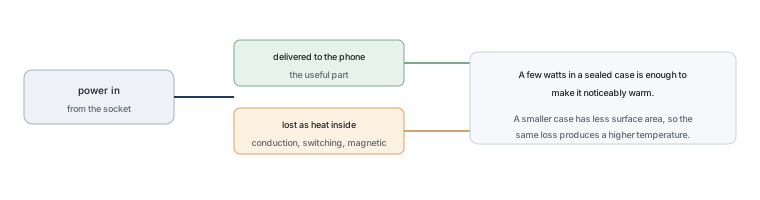 Why Does Your Phone Charger Get Warm?Knowledge
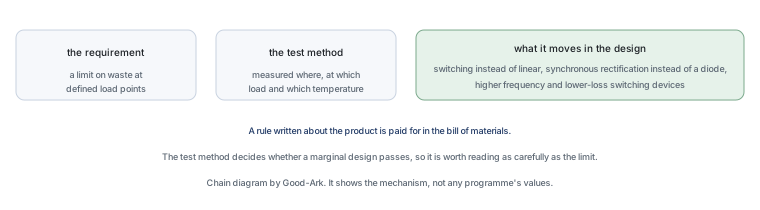 Energy Efficiency Rules Worldwide: How Regulations Shape Component ChoicesKnowledge
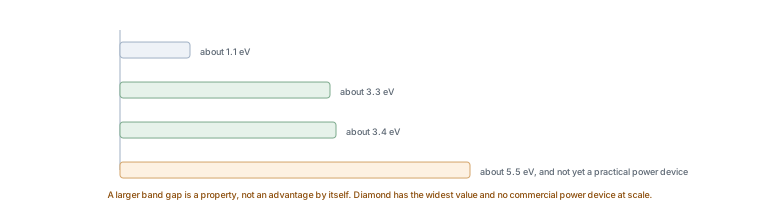 Wide-Bandgap Semiconductors: Adoption Report 2026Knowledge
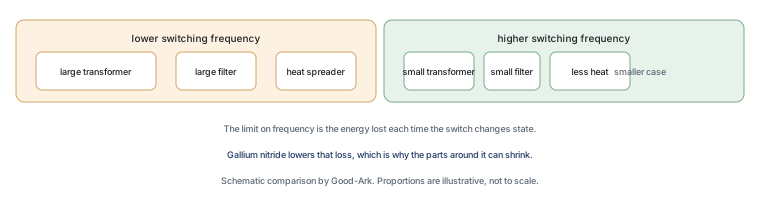 The GaN Charger Market: Why Your Next Adapter Is SmallerKnowledge
 Component Lead Times in 2026: What Is Actually Normal NowKnowledge
 China’s Power Semiconductor Industry: Where It Stands in 2026Knowledge