AWSS10H100: A 10 A, 100 V Schottky for ECU and Lighting Power
AWSS10H100 appears in the Good-Ark new-release table as a 10 A, 100 V Schottky rectifier in eSGC (TO-277). This part occupies the…
AWSS10H100 appears in the Good-Ark new-release table as a 10 A, 100 V Schottky rectifier in eSGC (TO-277). This part occupies the 10 A, 100 V corner of the four-part AWSS comparison. A substitution review must explain which original constraint needs that combination.
Last updated:
Record the reason for changing both ratings
A proposed move to AWSS10H100 should identify the constraint it resolves. Replacing AWSS5H60 changes both catalog classes; replacing AWSS5H100 changes the current class; replacing AWSS10H60 changes the reverse-voltage class. These are three different engineering reviews.
For a current-driven change, compare conduction loss, waveform and the rated mounting conditions. For a voltage-driven change, compare the maximum reverse stress and its margin. When both change, review both sets of evidence instead of treating the largest labels as an automatic upgrade.
Use a substitution checklist with explicit outcomes
| Existing entry | Catalog change to AWSS10H100 | Evidence to resolve |
|---|---|---|
| AWSS5H60 | 5 A to 10 A; 60 V to 100 V | Current duty, reverse stress, losses and installed temperature |
| AWSS5H100 | 5 A to 10 A | Current-rating conditions, forward loss and surge behavior |
| AWSS10H60 | 60 V to 100 V | Reverse-voltage requirement and electrical differences at temperature |
The published labels support this matrix, but not a drop-in approval. Qualification status, terminal assignment, detailed dimensions, thermal behavior and lifecycle information require the exact applicable documents.
Separate fit from electrical compatibility
Check the ordering code and package drawing against the installed pad layout, polarity marking and assembly process. Sharing eSGC (TO-277) does not alone prove identical land-pattern guidance or heat flow. Compare the circuit operation again after confirming physical fit.
Record a clear outcome for every requirement: satisfied by cited data, requires a measurement, or unresolved. Avoid replacing missing information with assumptions taken from another AWSS member. The family comparison is the common starting point; this page records the combined-rating substitution decision.
Obtain the exact model documents
Use the AWSS10H100 product page to locate the manufacturer entry. Obtain the current datasheet revision and resolve any missing operating, thermal, surge or qualification limit before approving the part.
Continue through this engineering topic
For the complete selection, design, verification, and troubleshooting path, explore the Automotive Power Electronics Hub.
Recommended
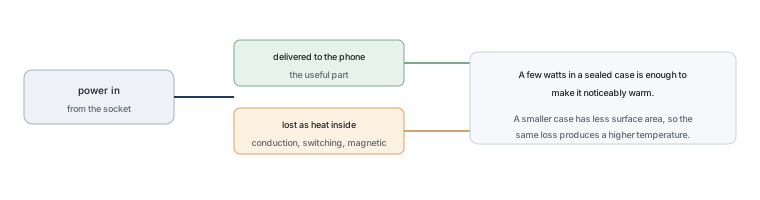 Why Does Your Phone Charger Get Warm?Knowledge
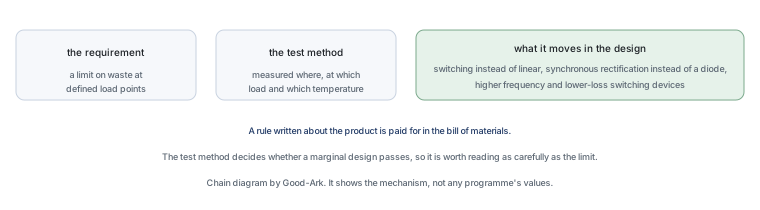 Energy Efficiency Rules Worldwide: How Regulations Shape Component ChoicesKnowledge
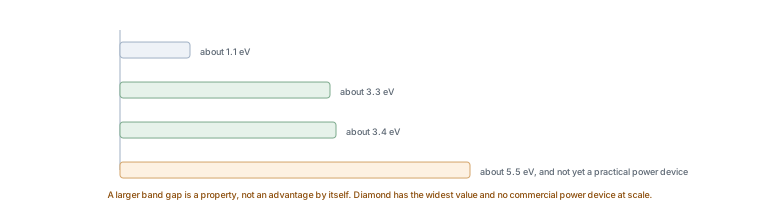 Wide-Bandgap Semiconductors: Adoption Report 2026Knowledge
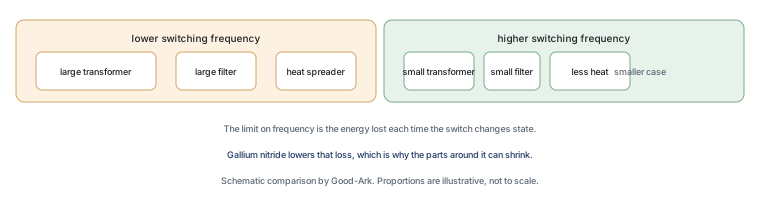 The GaN Charger Market: Why Your Next Adapter Is SmallerKnowledge
 Component Lead Times in 2026: What Is Actually Normal NowKnowledge
 China’s Power Semiconductor Industry: Where It Stands in 2026Knowledge