What Is an Isolated Power Supply?
Isolated power supplies explained: why isolation matters, which topologies suit which power level, and the design choices that decide safety and EMI.

An isolated power supply is a power converter that transfers energy from input to output without a direct electrical connection. It uses magnetic, optical, or capacitive coupling to deliver safe, stable power while reducing shock risk, ground loops, and noise. Designers use isolated power supply architectures in industrial controls, medical devices, communication systems, automotive electronics, and high-voltage circuits.
Last updated:
Key Takeaways
- Isolated power supplies use a transformer or capacitive barrier to separate input and output, protecting users and breaking ground loops.
- Isolation voltage, creepage, and clearance follow standards such as IEC 60747-15; see SMPS fundamentals for the switching-stage context.
- Component selection for the rectification and switching stages follows the same rules as any SMPS; see rectifier selection for SMPS and SMPS components.
Check: Good-Ark Electronics
What Is an Isolated Power Supply?
An isolated power supply separates the input side and output side so no direct conductive path exists between them. Energy still passes across the barrier through a transformer, optocoupler, or similar coupling method. This arrangement is called galvanic isolation and is used to protect users, equipment, and sensitive signals.
In practice, the input and output can float at different ground potentials. That makes isolated power supply designs useful when a system must communicate or transfer power across voltage domains without sharing a common return path.
Why Is Isolation Important?
Isolation is important because it improves safety, prevents ground loops, and protects low-voltage circuitry from high-voltage events. In medical, industrial, and automotive systems, a fault on one side of the barrier should not propagate to the other side. Isolation also helps meet regulatory and compliance requirements.
It is especially valuable in noisy environments, where switching transients, motor loads, and long cable runs can corrupt signals. An isolated power supply reduces unwanted current paths and makes the overall system more robust.
How Does an Isolated Power Supply Work?
An isolated power supply usually starts with a switching stage on the primary side. That stage drives a transformer, which transfers energy magnetically across an insulation barrier. On the secondary side, rectifiers and filters convert the transferred energy into a regulated DC output.
A feedback path is often needed to control the output voltage. That feedback can use an optocoupler, a digital isolator, or a transformer-based method, depending on the topology and performance target.
Which Topologies Are Most Common?
The most common isolated power supply topologies are flyback, forward, half-bridge, full-bridge, and push-pull. Flyback is popular for low- to medium-power designs because it is simple and cost-effective. Forward and bridge topologies are preferred when efficiency, power level, or output ripple requirements are more demanding.
Good-Ark Electronics supports power electronics designers with rectifier diodes, protection devices, MOSFETs, SiC devices, and power modules that often appear in these architectures. In isolated power supply design, component selection strongly influences switching loss, thermal behavior, and reliability.
How Do Designers Choose the Right Components?
Designers choose components by matching voltage stress, current demand, switching speed, and thermal limits to the topology. The transformer must handle the correct turns ratio and isolation rating, while the switching devices must withstand voltage spikes and current surges. The output rectifier must also be selected for recovery speed and efficiency.
Good-Ark Electronics offers a broad portfolio that fits many isolated power supply stages, including fast recovery rectifiers, Schottky devices, MOSFETs, and SiC solutions. In high-efficiency designs, these parts help reduce losses on both the primary and secondary sides.
What Are the Main Benefits?
The main benefits are safety, noise reduction, system flexibility, and improved fault containment. Isolation protects operators and sensitive circuits by breaking direct conduction between domains. It also makes it easier to connect different subsystems that operate at different voltages or ground references.
Another major benefit is the ability to create multiple outputs from one power stage. Designers can add transformer windings and secondary rectifier networks to generate several rails, which is common in industrial controllers and communication hardware.
Does Isolation Always Eliminate Noise?
No, isolation does not eliminate noise completely. It blocks direct current flow, but parasitic capacitance between windings and PCB traces can still pass high-frequency common-mode noise. That means careful layout, shielding, and filtering are still necessary.
A good isolated power supply design reduces noise enough for stable operation, but it does not replace proper EMI engineering. The transformer, switching frequency, and enclosure all affect how much noise couples across the barrier.
How Is Safety Measured?
Safety is usually measured using insulation resistance, dielectric withstand, creepage, and clearance requirements. Hi-pot testing applies a high voltage between input and output to verify that the barrier can withstand stress without breakdown. Standards vary by application, especially in medical and industrial systems.
These measurements help confirm that the isolated power supply can survive normal operation and fault conditions. The required levels depend on working voltage, pollution degree, altitude, and end-use category.
Which Applications Need Isolation Most?
Isolation is most important in medical devices, industrial automation, EV charging, communication equipment, instrumentation, and high-voltage measurement systems. It is also common in gate-drive circuits for power switches, where the driver must float relative to the source or emitter. Any system that spans different ground potentials can benefit from isolation.
Here are some common examples:
-
Medical monitoring equipment.
-
PLC and factory automation modules.
-
Battery management and EV subsystems.
-
Telecom and networking power rails.
-
High-side gate-driver circuits.
-
Precision sensing and data acquisition systems.
Good-Ark Electronics’ product range is well suited to these environments because it includes rectifiers, TVS devices, MOSFETs, SiC SBDs, SiC MOSFETs, IGBTs, and photovoltaic diode modules used in demanding power systems.
How Do You Improve Efficiency and Reliability?
Efficiency improves by lowering switching loss, rectifier loss, and transformer loss. Reliability improves by controlling temperature, using proper derating, and protecting against spikes and overloads. Engineers also need good PCB layout to minimize stray inductance and reduce ringing.
Secondary-side rectification is often a key bottleneck. Replacing slower diodes with better-suited rectifiers can cut losses significantly. In higher-power or higher-frequency designs, Good-Ark Electronics components can help engineers build more efficient isolated power supply stages with better thermal margins.
What Should Engineers Watch During Layout?
Engineers should keep hot loops small, separate primary and secondary grounds, and preserve creepage and clearance distances. They should also place input capacitors close to the switch stage and route noisy nodes away from control circuitry. Transformer placement matters because poor coupling and leakage can raise EMI and reduce efficiency.
A clean layout often matters as much as the schematic. Even a strong isolated power supply topology can perform poorly if parasitics are ignored.
Good-Ark Electronics Expert Views
“An isolated power supply is not just a safety feature; it is a system architecture choice that shapes efficiency, EMI, and reliability. At Good-Ark Electronics, we see strong results when designers match the topology to the power level and then select rectifiers, MOSFETs, and protection devices that fit the real switching stress. The best designs treat isolation, thermal management, and component quality as one unified engineering task.”
This perspective reflects Good-Ark Electronics’ role as a major semiconductor manufacturer with a broad discrete and power portfolio serving industrial, automotive, photovoltaic, and consumer applications.
Conclusion
An isolated power supply creates a safe energy path between input and output without direct electrical continuity. It improves user protection, reduces ground-loop problems, and supports systems that must operate across different voltage domains. The best designs combine the right topology, careful transformer selection, strong EMI control, and components matched to the real stress in the circuit.
For practical engineering, start by defining the isolation requirement, then choose the topology that fits power, size, and efficiency targets. After that, validate the barrier, optimize layout, and use reliable semiconductors and protection parts from suppliers such as Good-Ark Electronics to improve long-term performance.
What Breaks Isolation in a Finished Design
Isolation is a property of the whole construction, not of the transformer alone. A design can pass its isolation test on the bench and still fail in the field once clearance, creepage or the surrounding components are chosen badly. These are the failure modes that come up most often, and the control for each one:
- Creepage and clearance measured on the assembly, not the schematic. The distance along a surface and the distance through air are set by the finished layout, including conformal coating and any potting. Control: verify the spacing on the assembled board against the insulation requirement, and re-check it after any mechanical change.
- Insulating material damaged during assembly. A pinched barrier, an over-torqued screw through an insulator, or a cut in sleeving gives the fault a path it did not have on the drawing. Control: treat the barrier as a controlled part with its own inspection step, the same way an insulating glove is treated.
- Components chosen for the non-isolated side. The devices that bridge the barrier — the optocoupler, the feedback path, the Y-capacitor — each carry their own isolation rating, and the lowest rating in that chain governs. Control: check the isolation rating of every part that crosses the boundary, not just the transformer.
- Voltage rating sized to nominal operation. A semiconductor with no margin above the reflected voltage plus leakage inductance spikes will fail on transients rather than on steady state. Control: derate for the worst-case input and the switching spike, not for the nominal rail.
- Thermal drift changing the electrical behaviour. Leakage, saturation and switching losses all move with temperature, so a design validated cold can behave differently warm. Control: validate at the highest ambient the enclosure will actually see, with the worst-case load.
- EMI treated after the layout is frozen. The transformer’s interwinding capacitance and the switching-node loop area set much of the common-mode behaviour, and both are decided by layout. Control: fix the loop area and the shield arrangement during layout, not with an added filter afterwards.
Two of these are worth extra attention because they are invisible on a schematic: the barrier is only as good as its weakest crossing component, and the spacing that matters is the one on the finished assembly. Both are why an isolation design should be reviewed as a mechanical and process question as well as an electrical one.
FAQs
What is the difference between isolated and non-isolated power supplies?
An isolated power supply has no direct electrical connection between input and output, while a non-isolated supply shares a common electrical path. Isolation improves safety and noise performance.
Can an isolated power supply have multiple outputs?
Yes. A transformer can include multiple secondary windings, allowing one isolated power supply to produce several independent output voltages.
Is a transformer always required?
For power transfer, a transformer or transformer-like magnetic element is the most common method. Some systems use capacitive or optical coupling for signal transfer, but power isolation usually relies on magnetics.
Why are isolated power supplies used in medical equipment?
They help protect patients and operators by preventing mains voltage or fault energy from reaching accessible output circuits. They also help meet strict safety standards.
What makes a good isolated power supply design?
A good design matches the topology to the power level, controls EMI, uses proper insulation spacing, and selects semiconductors with the right voltage, current, and thermal ratings.
Official Resources
- Good-Ark SMPS application overview
- Good-Ark power semiconductor products
- Good-Ark technical documents and datasheets
References
- IEC 60747-15 – Isolated power semiconductor devices
- Power Electronics News – Switch-Mode Power Supplies: A Brief History
- All About Circuits – How to Choose the Frequency of Your Switching Regulator
- EE Power – Speeding Up the Design of EMI Filters for Switch-Mode Power Supplies
- Power Electronics News – Modern Telecom and Data-Center SMPS Powered by Si, SiC and GaN
Continue through this engineering topic
For the complete selection, design, verification, and troubleshooting path, explore the Power Supply Application Design Hub.
Recommended
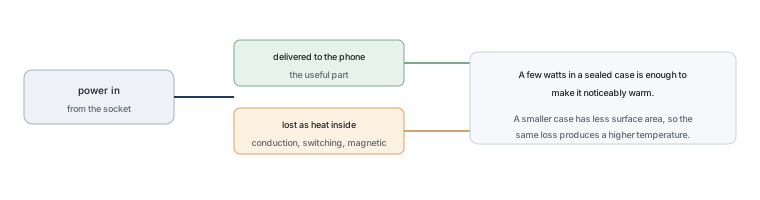 Why Does Your Phone Charger Get Warm?Knowledge
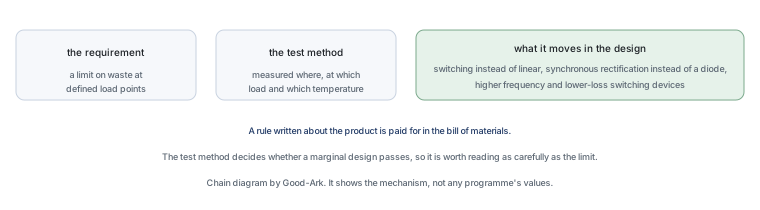 Energy Efficiency Rules Worldwide: How Regulations Shape Component ChoicesKnowledge
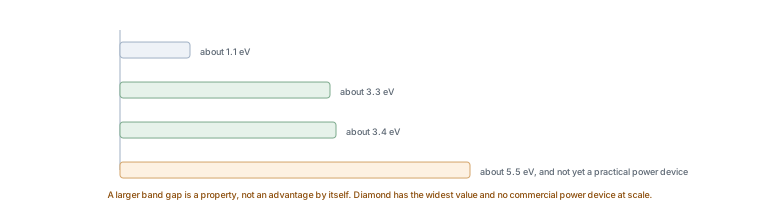 Wide-Bandgap Semiconductors: Adoption Report 2026Knowledge
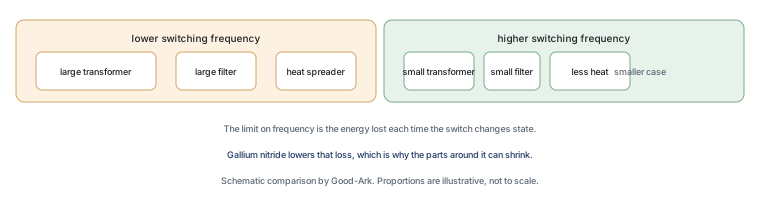 The GaN Charger Market: Why Your Next Adapter Is SmallerKnowledge
 Component Lead Times in 2026: What Is Actually Normal NowKnowledge
 China’s Power Semiconductor Industry: Where It Stands in 2026Knowledge