Good-Ark — discrete power semiconductors: rectifiers, Schottky, TVS, MOSFETs, SiC and IGBT
Request a Quote

What Is Inside a Power Bank?
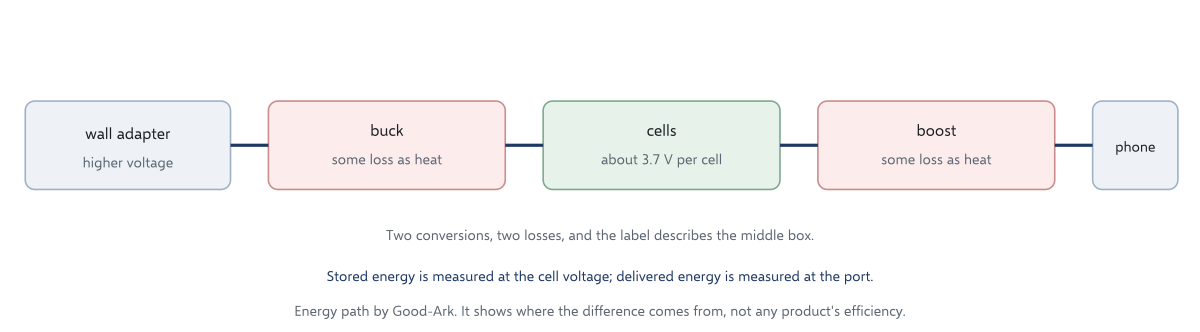
Inside a power bank there are four blocks: cells that store energy, a converter that changes the cell voltage into the voltage your device expects, protection circuitry that keeps the cells inside their safe operating range, and the connectors and indicator that connect all of it to the outside world. The gap between the number … Read more

QFN vs DFN Packages: Thermal, Electrical, and Assembly Trade-Offs

QFN vs DFN Packages: Thermal, Electrical, and Assembly Trade-Offs

Key Takeaways QFN and DFN are the leadless workhorses of modern power and signal electronics: small, low-inductance, and thermally capable when the PCB cooperates. Before you finalize the BOM, compare the related options: TO-252 (DPAK) Power MOSFETs and Low RDS(on) Power MOSFETs. Verify your choice against official product data and application guidance: Good-Ark MOSFET product … Read more

PV Blocking Diode Sizing: Reverse Current and Fault Coordination

Blocking Diodes: When They Are Necessary A blocking diode allows current to flow from the module to the load but not backward. The classic case is off-grid: at night, a battery connected to the panel would discharge through the module’s series resistance and reverse-bias the cells. The blocking diode stops the reverse current and protects … Read more

High-Speed Gate Driver Design for GaN Half-Bridges: Timing, Dead Time, and Layout

High-Speed Gate Driver Design for GaN Half-Bridges: Timing, Dead Time, and Layout

Updated: November 11, 2026 Updated after a US/EN SERP and competitor-page review: the sections below close selection gaps without replacing the original explanation. Topic hub: Power MOSFET selection guide · research query: GaN half bridge gate driver dead time layout. Key Takeaways In a converter switching at 500 kHz or 1 MHz, the gate driver … Read more

650V SiC MOSFETs for PFC and Server Power: When SiC Moves Down to 650 V

650V SiC MOSFETs for PFC and Server Power: When SiC Moves Down to 650 V

Updated: October 28, 2026 This page is a focused engineering note in the sic wbg cluster—use the checklists and links below to finish selection, not as a substitute for the datasheet. Topic hub: What is silicon carbide. Related deep-dives sit in the continue list at the end. Before release Pass criteria Ratings vs mission profile … Read more

1200V SiC Diodes for EV Charging and Industrial PFC: Selection Criteria

Updated: October 27, 2026 This page is a focused engineering note in the sic wbg cluster—use the checklists and links below to finish selection, not as a substitute for the datasheet. Topic hub: What is silicon carbide. Related deep-dives sit in the continue list at the end. Before release Pass criteria Ratings vs mission profile … Read more

TO-247 vs TO-220 vs D2PAK IGBTs: Thermal Mounting and Module Crossover

Not every IGBT design needs a power module. Below a few tens of kilowatts, discrete IGBTs in TO-247, TO-220, and TO-263 packages carry the load with lower cost, simpler sourcing, and a flexible layout—provided the package’s thermal, mounting, and insulation realities are respected. This article covers the discrete side of IGBT selection: how the packages … Read more

PV Bypass Diode Modules vs Discrete Diodes: Assembly, Thermal, and Reliability

A solar module’s bypass protection can be built from discrete diodes or from a bypass diode module—an integrated assembly that packages several diodes, the lead frame, and often the connectors into one unit. The two approaches reach the same electrical function through different assembly and thermal paths, and the choice affects production yield, field reliability, … Read more

How to Select a PV Bypass Diode: VF, Leakage, Surge, and Thermal Limits

Updated: October 27, 2026 Select a PV bypass diode from reverse voltage under cold Voc, continuous forward current in sustained shade, hot VF, leakage vs temperature, surge capability, and junction-box thermal resistance. This checklist complements the broader photovoltaic diodes guide, emphasizing VF, leakage, surge, and thermal limits that decide field reliability. The Bypass Role in … Read more

SiC Power Device Design Guide: Voltage, Topology, and Reliability

This guide is the entry point to the Good-Ark silicon carbide library. It maps the SiC decisions—which voltage class, which device (MOSFET or diode), which topology, and how hot the design can run—and points to the dedicated articles that carry the detail. Use it to position the design before the datasheet comparison. Last updated: October … Read more

Isolated DC-DC Power Modules for Gate Drive and Industrial Control: Selection

Updated: November 11, 2026 An isolated DC-DC converter can be built from a transformer, a controller, and a handful of discrete parts—or bought as a module that packages all of it into one component. For gate-drive supplies, industrial control boards, and sensor power, the module is often the engineering-correct choice: it moves the isolation design, … Read more

Power Discrete Package Testing: What to Verify Before Mass Production

The gap between a power device that works on the bench and one that survives years in the field is filled by testing—at the datasheet level, the thermal level, the reliability level, and the assembly level. For engineers and buyers qualifying power discretes, understanding what is tested, how, and with what criteria separates a trustworthy … Read more

Need a part number checked against your design?

Send the topology, current and voltage class. Good-Ark sales and application engineering will confirm the closest device, package and qualification status.

Copyright Suzhou Good-Ark Electronics Co., Ltd. All Rights Reserved