TVS vs Zener Diode: Two Similar Parts With Two Very Different Jobs
TVS and Zener diodes look alike on a schematic but do different jobs: one regulates, the other absorbs rare events. See what breaks if you swap them.
Updated: October 27, 2026
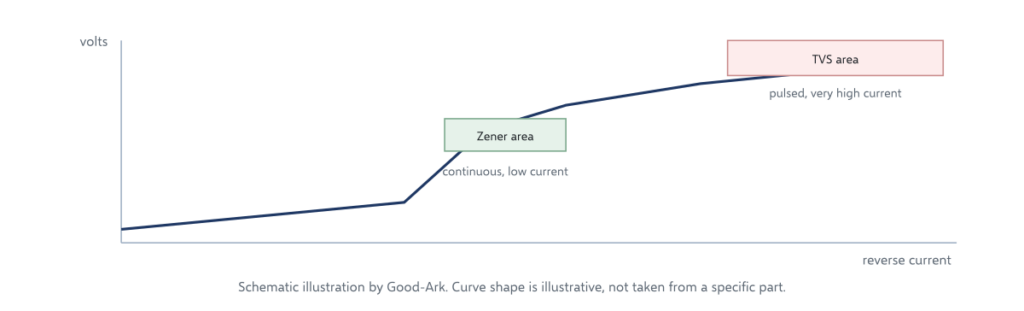
Use a TVS when the job is absorbing surge or ESD energy with a characterized clamp; use a Zener when the job is setting a DC reference or soft regulation at low current. Both avalanche, but the datasheets answer different questions.
If you are mid-selection on surge parts, jump to the TVS selection guide or the plain-language TVS diode explainer.
| Job | Prefer | Why |
|---|---|---|
| Load dump / lightning / ESD pulse | TVS | IPP, VC, and waveform ratings |
| Bias / reference / low-current clamp | Zener | VZ tolerance and IZ curves |
| Signal rail with both polarities | Bidirectional TVS | Symmetric clamp window |
| Precision shunt reference | Zener or bandgap IC | TVS VBR tolerance is too wide |
Why beginners confuse them
The confusion is structural rather than careless. A Zener and a TVS use the same physical mechanism — controlled reverse breakdown — so any explanation that stops at the mechanism describes both of them. The two parts only separate when you ask how often they are expected to conduct, for how long, and with how much energy.
The analogy that resolves it is a pressure relief valve versus a pressure regulator. A regulator sits in the line and holds the output at a set pressure continuously, adjusting as flow changes. A relief valve stays shut and opens only when pressure exceeds a safe limit, then closes again. Both are valves, both are set to a number, and fitting the wrong one is immediately obvious in operation — which is exactly the situation with these two diodes.
What each was designed for
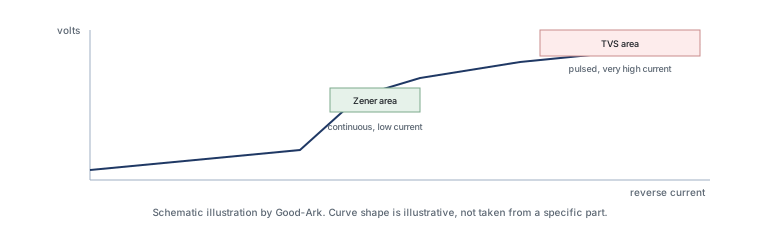
A Zener diode is designed to conduct continuously in breakdown while holding a reasonably stable voltage, and its datasheet is written around that steady state: the nominal voltage, the tolerance on that voltage, the test current, the dynamic resistance and the continuous power the package can dissipate. It is a reference and a regulator, and its performance is judged by how little the voltage moves as current and temperature change.
A TVS diode is designed to be off, and to conduct only during a transient, and its datasheet is written around that event: the standoff voltage it must not conduct below, the breakdown range, the clamping voltage at a high pulse current, the peak pulse power for a defined waveform, and often the capacitance. It is a clamp, and its performance is judged by how quickly it responds and how much energy it survives. TVS Clamping Voltage explains how stand-off margin relates to the system limit.
Speed of response, in everyday terms
Both devices begin to conduct as the voltage crosses their breakdown point, so the honest statement is that neither is instantaneous. The practical difference lies in how the part is built and specified. A TVS is optimised to present a low impedance within the timeframe of an event that lasts nanoseconds to microseconds, and its datasheet is written to let a designer check that. A Zener is optimised for a stable steady state, and its datasheet does not describe nanosecond behaviour because that is not its job.
The consequence is easy to state and easy to forget: a Zener protecting a fast transient is not a slower version of a TVS, it is an unspecified device in that role. It may work on a bench and fail in a product, because the event you are guarding against is defined by a standard that includes a rise time the part was never characterised for.
A three-scenario chooser
Most beginner decisions resolve into three cases, and the choice follows from the duty cycle.
You are holding a voltage during normal operation. A shunt regulator for a small reference rail, a clamp that has to sit at a defined level while the circuit runs, a bias network. This is a Zener’s job, and the parameters that matter are tolerance, test current and continuous power.
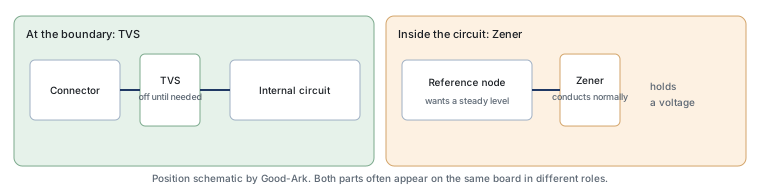
You are guarding a port or a node against an event that should never happen. A connector a user might touch, a cable that might collect a surge, an inductive load that might release its energy into the rail. This is a TVS’s job, and the parameters that matter are standoff voltage, clamping voltage and pulse capability.
You are doing both, at different points on the same board. That is normal, and it is why both parts often appear in one design — a Zener holding a reference, a TVS guarding the input. They are not competing for the same position.
What happens when you swap them
Put a TVS where a Zener belongs and the circuit starts to drift. The reference moves with current and temperature more than the design assumed, and because the TVS is often specified with a wide breakdown range, the nominal output may be well outside what the circuit needs. The board may still function, which is worse than failing, because the error shows up as an unexplained measurement problem rather than a fault.
Put a Zener where a TVS belongs and the failure is deferred. The part may survive the surge you test with and fail the standard you did not, or it may degrade quietly until a later event finishes it. Because a failed clamp usually shorts, the symptom appears as a dead rail rather than as damage to the circuit it was supposed to protect — and the protection part itself becomes the fault to find.
Designers who have been through a few projects tend to keep four numbers for each protected node in a spreadsheet: the normal voltage, the maximum tolerable voltage, the energy of the expected event, and the capacitance budget of the line. With those four numbers written down, comparing two candidate parts becomes a mechanical exercise rather than a judgement call — and if any one of the four is unknown, the selection is a guess wearing a datasheet.
Summary table
| If your requirement is… | Choose | Because |
|---|---|---|
| Hold a reference voltage while the circuit runs | Zener | Its datasheet is written around continuous conduction and tolerance |
| Survive a defined transient at a connector | TVS | Its datasheet is written around pulse power and clamping |
| Protect a fast data line | ESD-optimised TVS | Low capacitance matters as much as clamping |
| Clamp a gate or a comparator input continuously | Zener | The duty cycle is continuous, not transient |
| Absorb energy from an inductive load | TVS or a dedicated clamp, not a Zener | The event is energetic and repeated, which is a pulse specification |
Use the simple scenarios before reading the rating calculation
TVS and Zener devices can both use reverse breakdown, but their intended duty and specified limits differ. Start with the circuit task: a steady reference or regulation function, or a transient-clamping event. Read the exact datasheet rather than identifying the device from a similar-looking symbol.
Selection checklist: TVS or Zener?
- Is the threat a short high-energy pulse? Start with a TVS.
- Is the need a defined DC voltage at milliamps? Start with a Zener.
- Read VC@IPP on TVS parts—not only VBR.
- Read Zener power at ambient with derating—not only the 1 W label.
FAQ
Can I replace a TVS with a Zener of the same voltage?
Usually no. Voltage labels are not interchangeable with surge ratings. Confirm pulse current, clamp voltage, and failure mode before any substitution.
Why do TVS datasheets show 600 W or 1500 W?
Those are peak pulse power figures under a standard waveform (often 10/1000 µs). They are not continuous dissipation ratings.
Are Zener diodes useful for ESD?
Small Zeners can help at very limited energy, but dedicated ESD/TVS diodes are characterized for IEC waveforms and capacitance on high-speed lines.
Where should I go next after this comparison?
Use the TVS VRWM/VBR/VC guide or Zener diodes in plain language.
Continue through this engineering topic
- What is a TVS diode
- TVS diode selection guide
- Unidirectional surge protection diode
- Usb Esd Protection Diode Safeguarding High Speed Interfaces in Modern
- What Is an Sod 523 Esd Protection Diode
- Asmbj28ca 600 W Automotive Tvs in Smb for Lighting Drivers
Topic hub: TVS diode selection guide — related selection guides and application notes in this cluster.