MOQ and Lead Time: What Beginners Should Know Before Their First Component Order
MOQ and lead time explained: why minimum quantities exist, why a lead time is an estimate, how to ask for samples, and the mistakes first buyers make.

Updated: October 27, 2026
Translate brand or logistics pages into checks you can put on a PO: ratings, documents, MOQ, and lead time—not marketing adjectives.
| Topic | Record on the PO | Risk if vague |
|---|---|---|
| MPN + package | Full ordering code | Wrong die/package |
| Docs | Datasheet rev / CoC | Silent PCN surprises |
| MOQ / SPQ | Reel vs cut-tape | Schedule slips |
| Lead time | Factory vs stock | Line-down |
What MOQ protects and what it costs
The comparison that explains it best is a print shop. Printing one poster costs almost the same in setup as printing five hundred, so the shop charges a minimum order rather than a per-unit price for a single sheet. Component sellers face the same arithmetic: a reel has to be opened, a bag has to be sealed and labelled, a test record has to be raised, an invoice has to be issued and a shipment has to be booked, and those steps cost roughly the same for one hundred pieces as for five thousand.
For the supplier the minimum protects handling cost, and it also protects quality control: it is impractical to open a sealed production lot to extract a handful of pieces, because the remaining partial lot becomes harder to trace and harder to store. For the buyer the cost is cash tied up in stock, the space to store it, and the risk that the parts are obsolete before they are used. That last point matters more than beginners expect, because a design change can strand an entire minimum-order quantity.
Why the number changes with package and family
The minimum is usually the packing unit of the product rather than a round business decision. Surface-mount devices arrive on tape and reel, and a reel holds a fixed number of parts that depends on the package size. Through-hole parts arrive in ammo packs or boxes, and large packages arrive in tubes holding a small number of pieces. A quoted minimum of 200 is often exactly one tube, and a quoted minimum of 5,000 is often exactly one reel.
| Part shape | Usual presentation | Why the minimum lands there |
|---|---|---|
| Small surface-mount diode or transistor | Tape and reel, thousands per reel | The reel is the smallest unit the assembly line can feed |
| Larger surface-mount package | Tape and reel, fewer per reel | Fewer parts fit across the tape width |
| Axial through-hole diode | Ammo pack or box, often a stated count | The pack is the shipping unit |
| Bridge rectifier or module | Tube or tray, single or double figures | A small number fills the tube |
| Wafer, die or custom part | Per project | Process setup dominates, so the minimum is a project conversation |
This is why the same supplier can quote a hundred pieces on one line and several thousand on the next, and it explains a question that comes up constantly: what does a minimum of 200 pieces mean? It means the seller will not break a smaller quantity out of that pack. Sometimes a seller will agree to a cut quantity from an already opened pack, and asking is free.
How to ask for samples
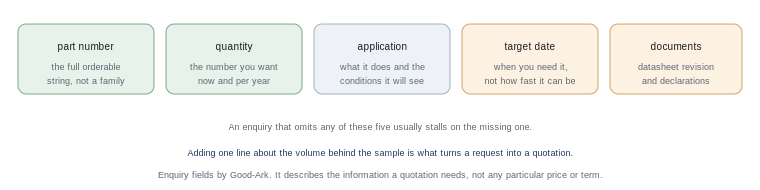
Sample requests work best when they are treated as a small order rather than a favour. A request a supplier can act on states the exact orderable part number, the quantity wanted, what it is for, whether you will pay, who pays the freight and when you need it. A request that only says you would like to try the part goes to the back of the queue, because it cannot be entered into any system.
Two details make sample requests succeed more often. Accept a cut quantity from an opened pack, which removes the objection about breaking a sealed lot, and say what happens next: a buyer who explains that a successful sample leads to production is describing a commercial relationship, and suppliers price their effort against that.
What determines lead time
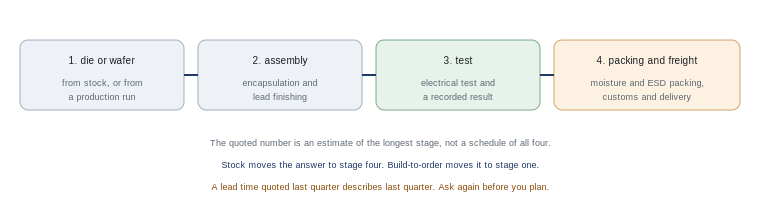
A quoted lead time is a chain of four stages, and the number you are given is usually an estimate of the longest one. The wafer or die has to be available, either from stock or from a production run. The parts have to be assembled into the package. They have to be tested and the results recorded. Then they have to be packed, shipped and cleared through customs. Each stage has its own waiting time, and a shortage at any stage sets the total.
That is why two parts from the same family can carry very different lead times. A device held in finished-goods stock ships in days. The same device built to order can take a full production cycle, because it has to be slotted into a schedule. The number also moves: it lengthens when demand rises across the industry and shortens when inventory builds up, which is why a lead time quoted two months ago is a historical document rather than a current fact.
Planning your first order
Lead time determines how much safety stock a project needs, and the arithmetic is simple once you know the demand rate. If a build consumes a part every week and the lead time is four weeks, buying four weeks ahead keeps the line running and eight weeks ahead survives one slipped delivery. The numbers here are invented to show the method; the real values come from your own plan and the supplier’s quote.
Two concepts from inventory management are worth knowing by name. Economic order quantity is the order size that balances the cost of holding stock against the cost of placing orders, and it usually produces a number larger than a project needs. Minimum order quantity is the floor the supplier imposes. When the two point in different directions, the minimum wins, because it is a constraint rather than a preference, and the practical response is to plan for a larger purchase than the project strictly requires.
Payment and shipping basics
A first order is usually paid before shipment, because the seller has no credit history to work with. Later orders may be offered on terms once a relationship and a payment record exist. Bank charges on an international transfer are worth checking before the invoice is agreed, because on a small order they can be a visible fraction of the value.
Incoterms are the three-letter codes that say where the seller’s responsibility ends. In plain language: a term beginning with E leaves almost everything to the buyer, F or C puts the main freight on the seller with the risk at a defined point, and DDP means the seller delivers with duty paid. Whoever is named in the term pays the duty and the tax, which matters because an unexpected customs bill can cost more than the parts.
One technical point belongs here. Semiconductors are electrostatic-discharge sensitive and many packages are moisture sensitive, so the packing is part of the quality of the goods. A supplier who ships a moisture-sensitive part without a barrier bag and a humidity card is telling you something about process control.
Mistakes first-time buyers make
The same handful of errors appear again and again, and every one is cheap to avoid.
- Ordering by description rather than by the full orderable part number, and receiving a different package or grade.
- Asking for a few pieces from a sealed production lot, then reading the refusal as unwillingness rather than as traceability practice.
- Treating a quoted lead time as a delivery date instead of a current estimate.
- Forgetting to agree who pays the duty, then discovering it at the door.
- Choosing the cheapest freight for parts that need moisture protection or ESD-safe packing.
- Not asking whether a second source exists, which becomes urgent only when the first one slips.
Sample inquiry template
A message that can be processed in one reading gets answered faster. The structure below works for a first approach to any manufacturer.
Subject: Sample request — full orderable part number — quantity — target date
Hello, we are evaluating this part for a new design. Please quote the exact orderable part number as listed in your datasheet, a quantity of the packing unit you can supply, and your current lead time.
Application: what the part does and the conditions it will see. Annual quantity: the volume we expect if the design goes ahead. Sample timing: the date we need them. Shipping: who pays duty and tax. Documentation: the datasheet revision and the declarations that would accompany the shipment. Application guidance to help define those conditions is available in the application design center.
We can accept a cut quantity from an opened pack if that is easier for you.
Practical checklist
- Separate blog orientation from contractual quality docs.
- Keep lot traceability when reliability matters.
- Do not invent certificates or financial claims—ask the supplier for primary documents.
FAQ
What belongs in a first RFQ?
MPN, annual/volume bands, target price, required documents, and whether automotive grade is mandatory.
Why do lead times move?
Package capacity, wafer starts, and regional holidays. Ask for package-level answers, not only family averages.
How do I read a Zener line card quickly?
Start with VZ, power, and test current—then see Zener diodes in plain language.
Counterfeit concerns?
Follow counterfeit avoidance.
Continue through this engineering topic
- AEC-Q101 explained
- Avoiding counterfeit semiconductors
- Where to buy Good-Ark parts
- Aec Q101 in Practice How to Verify an Automotive Part
- Authorized Distributor vs Marketplace
- Automotive Grade vs Commercial Grade Semiconductors a Selection Framew
- Samples & Quotes Guide
Topic hub: Avoiding counterfeit power semiconductors — related selection guides and application notes in this cluster.
Explore the related topic guides
Continue with the related selection, design and verification guides: