AMBRP10H100: 10 A, 100 V Schottky Rectifier in PDFN56
The AMBRP10H100 is a 10 A, 100 V Schottky barrier rectifier in a PDFN56 package from Good-Ark, with 0.76 V typical forward…
The AMBRP10H100 is a 10 A, 100 V Schottky barrier rectifier in a PDFN56 package from Good-Ark, with 0.76 V typical forward drop at 10 A, a 180 A surge rating, and 3 °C/W junction-to-case resistance. It targets automotive lighting, ECU, and SMPS output stages where a low-profile, board-mounted rectifier carries real current. This article covers the rating set, the package value, and the application fit.
Last updated:
AMBRP10H100 at a Glance
All values below come from the official Good-Ark datasheet, read at TA = 25 °C unless noted:
| Parameter | Symbol | Value | Unit |
|---|---|---|---|
| Maximum repetitive peak reverse voltage | VRRM | 100 | V |
| Maximum RMS / DC blocking voltage | VRMS / VDC | 70 / 100 | V |
| Maximum average forward current | IF(AV) | 10 | A |
| Peak forward surge current (8.3 ms half-sine) | IFSM | 180 | A |
| Forward voltage, IF = 10 A, TJ = 25 °C | VF | 0.76 typ | V |
| Forward voltage, IF = 10 A, TJ = 125 °C | VF | 0.62 typ | V |
| Reverse leakage, TJ = 25 °C / 100 °C | IR | 10 µA max / 2.5 mA max | — |
| Junction temperature range | TJ / TSTG | −55 to +150 | °C |
| Thermal resistance | RθJC / RθJA | 3.0 / 50 | °C/W |
The part ships in PDFN56, 3,000 pieces per reel, with AEC-Q101 qualification available on request. The full rating set, curves, and package drawing are in the AMBRP10H100 datasheet.
Why the PDFN56 Package Matters
PDFN56 is a 5 × 6 mm leadless package that conducts heat through an exposed bottom pad into the PCB copper. Three properties make it the right choice for this current class:
- Low profile and small footprint. The package saves height and board area compared with tab packages, which matters in compact automotive modules and adapters.
- A real heat-flow route. With a matching copper pad and thermal vias, the board becomes the heatsink; the 3 °C/W junction-to-case resistance is usable, not theoretical.
- Automotive-friendly construction. The leadless body suits automated SMT assembly, and the pad layout is designed for the solder joint quality that vehicle thermal cycling demands.
The heat-flow route only works if the PCB supports it: the exposed pad needs a matching copper area and vias into inner planes, and the board-level design rules are covered in the PDFN PCB design guide.
Three Applications That Fit
The datasheet names automotive lighting and ECU, and the electrical profile also fits SMPS output stages:
- Automotive lighting and ECU. A 10 A, 100 V class with low forward drop and a compact package serves lamp driver outputs and ECU power rails where the board is dense and the ambient is high.
- SMPS output rectification. In adapter and server output stages, 0.76 V typical at 10 A keeps conduction loss low at the 5–10 A loads these supplies deliver, and the 180 A IFSM rating provides a non-repetitive survival margin that must be checked against the actual inrush waveform.
- Board-mounted bypass and secondary roles. Where a string or output current lands in the 5–10 A band, the low-dissipation profile and PDFN footprint give the thermal design headroom.
Each application still runs the standard checks: reverse peak with margin, case temperature at maximum load, and leakage at the hot junction.
Reading the Datasheet Like a Designer
Three columns deserve attention before the part goes into a BOM. First, the VF pair: 0.76 V at 25 °C and 0.62 V at 125 °C show that conduction loss falls as the junction warms—but the leakage column moves the other way, from 10 µA maximum at 25 °C to 2.5 mA maximum at 100 °C. Even at 100 V reverse, that maximum leakage is about 0.25 W—a small term by itself, but a meaningful fraction of the loss budget at the hot junction, so it belongs in the thermal calculation. Second, the derating curve: IF(AV) is valid at a stated case temperature, and the curve shows how much current the part carries at the case temperature your board actually reaches. Third, the RθJA of 50 °C/W: it assumes a defined board and copper area, so match the PCB design to that assumption or measure the real value.
Qualification and Sourcing
The AMBRP10H100 carries AEC-Q101 qualified available on the datasheet, meaning it can be supported for automotive qualification with the appropriate documentation—confirm the exact status and documents with Good-Ark before project approval if automotive compliance is required. The part is supplied on 3,000-piece reels for SMT production, and the datasheet includes the PDFN56 outline drawing and dimensional table for mechanical design.
Engineering note. The rating structure above follows the AMBRP10H100 datasheet: VRRM 100 V, IF(AV) 10 A, IFSM 180 A, VF 0.76 V typical at 10 A and 25 °C, IR 10 µA maximum at 25 °C, and RθJC 3.0 °C/W. Validate the final margin with the derating curve at the real case temperature, include the leakage term at the hot junction, and confirm the automotive qualification wording on the datasheet before project approval.
Frequently Asked Questions
What is the maximum reverse voltage of the AMBRP10H100?
The maximum repetitive peak reverse voltage is 100 V, with 70 V maximum RMS and 100 V maximum DC blocking. Apply 20–30% margin over the maximum reverse peak in the circuit.
What package is the AMBRP10H100 in?
PDFN56, a 5 × 6 mm leadless package with an exposed bottom pad for board-level heat conduction. It suits compact automotive and SMPS boards where a tab package is too large.
Is the AMBRP10H100 automotive qualified?
The datasheet states AEC-Q101 qualified available, meaning the part can be supported for automotive qualification with the appropriate documentation. Confirm the exact status and documents with the supplier before project approval.
How much current can the AMBRP10H100 carry continuously?
The 10 A rating is valid at a stated case temperature with a defined heat-flow route. Read the derating curve at the real case temperature and derate for continuous duty—the junction temperature calculation, not the headline amps, is the binding constraint.
What is the leakage current at high temperature?
Maximum 10 µA at 25 °C and 2.5 mA at 100 °C. At high reverse voltage and junction temperature the leakage power becomes a real part of the loss budget and must be included in the thermal calculation.
Conclusion
The AMBRP10H100 answers a specific question: what carries 10 A at 100 V on a compact board without a heatsink? A low-VF Schottky in PDFN56 with a 180 A surge rating and a heat-flow route that works through the PCB. Match the copper and vias, include the leakage term at the hot junction, and the part fits automotive and SMPS outputs alike.
Review the AMBRP10H100 product page for the datasheet and packaging details, compare it with the rest of the family in the Schottky rectifier diodes category, and contact Good-Ark to confirm samples and qualification documentation.
Sources
- Good-Ark — AMBRP10H100 Product Page
- Good-Ark — AMBRP10H100 Datasheet (PDF)
- Good-Ark — Schottky Rectifier Diodes
- AEC — AEC-Q101 Documents
Continue through this engineering topic
For the complete selection, design, verification, and troubleshooting path, explore the Schottky Diode Selection Hub.
Recommended
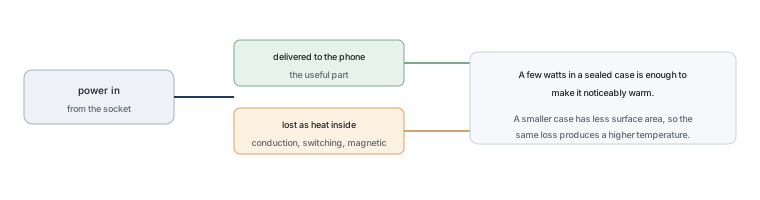 Why Does Your Phone Charger Get Warm?Knowledge
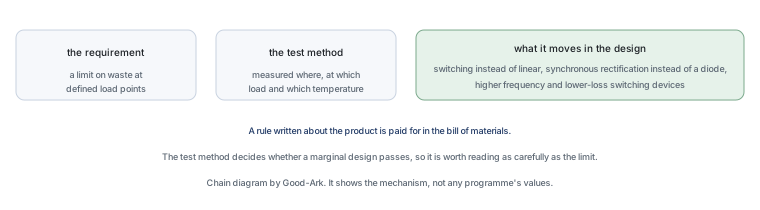 Energy Efficiency Rules Worldwide: How Regulations Shape Component ChoicesKnowledge
 Wide-Bandgap Semiconductors: Adoption Report 2026Knowledge
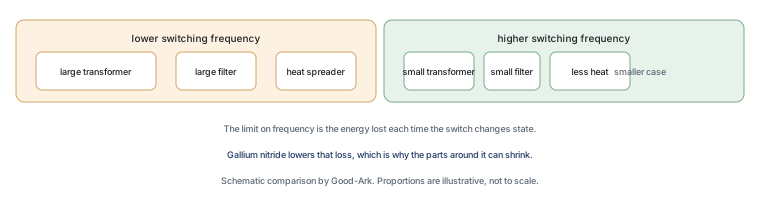 The GaN Charger Market: Why Your Next Adapter Is SmallerKnowledge
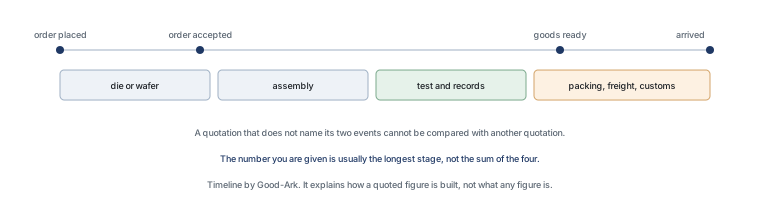 Component Lead Times in 2026: What Is Actually Normal NowKnowledge
 China’s Power Semiconductor Industry: Where It Stands in 2026Knowledge