What Is a Diode? A Beginner’s Guide to How It Works
A small component with two leads can determine which way current travels through a circuit. That component is a diode. You may…

A small component with two leads can determine which way current travels through a circuit. That component is a diode. You may see one as a black cylinder with a band near one end, or as a tiny rectangular package soldered directly to a circuit board.
A useful starting point is a one-way valve in a water pipe. Water can pass easily in one direction, while the valve resists flow in the other. A diode gives an electrical circuit a similar directional behavior. Real diodes also have voltage drops, leakage, and operating limits, which explain why choosing one involves more than finding the right direction.
Also Check: Fast Recovery Diodes: Reverse Recovery, Losses and Selection
What is a diode, and what do its two terminals do?
A diode is a component that conducts much more readily in one direction than the other.
Its terminals are the anode, marked A, and the cathode, marked K. During forward conduction, conventional current flows from anode to cathode. Conventional current is the direction used in ordinary circuit analysis; electron motion is in the opposite direction. When learning to follow a circuit, consistently using conventional current avoids unnecessary confusion.
Many axial rectifier diodes have a band identifying the cathode end. That marking is helpful, but it is not a universal rule for every package. Surface-mount devices, dual diodes, and bridge rectifiers may use different marking systems. Check the package drawing for the exact part number before deciding how to connect it. ROHM’s diode introduction explains the terminals and basic current direction.
Why does a PN diode conduct in only one direction?
An applied voltage changes how easily charge crosses its internal junction.
Many familiar diodes contain a PN junction: the boundary between two regions of semiconductor treated to have different electrical properties. Near that boundary is a depletion region that restricts the movement of charge. Forward bias makes charge flow easier; reverse bias strengthens the blocking behavior.
You do not need to master semiconductor equations to use this idea. On a circuit diagram, find A and K and ask which terminal is at the higher voltage. If the anode is sufficiently positive relative to the cathode, the device can carry a useful forward current, provided the rest of the circuit supplies a path.
The word “useful” matters. A real diode does not jump from absolutely zero current to full current at one exact voltage. Its current changes continuously. The simple on/off picture is a model that helps explain a circuit, rather than a complete description of its physics.
Is a conducting diode the same as a wire?
A conducting diode still has a voltage drop and dissipates power.
This voltage difference is called the forward voltage, written VF. You may have learned to use about 0.7 V for a silicon PN diode in a basic calculation. That approximation is useful in some situations, but the actual value depends on the device, current, and temperature. It is not a fixed property of every silicon diode.
Consider a hypothetical circuit with a 5 V supply and a series diode dropping 0.8 V at its operating current. Ignoring other voltage drops, the downstream circuit receives approximately 5 V − 0.8 V = 4.2 V. This is a teaching example, not a specification for a particular product.
The lost voltage also helps explain why a diode gets warm: current passes through a component with voltage across it, so some electrical energy becomes heat. Vishay’s Fundamentals of Rectifiers defines forward voltage and the reverse-blocking parameters used to describe this behavior.
How do diodes help turn AC into DC?
Rectifier circuits use diode directionality to produce current that flows one way through a load.
Alternating current changes direction periodically. A simple half-wave rectifier allows one half of the waveform to reach the load. A bridge rectifier uses different pairs of diodes on alternate half-cycles, keeping load current in the same direction during both halves.
The result is not necessarily a smooth, steady voltage. Without filtering, the rectified output rises and falls. Capacitors and later regulation stages may be needed to produce the supply a device requires. Rectification, filtering, and regulation perform related but different jobs.

Can a diode protect a circuit from a reversed battery?
A series diode can block current when a DC supply is connected with the wrong polarity.
In this simple arrangement, the diode faces the direction that allows normal supply current to reach the load. Reverse the battery and the diode becomes reverse-biased, interrupting that intended current path. The protection is only suitable if the device’s voltage, current, and thermal limits match the circuit.
The trade-off appears during normal use: the series diode drops voltage and produces heat. In a low-voltage circuit, losing part of a volt may affect operation. Other reverse-polarity arrangements can reduce that loss, but they introduce their own component and circuit requirements.
Diodes also come in types optimized for different tasks. Standard rectifiers, fast recovery diodes, Schottky diodes, and LEDs should not be treated as interchangeable just because they have two terminals. When examining a circuit, first identify the current direction and the diode’s purpose. Then consider the voltage, current, and switching behavior that position demands. The fast recovery diode guide explores the next step: what happens while a diode changes from conducting to blocking.
Frequently Asked Questions
Is reverse current always zero?
No. A real diode has reverse leakage current. Excessive reverse voltage can also cause breakdown. An ordinary rectifier should not be treated as a voltage-regulating Zener diode simply because it can enter breakdown.
Does a diode limit current by itself?
An ordinary rectifier does not replace a current-limiting resistor or constant-current circuit. The supply, load, and other circuit elements determine its current. Connecting it directly across a low-resistance supply can cause excessive current.
Can package size tell me the current rating?
Package size provides a clue about construction, but it cannot establish a reliable current rating. Identify the exact part and check its datasheet, including the temperature and mounting conditions attached to the rating.
Recommended
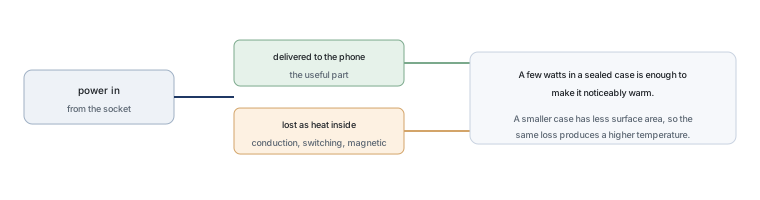 Why Does Your Phone Charger Get Warm?Knowledge
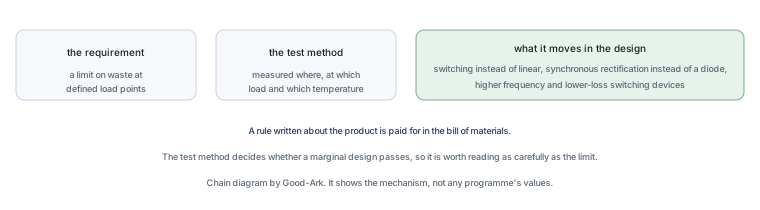 Energy Efficiency Rules Worldwide: How Regulations Shape Component ChoicesKnowledge
 Wide-Bandgap Semiconductors: Adoption Report 2026Knowledge
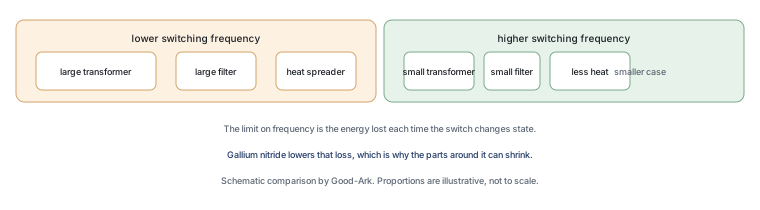 The GaN Charger Market: Why Your Next Adapter Is SmallerKnowledge
 Component Lead Times in 2026: What Is Actually Normal NowKnowledge
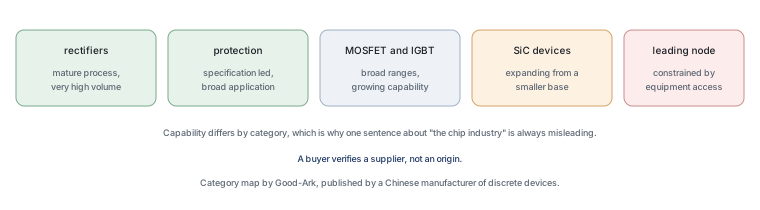 China’s Power Semiconductor Industry: Where It Stands in 2026Knowledge