How to Buy Electronic Components Safely: A Beginner’s Guide to Good-Ark and Beyond
Where components come from, what authorised really means, how to write an inquiry that gets a useful answer, and what to check on a Good-Ark distributor order.
Buying components safely is less about finding a cheap price and more about knowing what you are buying and from whom. The difference between a good purchase and a bad one is usually not the part itself but the traceability that comes with it, and that is decided before the order is placed rather than after.
What “authorised” actually guarantees
An authorised channel is one the manufacturer has agreed may sell its parts. That agreement usually brings three things: parts that have come through the manufacturer’s own distribution rather than through the secondary market, documentation that matches what was shipped, and a route to technical support and warranty handling that an unauthorised seller cannot offer.
What it does not guarantee is that the parts suit your circuit, that they are the right grade, or that the price is the lowest available. Authorisation is about provenance rather than about suitability, and conflating the two is how buyers end up assuming that a genuine part is automatically the right part.
The five supply channels, ranked by risk
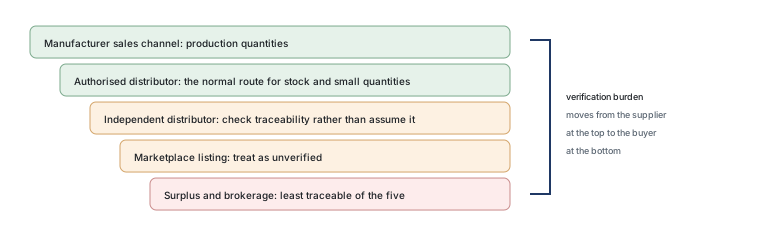
Components reach a buyer through five broad routes, and they carry different risks rather than different qualities. The manufacturer’s own sales channel is the reference point for production quantities. An authorised distributor is the normal route for small and medium quantities and for stock items. An independent distributor can be excellent for obsolete and hard-to-find parts, and it is where traceability becomes something you have to verify rather than assume. A marketplace listing is convenient and should be treated as unverified. And surplus or brokerage stock is the least traceable of the five, whatever its condition.
The useful mental model is a ladder rather than a hierarchy of quality. As you move down it, the burden of verification moves from the supplier to you, and the appropriate response is to increase the checks rather than to reduce the expectations.
How to write a first inquiry
A good inquiry gets a useful answer because it is easy to answer. It should name the complete orderable part number including the suffix, the quantity, the package, and any specific requirement such as a grade or a temperature range. It should ask for the datasheet revision that applies, the lead time, and the documentation that accompanies a shipment.
Four things are worth avoiding. Do not ask for a price without a quantity, because the answer will be a placeholder. Do not name a family rather than a part, because the reply will be a catalogue link. Do not ask whether the part is “genuine”, which is a question no supplier will answer in the negative; ask instead which revision and which lot documentation applies. And do not send the same message to twenty suppliers at once, because the replies will be impossible to compare.
What a quotation should contain
A useful quotation is more than a price. It should state the complete part number including the suffix, the manufacturer, the package, the quantity required for that price, the lead time, the minimum order quantity, and whether the parts are in stock or on order. For anything other than a catalogue item, it should also state the grade and the documentation that will accompany the shipment.
Two entries are routinely missing and both matter. The minimum order quantity is what turns a promising price into an unusable one, and the documentation statement is what tells you whether the purchase will be usable in a production context. A quotation without either is an invitation to negotiate rather than an offer.
| Entry | Why it matters | If it is missing |
|---|---|---|
| Complete part number with suffix | Determines package, grade and footprint | The offer may substitute a different variant |
| Quantity and price breaks | Makes comparison possible | You cannot compare two suppliers |
| Minimum order quantity | Determines whether the purchase is possible at all | The attractive price may not be available to you |
| Lead time and stock status | Distinguishes available stock from an order | Delivery may be quoted optimistically |
| Documentation set | Determines fitness for a production context | Traceability is unclear |
| Grade or screening, where applicable | Determines suitability for the environment | You may receive an industrial part |
Accepting your first delivery
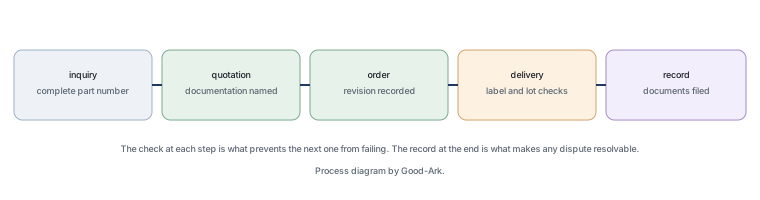
Receiving is a step, not an event. Four checks catch most problems before the parts reach a build. Confirm that the labels on the reel or tube and on the outer box agree on part number, quantity and lot. Confirm that the lot or date code on the label matches what the parts carry. Check a sample against the marking specification in the datasheet. And photograph what arrived, including the labels, before anything is unpacked further.
Those checks take a few minutes and produce a record that makes any later dispute resolvable rather than a matter of recollection. If a delivery fails one of them, the correct action is to stop and ask rather than to proceed and hope, because parts that have entered a build are difficult to remove from the story.
What to do when something is wrong
Report it early, in writing, and with evidence. The message should name the order, the part number, the specific problem, and what you observed — a label that disagrees with the packaging, a marking that does not match the datasheet, or a parameter that measures outside the specification. Attach the photographs taken at receiving.
Three things make the difference between a resolution and a stalemate. Reporting before the parts are used, because parts in a build are difficult to identify afterwards. Reporting in writing, because a documented exchange is what a warranty discussion is based on. And reporting the observation rather than the conclusion, because “the label disagrees with the box” is verifiable while “these are fake” is an argument.
Small-quantity buying without being fleeced
Small quantities have different economics, and understanding them prevents most bad experiences. Distributors add handling cost to small orders, which is why a single part costs proportionally more than a reel. Marketplaces compete on price because they carry no obligation to trace anything. And hobby suppliers exist because the quantities involved are below what a distribution channel wants to handle.
The reasonable approach for small quantities is to accept a higher unit price and buy from a channel that states a manufacturer relationship, or from a specialist hobby supplier whose reputation is the thing you are actually paying for. What to avoid is the pattern where an unusually low price is the only information available, because in that case the purchase has no verification path at all.
One further point belongs with the templates, and it is about what to keep. The inquiry, the quotation and the receiving report together form the record of a purchase, and that record is what makes a warranty discussion factual rather than a matter of recollection. Keeping them beside the datasheet, filed by part number, means that a question two years from now is answered by opening a folder rather than by reconstructing a conversation.
Two internal references make the practical side easier. The channel checks that decide where a part came from are in our guide to buying components safely, and the identification workflow that tells you which part you are holding in the first place is in confirming a part number is real.
Templates you can copy
Inquiry. “We are evaluating [complete part number], package [package], quantity [quantity]. Please confirm the current datasheet revision, the lead time, the minimum order quantity, and which documentation accompanies a shipment. If a specific grade or screening applies to this part number, please confirm which.”
Order confirmation. “Please confirm that the parts supplied will be [complete part number], manufacturer [manufacturer], and that the documentation set will include [list]. Please confirm the revision that applies so we can record it against this order.”
Receiving report. “Received [quantity] of [part number]. Outer label, reel label and part marking photographed and attached. Lot or date code observed: [code]. Please confirm that this lot corresponds to the revision we agreed, and provide the documentation set for it.”
Related reading on our own site covers electronic components and supply chains. Component test methods come from JEDEC, marking and traceability expectations from IPC, quality management requirements from ISO, the substance restrictions that appear on declarations from the EU RoHS Directive, and sector-level context from the Semiconductor Industry Association. Regulatory and quality background is published by ECHA.
FAQ
Who are the authorised distributors of these products?
We do not publish a list here, and the reason is practical rather than evasive: distribution agreements change, and a list that is a year out of date sends buyers to a channel that may no longer be authorised. The reliable method is to start from the manufacturer’s own contact or channel information and confirm the distributor name with the manufacturer in writing. That single email is the check that matters, and it works for any brand rather than only this one.
Where can I buy diodes?
It depends entirely on quantity. For one or two pieces, a distributor or a reputable hobby supplier. For samples before a design, the manufacturer’s sample channel or an authorised distributor. For production, the manufacturer’s own sales channel plus agreed distribution. The choice of route should follow the quantity and the documentation requirement, not the price alone, because the price almost always reflects what comes with the part.
How do I know a supplier is legitimate?
Three checks, in order. Ask the manufacturer to confirm the channel in writing. Ask the supplier for the datasheet revision and the documentation that accompanies a shipment. And check what arrives at receiving against both. A supplier who cannot or will not answer the first two has told you something useful before any money changes hands.
Is buying from a marketplace ever acceptable?
For a prototype or a bench experiment where an error is harmless, often yes, and the price advantage is real. For anything that ships, the absence of traceability is the problem rather than the risk of counterfeiting alone, because a genuine part whose lot cannot be identified is still unusable in a production context. The distinction is between consequence-free experimentation and a product with a warranty.
What is the most common mistake first-time buyers make?
Ordering by family name or by a shortened part number. The seller then chooses the variant, and the variant is often the package or grade that mattered. The second most common is comparing prices without comparing what comes with the part, which makes the cheapest offer look better than it is until the documentation is needed.
What to do next
Before your next purchase, write the four things you need from it: the complete part number, the documentation set, the quantity and the application context. Those four lines become an inquiry that gets a useful answer and a record that answers a question two years from now. Once the parts arrive, the verification side of the same exercise is in our article on sourcing and verification.
Tell Good-Ark the part number, the quantity and the documentation your process requires, and we can confirm the channel and the revision that apply.
Email sales@goodark.com, or start from the authorised channels guide.
This article is published by Good-Ark, a manufacturer of discrete semiconductor devices. It does not name any distributor, because channel agreements change and the current list should be confirmed with the manufacturer.
Recommended
 Why Do Diodes Get Hot? Conduction and Switching Losses ExplainedInfoStandard, Fast Recovery, and Schottky Diodes: What’s the Difference?Info
 What Is a Fast Recovery Diode? Understanding “Fast Recovery”Info
 What Is a Diode? A Beginner’s Guide to How It WorksInfo
 Automotive Semiconductor Report 2026: Chips Per Car Keep RisingKnowledge