Schottky vs Normal Diode: Which One Should You Pick?
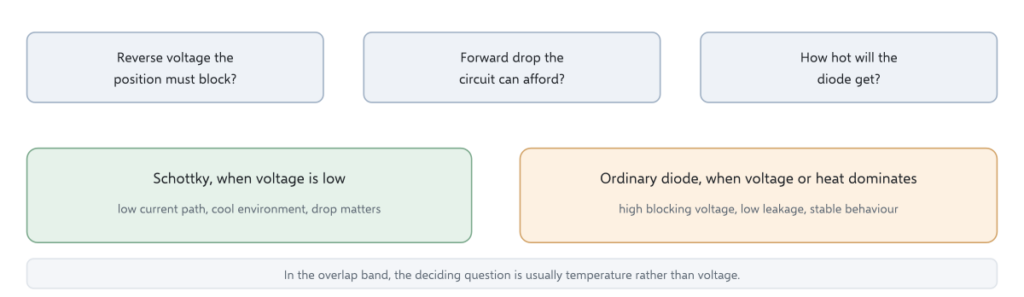
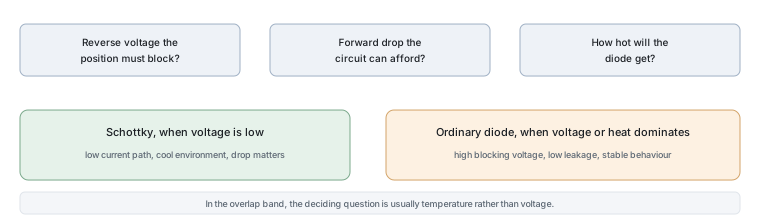
Schottky or normal diode? Decide with three questions: the reverse voltage to block, the forward drop you can afford and how hot the part will run.
Updated: October 27, 2026
A Schottky diode uses a metal-semiconductor barrier for lower forward drop and faster switching than a typical PN rectifier—at the cost of higher reverse leakage and lower practical reverse-voltage range in many silicon parts.
Compare when Schottky wins vs standard/fast PN diodes. Selection depth: Schottky barrier rectifier selection, low VF Schottky, SMPS rectifiers.
| Topic | Schottky | Normal PN rectifier |
|---|---|---|
| VF | Typically lower | Higher (~0.7 V class Si) |
| Reverse recovery | Negligible (majority carrier) | Qrr can dominate high-f circuits |
| Leakage | Higher, rises with T | Usually lower |
| VR range | Often limited for low-VF Si | Wide, including kV classes |
The short answer for hobby projects
Below roughly fifty volts and above a few hundred milliamps, a Schottky diode is usually the better choice because its lower forward drop wastes less and keeps it cooler. Above roughly a hundred volts, or wherever reverse leakage matters, an ordinary silicon diode is usually the better choice because it blocks more reliably and leaks far less when hot. If you are narrowing down a rectifier choice, Schottky Barrier Rectifier Diode continues with the practical selection steps.
In between there is a genuine overlap, and the tie-breaker is usually temperature. If the diode sits in a closed box or near a heat source, the Schottky’s leakage rises with the same heat that its lower drop was meant to reduce, and that trade can flip. If the diode sits in open air with modest current, the Schottky’s advantage holds comfortably.
What each type does well
An ordinary silicon diode’s strengths are voltage and stability. It blocks high voltages without leaking meaningfully, its behaviour changes less with temperature, and it is cheap in every package size. Its weakness is a forward drop around 0.7 volts and a stored charge that has to clear every time the current reverses, which limits how fast it can switch efficiently.
A Schottky diode’s strengths are the mirror image. Its forward drop is typically a third to a half of a volt, which is a large fraction of the total loss in a low-voltage circuit, and it has almost no stored charge, so it stops conducting almost immediately. Its weaknesses are a much lower blocking voltage and reverse leakage that grows steeply with temperature.
| Property | Ordinary silicon diode | Schottky diode |
|---|---|---|
| Forward drop | Around 0.7 V, rising with current | Lower, around 0.3 to 0.5 V in common parts |
| Reverse voltage range | Wide, from tens of volts upwards | Limited in silicon; higher with silicon carbide |
| Reverse leakage | Low and fairly stable | Higher, and rises steeply with temperature |
| Reverse recovery | Slow; stored charge must clear | Very fast; almost no stored charge |
| Behaviour when hot | Reasonably predictable | Leakage becomes a heat source, which can reinforce itself |
| Cost for a given current | Lower | Higher, but the gap narrows at low voltages |
A three-question decision flow
The flow is short enough to remember. First, what is the highest reverse voltage this diode will ever see, including transients? If it is above the Schottky’s comfortable range, the decision is made. Second, what current will it carry, and what is that current worth in lost voltage? If the circuit runs at five volts and the diode drops 0.7, you are throwing away a seventh of your supply. Third, how hot will it get? If the answer is “inside a sealed box next to a regulator”, the leakage question becomes decisive.
When the three answers point in different directions, the tie-break is usually to ask what the failure looks like. A Schottky pushed beyond its voltage range fails in a way that puts leakage into the circuit before it fails outright, which can look like an efficiency problem rather than a fault. An ordinary diode pushed beyond its speed range fails by getting hot. Both are diagnosable, and neither is preferable in the abstract.
Voltage limit: the number beginners miss
The reverse voltage rating is the number that most often gets ignored, for a simple reason: in a low-voltage circuit it never seems to be a problem. A diode in a five-volt rail with a 40-volt rating has eight times the margin it needs, so the rating looks like a detail.
It becomes the whole problem the moment the circuit contains anything inductive. A relay coil, a motor, a solenoid or a long cable can produce a transient many times the supply voltage when the current through it is interrupted, and that transient lands on the diode in the direction it is supposed to block. A Schottky with a modest rating that looked comfortable at five volts can be operating beyond its limit for a few microseconds every time the load switches off — repeatedly, for the life of the product.
The practical habit is to size the reverse rating against the worst transient the position can see, not against the supply voltage. Where a transient is possible and the voltage is high, that usually means an ordinary diode or a different protection approach rather than a Schottky.
Heat and leakage trade-offs
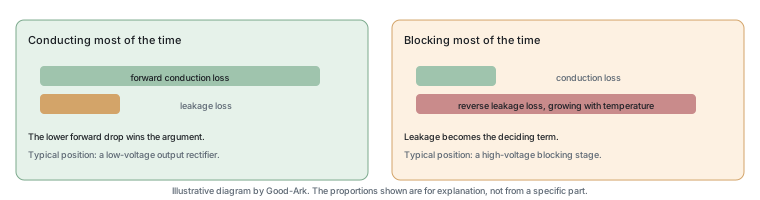
The heat story has two halves and they point in opposite directions. A Schottky generates less heat while conducting, because its forward drop is lower. But it generates more heat while blocking, because its reverse leakage is higher, and that leakage roughly doubles for every ten degrees of junction temperature rise.
In a circuit where the diode conducts most of the time, the first half dominates and the Schottky wins. In a circuit where the diode blocks most of the time — a rectifier in a high-voltage stage, for example — the second half dominates, and the leakage can become a self-reinforcing heat source. This is the mechanism behind Schottky thermal runaway, and it is worth understanding before choosing the family, because the failure looks like a slow efficiency loss rather than a fault.
The mechanism is explained in our article on thermal runaway in Schottky diodes, and the forward-drop side is covered in why diodes get hot.
Real examples: which to grab
Four situations cover most of what a beginner meets. A five-volt output rectifier in a small supply: use a Schottky, because the drop is a large fraction of the output and the diode conducts most of the time. A flyback diode across a relay coil: an ordinary diode is usually adequate and cheaper, because the current is modest and the diode is only called on at switch-off. A high-voltage rectifier from a mains transformer: an ordinary diode, because the reverse voltage rules the Schottky family out. A freewheeling path in a high-frequency converter running at low voltage: a Schottky, because the recovery behaviour matters as much as the drop.
Where a designer chooses differently from these defaults, the reason is usually visible in the circuit: a transient that raises the required voltage, a temperature that rules out leakage, or a frequency that rules out slow recovery.
Where they are interchangeable
There are positions where either part works and the choice is cost or convenience. A blocking diode in a low-current signal path, a small reverse-polarity guard in a battery circuit, or a crude protection diode across a low-voltage input will all function with either type, provided the reverse voltage rating is adequate.
That interchangeability is exactly where beginners get into trouble, because a bench test cannot distinguish the cases. A part that works on the bench may be operating outside its leakage or voltage margin in the product, and the difference only appears after hours of operation or after the first cold morning. The safe habit is to size the part against the worst conditions the position will see, not against the conditions it saw on your desk.
If you want to check the comparison against external material, three references are useful. The two device behaviours are described under Schottky diodes and diodes, and the power-supply context that explains why the choice matters so often under switched-mode power supplies. Device measurement methods come from JEDEC, thermal and assembly expectations from IPC, and sector-level reporting from the Semiconductor Industry Association. Device and assembly background is published by ISO, NIST and IEC.
Cheat sheet table
| Situation | Start with | Because |
|---|---|---|
| Low-voltage output rectification | Schottky | The forward drop is a large share of the output, and it conducts most of the time |
| High-voltage rectification | Ordinary diode | The Schottky family does not comfortably block at that voltage |
| Freewheeling in a fast low-voltage converter | Schottky | Recovery behaviour matters as much as the drop |
| Relay or solenoid flyback | Ordinary diode | Modest current, occasional duty, and cheaper |
| Low-leakage or precision node | Ordinary diode | The Schottky’s leakage is temperature dependent and comparatively large |
| Hot enclosure with a high blocking duty cycle | Ordinary diode | Leakage in a hot Schottky can reinforce itself |
Decision rules: Schottky or PN?
- Choose Schottky when low VF at your current beats hot leakage under reverse bias.
- Stay with PN/fast recovery when VR or temperature makes Schottky leakage unsafe.
- Consider sync MOSFET when diode conduction loss still dominates a low-voltage output.
- For automotive under-hood heat, re-check leakage and AEC evidence (automotive Schottky).
FAQ
Is a Schottky always more efficient?
No. Hot reverse leakage under voltage can erase the VF advantage. Compare total loss at temperature.
Why do Schottky diodes have lower voltage ratings in many catalogs?
Silicon Schottky barrier designs trade reverse voltage capability against VF. Higher-voltage Schottky or SiC Schottky exist but change cost and leakage behavior.
Can I drop in a Schottky for a 1N400x bridge?
Only if VR, surge, and leakage meet the line and thermal case. Many Schottky parts are not substitutes for mains bridges.
What about SiC Schottky?
Useful in high-voltage, fast-recovery-limited stages (for example PFC). Still run a loss and cost comparison. See silicon carbide basics.
Continue through this engineering topic
- Schottky barrier rectifier selection
- Low VF Schottky rectifier
- Automotive Schottky rectifier
- 60 V Vs 100 V Schottky For Automotive
- Ambr40250s 40 A 250 V Schottky Rectifier In
- Ambrb30200ct 30 A 200 V Schottky In D2pak
Topic hub: Schottky barrier rectifier selection — related selection guides and application notes in this cluster.