BAT46WS Small-Signal Schottky: Leakage, Vf, and Sensing Uses
Two sensor paths can react very differently to the same diode. In a low-impedance path, a small leakage current may cause little…

Two sensor paths can react very differently to the same diode. In a low-impedance path, a small leakage current may cause little voltage error. At a high-impedance node, that current can become a significant offset even while the diode remains reverse biased and appears inactive.
For a BAT46WS diode, examine leakage and capacitance alongside forward voltage. A low forward-drop headline is useful only when the complete sensing or clamp circuit still meets its accuracy, settling, and fault requirements.
BAT46WS diode: what matters in a sensing circuit
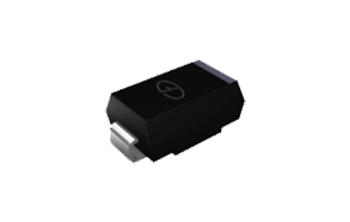
The BAT46WS is a small-signal Schottky diode available in compact surface-mount packages, with manufacturer-specific electrical limits. In sensing or clamp applications, compare leakage at actual bias and temperature, forward voltage at expected current, capacitance, and fault-current handling. A small package and low forward drop do not independently establish precision or protection performance.
The numerical reference is the Good-Ark BAT46WS datasheet, document 643141. Another supplier’s version needs its own review; for example, Diotec lists a BAT46WS in SOD-323F. Do not pool limits from the two sources.
Separate normal measurement from fault conduction
During normal operation, a clamp diode may be reverse biased. Its leakage and capacitance can still affect the measured node. During a fault, forward conduction and the complete current path become central. Those are different operating states and need separate checks.
The Analog Devices sensitive-amplifier protection discussion explains why protection diodes can add leakage and capacitance to a precision input. A component that survives a fault may still introduce unacceptable error during normal measurements.
Check the receiving IC’s allowed input conditions and the destination of fault current. A diode connected to a supply rail does not establish that the rail can absorb injected current or that the protected pin remains within its limits.
A checklist from the sensor node to the clamp path
Start with normal signal range, source impedance, required accuracy, and operating temperature. Then identify the fault amplitude, duration, source impedance, and current destination. A part selection made without those inputs is incomplete.
- Determine the diode’s normal reverse bias over the signal range.
- Translate leakage into an error budget at the relevant impedance.
- Check capacitance against bandwidth and settling needs.
- Evaluate forward voltage at the expected fault current.
- Limit current and verify the receiving rail and IC constraints.
- Check power, pulse conditions, package, and mounting.
The TI ADS131M0x input-protection circuit note illustrates a complete ADC-specific protection review. It is not a qualification of BAT46WS for every ADC; apply the requirements of the actual receiving device.
A condition-based reference table
These selected entries belong to the named Good-Ark document. Keep test current, reverse voltage, and temperature with each value. In particular, do not treat the source’s non-repetitive current entry as a continuous operating allowance.
| Check | Reference entry | Condition |
|---|---|---|
| Repetitive reverse voltage | 100 V | Blocking limit, not a clamp threshold |
| Maximum forward voltage | 250 mV / 450 mV | 0.1 mA / 10 mA respectively; table ambient 25 °C |
| Maximum reverse current | 0.5 µA / 20 µA | Reverse 10 V; 25 °C / 70 °C respectively |
| Junction capacitance entry | 20 pF | Reverse 0 V; 1 MHz |
| Package and marking | SOD-323; S9 | Documented cathode band; confirm drawing view |
A maximum leakage value is not a prediction of every sample. A capacitance entry at one bias is not a constant for every signal voltage. Use the appropriate limits, curves, or measurements for the accuracy requirement.
Common mistakes in a precision-input selection
The first mistake is selecting only for low forward voltage. A high-impedance input may be more sensitive to reverse leakage than to the diode’s conduction behavior during a fault. Include the hot operating condition, not only a room-temperature screen.
A second mistake is ignoring capacitance because the diode is small. Capacitance loads the node and can change bandwidth or settling. A third is assuming two clamps cancel their leakage exactly; bias and temperature differences can prevent that simplification.
Finally, a reverse rating does not specify controlled avalanche or transient clamping. Keep normal bias, forward fault conduction, and reverse blocking as distinct requirements.
Verification with an explicit error estimate
For an illustrative linear estimate, 0.5 µA flowing through 100 kΩ produces 50 mV. The calculation is I × R, not a prediction that every BAT46WS introduces that offset. Actual current depends on bias, temperature, and the circuit’s response to the changed node voltage.
For a separate settling illustration, 100 kΩ and 20 pF give a time constant of 2 µs. Include the sensor, PCB, IC, and probe capacitances before applying such a model to an actual input. An ADC acquisition requirement needs the complete source network.
The Fluke diode-test guide supports basic unpowered junction screening. It does not measure microamp leakage at the intended bias or validate precision settling. Use suitable measurements for those requirements.

Connections to other diode choices
The Schottky versus fast-recovery comparison and Schottky selection guide explain broader tradeoffs. A power-rectifier headline is not a substitute for the leakage and loading review of a small-signal node.
The TVS introduction explains a different protection role. The USB ESD guide adds signal and array considerations. Choose a documented protection function rather than assuming a familiar Schottky part covers every fault mechanism.
A purchasing checklist for an accuracy-sensitive circuit
Preserve the full manufacturer code, source document, package drawing, and operating conditions. Specify which leakage, capacitance, and forward-current conditions matter to the design. A shortened BAT46WS listing can omit the distinctions that affect accuracy.
Keep sample identity and test setup with the results. A plausible forward reading does not establish the specified hot leakage, and a room-temperature prototype does not independently validate the intended temperature range.
When the datasheet must resolve the next step
Return to the exact source when an error budget needs a value at an unstated bias, temperature, or frequency. Resolve missing guarantees or measure an appropriate bounded condition rather than filling the gap with another supplier’s typical data.
The practical choice balances ordinary measurement quality with fault behavior. A diode is suitable only when the sensing node remains accurate and the complete protection path meets the intended fault conditions.
FAQ
Does low forward voltage make BAT46WS ideal for every sensor input?
No. Normal-operation leakage and capacitance may matter more than forward drop in a high-impedance or precision sensing path. Evaluate bias, temperature, source impedance, accuracy, settling, and the receiving IC requirements. Also review fault current and its destination. A low forward-voltage value at one test current does not establish complete sensing performance or guarantee protection in every circuit. Keep the selected manufacturer conditions attached to the decision.
Can diode mode check the leakage specification?
An ordinary diode-mode result is not a leakage measurement at the intended reverse bias and temperature. It can support a basic junction screen on an unpowered, discharged circuit, but a normal reading does not establish microamp or lower leakage performance. Use a suitable controlled reverse-bias measurement with adequate instrument sensitivity, account for board contamination and fixture leakage, and compare the actual source conditions.
Can I substitute another BAT46WS manufacturer without changing the design?
Treat it as a candidate requiring comparison. Verify package drawing, marking, pin mapping, leakage over the relevant bias and temperature range, forward behavior, capacitance, and pulse limits. Matching the base number does not prove identical accuracy or mounting behavior. Keep each supplier document intact rather than combining favorable entries from different sources, then validate the actual circuit before approving the substitution for production or repair.
Recommended
 FR107 and 1N5408: Choosing Higher-Current Axial RectifiersKnowledge
 UF4007 Diode: Ultrafast Sibling of the 1N4007 FamilyKnowledge
 SS34 Schottky Diode (SMC): Specs and Board-Level FitKnowledge1N5819 Schottky Diode: Low-Voltage Uses and LimitsKnowledgeES1J and UF5408: Picking a Fast or Ultrafast Axial RectifierKnowledge
 MUR2060CT and MUR3040PT: Dual Ultrafast Rectifiers in Power StagesKnowledge