Zener and Signal Diode Hub
Use the Zener and Signal Diode Hub to choose devices, check ratings, solve failures, verify alternatives, and reach the right Good-Ark technical support path.
18 guides
Separate the job of a Zener reference or clamp from the job of a small-signal switching diode. These guides connect basic behavior, ratings and comparisons with the practical circuit that uses the device.
Understand breakdown and compare diode jobs
Start with the operating behavior and the distinctions between regulation, clamping and switching.
What Is a Voltage Regulator Zener Diode?
A Zener regulator is sized by its worst case, not its typical load. What a real low-power Zener specifies, and how the series resistor is chosen from those numbers.
Zener Diodes in Plain Language: Breakdown Voltage, Zener Knee, and the Three Things to Check
A Zener diode is the component that looks like a normal diode and behaves like a voltage gate in reverse. Every diode blocks reverse voltage until a limit; a Zener is engineered to break down cleanly at a…
Read ratings and design Zener circuits
These references explain how the relevant ratings, bias conditions and circuit requirements fit together.
1N4728A in Practice: Datasheet Numbers, Real Measurements, and Safe Replacements
The 1N4728A is a 3.3 V Zener diode that a buyer and a repair bench read in two completely different ways. The buyer sees a part number, a voltage rating, and a price; the bench sees a curve to measure, a…
From 3.3 V to 12 V: Matching Zener Part Numbers to Your Voltage and Power Needs
The 1N47xx ladder is the fastest route from “I need a Zener at this voltage” to “I have the part number.” A single table maps the voltage ladder from the 3.3 V 1N4728A up to the 12 V parts, with the power…
Precision Zener Reference Diode: Stable Voltage In Demanding Power Designs
A precision Zener reference is a tolerance grade: 33 mV at 1 % against 165 mV at 5 % on a 3.3 V rail. What that means for a 12-bit measurement.
SMD Zener Voltage Regulator: Reliable Board-Level Protection And Stabilization
An SMD Zener regulator is rated by its pad: 350 mW standard footprint against 590 mW with 1 cm2 of cathode copper. How the layout sets the budget.
Zener Datasheet Language: Turning Vz, Iz, Izk, and rz Into a Working Design
A Zener datasheet looks shorter than a rectifier datasheet — a few voltage numbers, a current or two, a temperature coefficient — yet it is one of the easiest spec sheets to misread. The nominal voltage is…
Zener Reverse-Current Ratings in H-Bridges: The Freewheeling Path Nobody Sizes
An H-bridge drive for a motor has two hidden electrical paths: the switching path that everyone sizes, and the freewheeling path that nobody does. When the H-bridge releases a motor, the back-EMF drives…
Zener Shunt Regulator by Hand: Choosing the Series Resistor for Worst Case, Not Typical
A Zener shunt regulator is the cheapest voltage regulator you can build — one Zener, one resistor, no active components — and the reason so many of them fail on the bench is that they are designed for the…
Zener, LDO, or DC-DC for a 5 V Rail: The Honest Loss-and-Cost Comparison
There are three ways to make a 5 V rail from a higher supply, and they are not equivalent. A Zener shunt is simple and cheap but wastes power as soon as the load is small; a linear LDO is cleaner but burns the…
Zeners as Precision References: Tolerance, Temperature, and the 4 V Rule
The Zener’s reputation as a “voltage reference” suggests it holds its voltage like a calibration standard, and the honest answer is that it does not — a Zener holds its voltage within a tolerance, it drifts…
Select and apply small-signal diodes
Follow the guide for the switching task, package or common part family you need to identify.
Good-Ark Schottky Portfolio: From Small-Signal to Power Rectifiers
An engineer searching for “Schottky rectifier” faces a catalog problem, not a physics problem: the same technology appears in SOD-123 packages for signal clamping and in TO-220 dual-die parts for 20 A outputs,…
High Speed Switching Diode: Optimizing Fast Recovery for Power Electronics and Signal Integrity
A high-speed switching diode is specified by a 4 ns recovery at 10 mA and defined conditions, plus 1.5 pF of capacitance. What the test line decides.
Small-Signal Diodes and Switching Speed: From BAS16 and 1N4148 to Fast-Switching Trains
Small-signal diodes are everywhere in a board — logic inputs, I/O protection, level shifters, and switching trains — and their datasheet rarely tells you the thing you actually need to know. The…
SOD-123 Switching Diode: Fast, Reliable Signal Control for Compact Electronics
A SOD-123 switching diode is a package choice: the same 100 V, 4 ns silicon comes in seven outlines. What the outline changes, and what it does not.
What Is a Low Leakage Small Signal Diode?
A low leakage small signal diode is a low-current semiconductor device engineered to minimize reverse current while switching, steering, clamping, or protecting sensitive signals. It helps preserve accuracy in…
What Is a Small Signal Schottky Barrier Diode?
A small-signal Schottky diode trades leakage for a 410 mV forward drop. What three real parts specify, and the calculation that decides whether it fits.
What Is a SOT-23 Switching Diode?
SOT-23 is a package, not a specification: the same 100 V, 4 ns switching silicon ships in six outlines. What the outline decides, and what it does not.
Need help with a particular circuit?
Include the circuit position, operating conditions and the part number or marking when you contact Good-Ark technical support.
Recommended
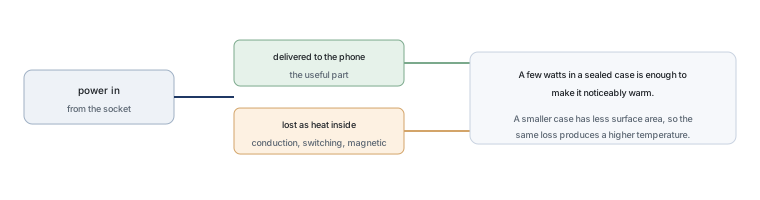 Why Does Your Phone Charger Get Warm?Knowledge
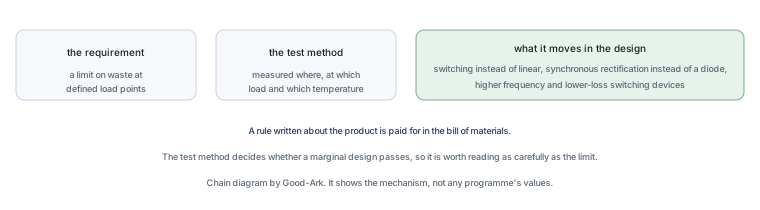 Energy Efficiency Rules Worldwide: How Regulations Shape Component ChoicesKnowledge
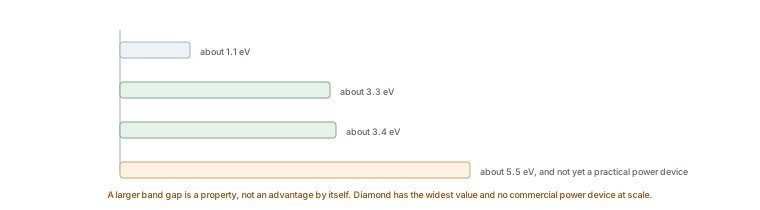 Wide-Bandgap Semiconductors: Adoption Report 2026Knowledge
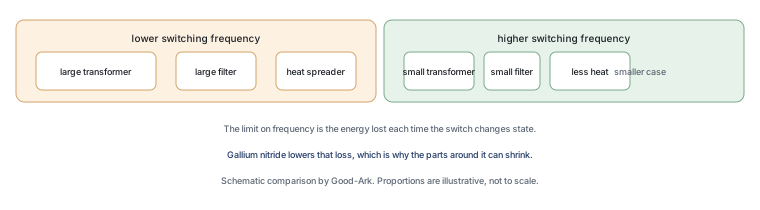 The GaN Charger Market: Why Your Next Adapter Is SmallerKnowledge
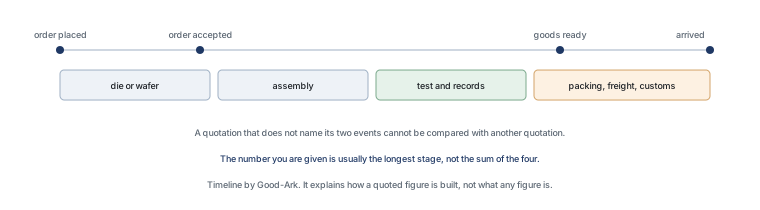 Component Lead Times in 2026: What Is Actually Normal NowKnowledge
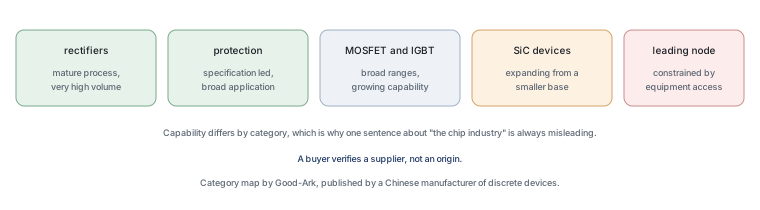 China’s Power Semiconductor Industry: Where It Stands in 2026Knowledge