The GaN Charger Market: Why Your Next Adapter Is Smaller
GaN charger market 2026: what gallium nitride changes physically, why adapters shrank, how price and standards shaped adoption, and what to check.
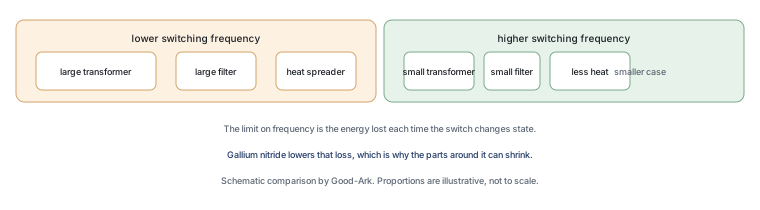
A gallium nitride charger is smaller than the silicon one it replaces because the switch inside it can be turned on and off more times per second without wasting as much energy as heat, and a higher switching frequency allows the transformer and the filter components to shrink. That is the whole mechanism. Everything else about the category — the price premium, the marketing, the way the adapters became pocket-sized — follows from that one property and from a standard that decides how much power a small connector may carry.
From brick to pocket-sized
The power adapter that came with a laptop fifteen years ago was a brick with a mains cable, and the size was set by the components needed to handle the power. Two of those components scale with frequency. The magnetic part, which transfers energy across the isolation barrier, and the capacitors that smooth the output, both become smaller when the switching frequency rises, because each switching cycle handles less energy and the smoothing interval becomes shorter.
Silicon switches cannot simply be driven faster, because the energy lost each time they switch rises with frequency, so an attempt to shrink the magnetics by switching faster produces a hotter converter rather than a smaller one. The comparison that fits is a door that has to be opened and closed: doing it more often is only useful if each movement is cheap. Gallium nitride devices make each movement cheaper, which is what allows the frequency to rise and the components to shrink.
What GaN changes physically
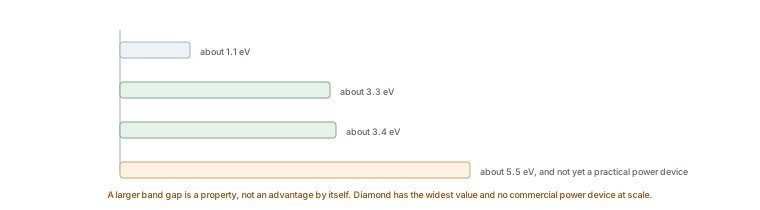
The difference is a material property. Gallium nitride has a bandgap of roughly 3.4 electronvolts against silicon’s 1.1, which means a device of the same voltage rating can be built in a much thinner layer with lower resistance. It also has a higher electron mobility in the channel of the transistor that is normally used, so for a given die area the device can carry more current and switch faster.
In a charger that translates into three visible effects. The converter runs at a higher frequency, so the transformer and the filter shrink. The losses per switching event are lower, so less heat has to be removed, which reduces the heat spreader. And the whole power stage can occupy less board area, which allows the enclosure to shrink around it. None of that changes the amount of power delivered; it changes how much space and heat it takes to deliver it.
| Property | Effect in a charger | What it does not change |
|---|---|---|
| Higher switching frequency | Smaller transformer, smaller filter | How much power the output can deliver |
| Lower switching loss | Less heat, smaller heat path | The heat generated by the load itself |
| Higher breakdown field | Thinner device, lower resistance | The isolation and safety requirements |
| Fast switching edges | Design attention to layout and noise | Anything the customer sees |
How the market grew
Three things had to be true at the same time for this category to become ordinary. The devices had to be manufacturable at a cost a consumer product could absorb. A standard had to exist that let a small connector carry enough power to charge a laptop. And the rest of the design had to be able to follow the faster switching without becoming unreliable, which meant better controllers, better layout practice and better magnetics.
The order matters. Standards came before volume, because a charger can only be small if the cable and connector allow the power to pass. Device cost fell as production volumes rose, which happened after the standard made a mass market possible. And the design practice accumulated as engineers learned to control the faster edges that come with the material.
Price parity with silicon
The premium has narrowed for the same reason it narrowed in silicon carbide: yield improves, volumes rise and the process becomes routine. What has not changed is that the gallium nitride device is still more expensive per unit than the silicon switch it replaces, and the charger is cheaper because the components around it are smaller rather than because the switch itself is cheap.
That has a practical consequence for anyone comparing two adapters that look identical. The savings from the smaller magnetics and the smaller enclosure are what pay for the more expensive switch, and a design that takes the expensive switch without taking the size benefit has paid the premium for nothing. It is one reason a nominally similar adapter can be heavier, or run hotter, than another with the same rating.
Where SiC still wins
The two wide bandgap materials are not interchangeable, and the boundary is roughly set by voltage and current rather than by fashion. Gallium nitride devices are strong at the voltages and frequencies a charger works at, which is why the consumer power adapter is their natural home. Silicon carbide devices are strong where the blocking voltage and the current are much higher, such as traction inverters and high-power solar conversion, where the operating frequency is lower and the thermal load is much larger.
The comparison is a sports car and a truck. Both are more capable than a family saloon, and only one of them is useful for moving a load up a hill. For an adapter, gallium nitride; for a traction inverter, silicon carbide; and for an ordinary rectifier at mains voltage, plain silicon, which is still the right answer for most of the parts in the product.
Standards and USB power delivery as a driver
The reason a small adapter can charge a laptop is the standard that governs the negotiation between the charger and the device. The USB Power Delivery specification defines a set of voltage levels beginning at 5 V and rising through 9 V, 15 V and 20 V, with a maximum power of 100 W in the original specification and a later extended range that raises that ceiling to 240 W. The charger and the device negotiate which level to use, so the same port can serve a phone and a laptop.
That negotiation is what makes a universal adapter possible, and it is also why the physical size fell. Before it, a laptop needed a barrel connector and a fixed voltage, which meant the adapter could not be shared. The standard turned the adapter into a commodity with a defined interface, which in turn justified investment in making it smaller.
What to look for when buying
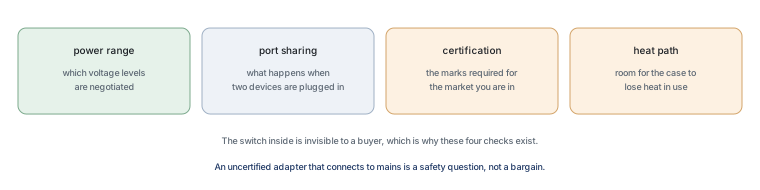
Four things matter more than the material claim. The negotiated power range, because an adapter that supports higher voltage levels can charge more devices faster. The number of ports and whether power is shared between them, because a two-port adapter divides its output when both are in use. The certification marks for the market you are in, because those are the evidence that the safety and efficiency requirements were met. And the physical arrangement, because a compact charger concentrates its heat in a small volume and needs airflow around it.
A safety note belongs here, because the category’s popularity has produced a market in uncertified copies. An adapter that connects to mains voltage is a safety-relevant product, and an uncertified unit may lack the insulation, the creepage distance and the protection that the standards require. The absence of a recognised certification mark is not a stylistic detail.
Outlook
The direction is that the technology keeps moving into smaller and cheaper products as the device cost falls, and the constraint is that the safety and efficiency requirements do not change with the material. Where the next step lies is not in shrinking the adapter further, because the mains interface and the isolation barrier set a floor, but in integrating more of the system into the same package and in using the higher power range the standard now allows.
FAQ
Should I buy a gallium nitride charger?
It is worth it if you value size and weight, and if you need one adapter for several devices. The advantage shows up as a physically smaller unit for the same power, not as more power or as a lower electricity bill. If the adapter stays on a desk and size does not matter, a well-made silicon unit does the same job.
Does a GaN charger charge my phone faster?
Not because of the material. Charging speed is decided by the power the device and the charger negotiate and by what the battery can accept, and that negotiation follows the standard rather than the internal switch technology. A gallium nitride adapter may support a higher power range in a smaller body, which can permit faster charging for a device that also supports it.
Which company makes the best GaN charger?
That is a comparison a buyer can only make against stated criteria: the negotiated power range, the behaviour with two ports loaded, the certification for the relevant market, the size and weight, and the warranty. Without those criteria a recommendation is a statement about brand rather than about the product, and this article does not name or rank products.
Why does a small charger still get hot?
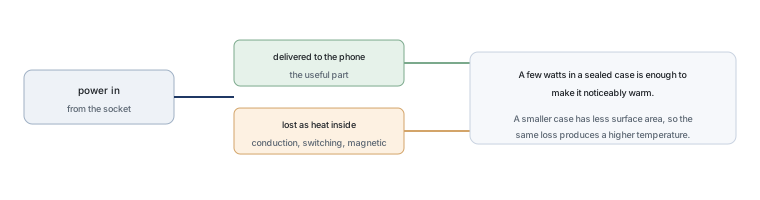
Because the wasted energy has not been eliminated, only reduced, and it is now concentrated in a smaller volume with less surface area to lose it from. A compact adapter running at high power will be warm, and that is normal. What is not normal is a case that is painful to hold, an audible buzzing or a smell of hot plastic, and any of those is a reason to stop using the unit.
Is gallium nitride better than silicon carbide?
Neither is better in general; they are suited to different ranges. Gallium nitride is strong at the voltages and frequencies used in compact power supplies, which is why it dominates this category. Silicon carbide is strong where the voltages and currents are much higher and the frequency is lower, such as traction inverters and utility-scale conversion.
What to do next
Compare chargers on the negotiated power range, the port behaviour and the certification marks, and treat the material claim as context rather than as the deciding factor. The device-level comparison between the three chemistries is in gallium nitride, silicon carbide and silicon compared, and the rectifier side of a modern adapter is in USB-PD charger rectifier design.
Background is available in our overviews of gallium nitride, band gaps, USB and switched-mode power supplies, plus standards material from IEC, test methods from JEDEC, and sector context from the Semiconductor Industry Association. Sector and energy background is published by the US Department of Energy, NIST and ISO.
Tell Good-Ark the power level, the switching frequency and the space available, and we will confirm which rectifiers, protection devices and switches suit the design.
Email sales@goodark.com, or start from the application design centre.
This article is published by Good-Ark, a manufacturer of discrete semiconductor devices including rectifiers and protection components used in power supplies. It publishes no market value or adoption figure, and it names and ranks no product.
Recommended
 Why Does Your Phone Charger Get Warm?Knowledge
 Energy Efficiency Rules Worldwide: How Regulations Shape Component ChoicesKnowledge
 Wide-Bandgap Semiconductors: Adoption Report 2026Knowledge
 Component Lead Times in 2026: What Is Actually Normal NowKnowledge
 China’s Power Semiconductor Industry: Where It Stands in 2026KnowledgeHow to Read a Diode Datasheet: Key Parameters for BeginnersInfo