The Discrete Diode Market Explained: Size, Players and Trends
Discrete diode market explained: why a device that costs cents still matters, how the category splits by function, and where the value actually sits.
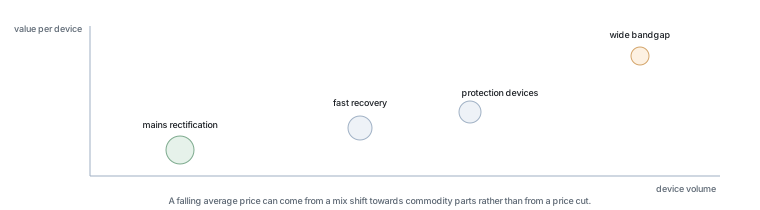
A rectifier diode can sell for a few cents, and the industry around it is still substantial, which is the part that surprises people. The explanation is arithmetic rather than sentiment: a device that appears in almost every electronic product is bought in enormous quantities, and a few cents multiplied by a very large number is a business. The interesting questions are which parts of the category behave like commodities, which carry value, and why a search for the topic so often returns something else entirely.
Where diodes still matter
A diode conducts in one direction and blocks in the other, and there is no simpler way to convert alternating current into direct current or to protect a circuit from a reversed supply. Every mains-powered product does this somewhere, which is why the device has not been displaced. Where it has been displaced, it has been replaced by a transistor doing the same job when the circuit needs control as well as direction.
The comparison that fits is a hinge. Nothing about a hinge has changed in centuries, it is dirt cheap, and buildings still contain thousands of them. A diode occupies the same position in electronics: a basic component whose value lies in being reliable, cheap and available rather than in being clever.
Segmenting the market by function
The category splits into functions that behave very differently in price and in demand. Rectification at mains frequency is the commodity end, where the part is bought by the reel and price is decided by the cost per thousand. Fast recovery rectification inside switching supplies is a step above, because the recovery behaviour matters and the part is specified more tightly. Schottky diodes occupy low-voltage rectification, where their low forward drop is worth paying for. Zener and transient suppressors are protection devices sold by characteristics rather than by average current. And the wide bandgap rectifiers are the newest segment, where the price is high and the volume is small.
| Segment | What drives selection | Market character |
|---|---|---|
| Mains rectification | Current rating, forward drop, cost | High volume, commodity pricing |
| Fast recovery | Recovery time, losses, thermal behaviour | High volume, moderate differentiation |
| Schottky | Low forward drop at low voltage | Volume with a defined technical niche |
| Zener and transient suppressors | Clamping voltage and energy handling | Specification driven, protection application |
| Silicon carbide rectifiers | High voltage, no reverse recovery | Lower volume, higher value |
Volume versus value
The distinction that organises this market is that volume and value sit in different places. Rectification by device count is the largest segment and the smallest by value per unit. Protection is the opposite: a transient suppressor handles a tiny amount of energy in normal operation, costs little more than a rectifier and is essential to the reliability of everything downstream.
Wide bandgap rectifiers occupy the top of the value range and the bottom of the volume range. A device that costs many times a silicon equivalent has to justify itself by saving energy or by making a converter smaller, and it can only do that where the switching frequency and the voltage are both high enough for the difference to matter.
Who the main producers are, by segment
The structure is more useful than a list of names. The commodity end is served by a large number of manufacturers across several regions, because the process is mature and the capital requirement is moderate relative to advanced logic. The upper end is served by fewer manufacturers, because fast recovery and wide bandgap devices need tighter process control and better test capability. And the modules that package several diodes with cooling are made by a smaller group again.
Two regions matter for different reasons. Mature silicon processes are widely distributed and have been expanding, which is what keeps the commodity end competitive. Wide bandgap material is concentrated where the crystal growth experience sits, which is what keeps the high end more expensive. For a buyer, the practical consequence is that the low end is easy to second-source and the high end is not.
Price trends and the commoditisation story
Commoditisation in this category has happened for a reason that is easy to misunderstand. The price of a standard rectifier has fallen not because the device became worse but because the process became routine: a mature process with many suppliers and stable yields produces a part that behaves like a commodity, and commodities are priced against the cheapest capable producer.
That has a consequence worth naming, because it appears in technical decisions. When price competition is strong, the difference between a good and a marginal supplier shows up in consistency rather than in the datasheet: lot-to-lot variation, marking quality, packaging and documentation. A buyer comparing two quotations that differ by a small percentage is really comparing processes, and the way to see the difference is to inspect the packaging and the traceability rather than the average parameter on the front page.
The automotive and industrial shift
Two end markets have moved the mix upwards. Automotive use requires qualification and documentation rather than the lowest price, so the same device that sells as a commodity elsewhere is sold in a graded form with a test record. Industrial use has moved the same way for a different reason: equipment with a long service life and an expensive downtime cost justifies paying for a specified part.
This is where the diode business stops looking like a commodity market. Once a part carries a qualification, a documented traceability route and a change-notification process, the buyer is purchasing assurance as well as silicon, and the price difference reflects that. The comparison is a standard bolt against a certified fastener for a pressure vessel: both are bolts, and only one of them comes with the paperwork an inspector will accept.
Where the market is heading
Three directions are supported by what the category does rather than by a forecast. The share of value in protected and graded parts keeps rising, because more equipment needs documented reliability. The wide bandgap rectifier segment keeps growing from a small base, because the applications that justify it are the ones growing fastest. And the commodity segment keeps consolidating around producers whose process consistency is good enough to be trusted at volume.
What none of that says is that the commodity part is going away. The mains rectifier will still be in every adapter and every appliance long after the newest wide bandgap device has become routine, for the same reason hinges are still in doors.
Reading the numbers
Two reading rules apply to any diode market figure. First, check whether “diode” means rectifiers only or includes protection devices and modules, because the two definitions produce very different totals. Second, check whether a growth figure is being driven by volume or by mix, because a market can shrink in units while growing in revenue if the mix moves towards higher-value parts.
There is also a naming trap that costs readers real time. The phrase “data diode” describes a network security appliance that allows traffic in one direction only, named by analogy with the semiconductor and built from an entirely different set of components. A page about data diodes will not answer a question about rectifiers, and a research report about that appliance market says nothing about power semiconductors.

FAQ
Are diodes still used today?
Yes, and in very large numbers, because converting alternating current to direct current and protecting a circuit from reverse polarity are functions that no product can avoid. Where a diode has been replaced, it has usually been replaced by a transistor performing the same function in a circuit that also needs control.
Who are the major manufacturers of diodes?
The commodity end is served by many manufacturers across several regions, and the higher-value end by fewer, so a single list would mix two different competitive situations. A useful comparison would have to state the segment, the region and the period, and would still reflect the fact that the same company can be a leader in one segment and absent from another.
Why do searches for the diode market return network security results?
Because a data diode is a network appliance that permits traffic in one direction only, named after the semiconductor by analogy. It belongs to information security rather than to power electronics, so pages about it are about hardware that enforces one-way traffic, not about rectifiers. Recognising the collision saves a reader from comparing two unrelated markets.
Is a cheaper rectifier a worse rectifier?
Not necessarily. Commodity pricing comes from process maturity and competition, and a well-run factory can sell a standard part cheaply. What price competition does change is where the difference between suppliers appears: in lot-to-lot consistency, in marking and packaging quality, and in the ability to answer a traceability question. Those are worth checking on any part, expensive or cheap.
What are the diodes inside a solar module?
They are bypass diodes, and their job is to give current a path around cells that are shaded or damaged so that the rest of the string keeps working and the shaded cell is not driven into reverse. They are power devices with a voltage and thermal rating, and a failed one shows up as a hot spot on a panel rather than as an obvious electrical fault.
What to do next
If you buy in this category, decide whether you are buying a commodity or an assurance. The commodity answer is a price comparison between capable suppliers. The assurance answer is a conversation about consistency, traceability and qualification, and it belongs with the supplier rather than with a search page. The device-level basics are in what a diode is, the common part numbers in common diode part numbers, the thermal side in why diodes get hot, and the replacement question in finding a diode replacement.
Background is available from JEDEC on device test methods, IPC on assembly and materials, ISO on quality management, IEC on electrotechnical standards, the Semiconductor Industry Association on the sector, and our overview of diodes. Sector and energy background is published by the US Department of Energy.
Tell Good-Ark the part number, the application and the volume, and we will tell you what the ordering unit is and which documentation can accompany the shipment.
Email sales@goodark.com, or start from the product family learning centre.
This article is published by Good-Ark, a manufacturer of discrete semiconductor devices including rectifier and protection diodes. It publishes no market size, growth rate or company ranking of its own.
Recommended
 Why Do Diodes Get Hot? Conduction and Switching Losses ExplainedInfoStandard, Fast Recovery, and Schottky Diodes: What’s the Difference?Info
 What Is a Fast Recovery Diode? Understanding “Fast Recovery”Info
 What Is a Diode? A Beginner’s Guide to How It WorksInfo
 Automotive Semiconductor Report 2026: Chips Per Car Keep RisingKnowledge