Solar and Energy Storage Power Electronics: Report 2026
Solar inverter market 2026: what an inverter contains, why storage adds a second conversion, and how efficiency rules shape the devices chosen.
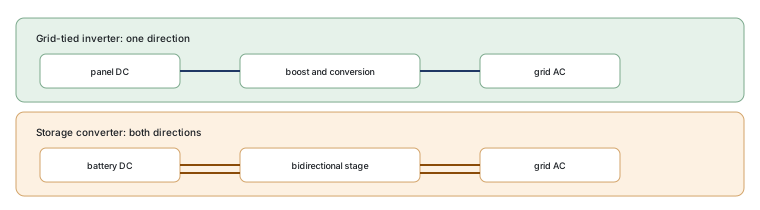
A solar installation and a battery storage system both convert electricity, but they do it differently, and the difference explains most of what is inside them. A grid-tied solar inverter changes direct current from the panels into alternating current for the grid. A storage system has to do that in both directions, which means the same power stage has to work as a rectifier and as an inverter, and that single requirement shapes the whole design.
Scope: what this report covers
This report covers the power electronics inside solar inverters and stationary battery storage: the conversion stages, the semiconductor devices they use and the rules that push those devices to improve. It does not publish installation volumes, market values or supplier rankings, because those figures depend on definitions — residential or utility scale, shipments or commissioned capacity, inverter only or the whole balance of system — and the plan carries no data of its own for them.
What it does describe is structure, which changes slowly and can be checked by anyone who opens a datasheet or reads a standards document. The technical values used below are characteristics such as voltage classes and switching behaviour rather than measurements of a market.
Installations and their regional split
The reason a regional split matters is that the three common installation types use different converters. A residential rooftop system is usually a single-phase string inverter with a modest power rating and a strong emphasis on size, noise and cost. A commercial or industrial installation may use three-phase string inverters or a central inverter with a higher power rating. A utility-scale plant uses central inverters at high power, where efficiency and serviceability matter most because the unit runs continuously for decades.
The comparison that helps is vehicles: the same journey is made by a bicycle, a van and a train, and each one has a different engine for reasons of size rather than of principle. In the same way, the device mix in a 5 kW residential inverter and a multi-megawatt central inverter is different, even though both are doing direct-to-alternating conversion.
Inverter topologies and part counts
A modern grid-tied inverter is a chain of stages rather than a single circuit. The panel side may feed a boost stage that lifts the voltage to a level the conversion stage can use. The conversion stage turns that direct current into alternating current. A filter removes the switching artefacts. A protection stage clamps surges and disconnects the unit when conditions are unsafe. And on the panel side, bypass diodes inside the modules protect cells that would otherwise be driven into reverse.
Each stage has its own device requirements. Boost and conversion stages need switches whose switching loss is low enough to keep the cooling manageable, which is where wide bandgap devices enter. The rectification and freewheeling positions need diodes with a low forward drop and a short recovery. The protection stage needs devices that can absorb a surge without failing, and those are specified by clamping voltage and energy rather than by switching speed.
| Stage | Job | Device role |
|---|---|---|
| Panel side and bypass | Protect shaded cells, provide a current path | Bypass and blocking diodes |
| Boost | Lift panel voltage to a usable level | Switches, freewheeling diodes, SiC where losses matter |
| Conversion | Direct to alternating current | Power switches, gate drivers, fast diodes |
| Filter | Remove switching artefacts | Passive components; devices set the switching frequency |
| Protection and disconnection | Surge clamping and safe isolation | Transient suppressors, thyristors, contactors |
Battery storage and bidirectional conversion
Storage changes the requirement in one specific way: energy has to flow in both directions, so the conversion stage has to work as an inverter when the battery is discharging and as a rectifier when it is charging. Some designs achieve this with a full bridge of switches and a control scheme that reverses the power flow. Others use separate stages for each direction. Both are legitimate, and they have different device counts and different control complexity.
There is a second consequence that appears at the battery interface. Battery packs operate over a wide voltage range as their state of charge changes, so the converter has to work efficiently across that range rather than at a single operating point. A design optimised for one voltage can be mediocre everywhere else, which is why the operating range is one of the first things to check in a storage converter specification.
Efficiency rules pushing newer devices
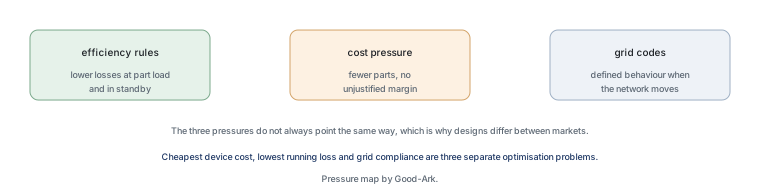
Efficiency requirements are the main external force acting on this equipment, and they act in two places. The first is conversion efficiency under load, which is usually expressed as a weighted figure across several load levels rather than a single number, because an inverter spends most of its life below full power. The second is standby consumption, which is small per unit and significant across a large installed base.
Both requirements push in the same direction: lower losses at partial load. That is where wide bandgap switches have an advantage, because their switching losses are lower and their behaviour at light load is better than a silicon device of equivalent rating. It is also where the pressure on cost is greatest, because the same rules apply to every competitor in the market.
Grid codes add a third requirement that is often overlooked by readers outside the industry. An inverter connected to a network has to behave in a way that supports the network — responding to frequency and voltage changes in a defined manner — and that behaviour is implemented in control and in switching, which places demands on the devices that have nothing to do with efficiency.
Price pressure on components
Solar conversion is a market where the cost per watt of the finished product has fallen for decades, and that pressure reaches the component list. Three consequences follow. Devices that offer the same function at a lower cost are adopted quickly. Designs are pushed to use fewer parts rather than more. And the margin for a device that is over-specified is small, because the specification has to be justified by the application rather than by caution.
That is also why the honest answer to “is a more expensive device worth it” is a calculation rather than a principle. If a lower-loss device allows a smaller heat sink, a smaller enclosure or a longer warranty, the saving can exceed the device cost. If it does not, the premium buys nothing that a customer can see, and it will be removed from the bill of materials at the first cost review.
Risks and uncertainties
Four risks are worth naming. Policy change can alter the economics of an installation faster than any component improvement. Grid-connection queues in some regions delay projects after the equipment has been ordered, which distorts shipment statistics. Component availability can constrain production even when demand is healthy, particularly for the control devices and the wide bandgap switches. And price competition can push designs towards the edge of their thermal margin, which shows up later as field failures rather than as cost savings.
The last of those is the one a component supplier has the least ability to fix. A device operated within its ratings lasts; the same device operated beyond them fails in a way that is hard to attribute. That is why temperature, derating and the thermal path are worth more attention than a line on a price list.
What to watch
Watch the efficiency requirement that applies in the market you sell into, because it moves the specification before it moves the price. Watch the operating voltage range of the storage systems you supply, because it decides which devices can be used efficiently. Watch the availability of the control and protection parts as well as the power switches, because a single unavailable small device stops a production line as effectively as a missing module. And watch the derating practice of your own design, because that is the part of the bill of materials you control.
FAQ
Will solar equipment get cheaper?
Cost per unit of capacity in this industry has fallen over long periods because of manufacturing scale, and the direction is not guaranteed for any particular year, because material prices, tariffs and demand cycles can reverse it. Any specific price forecast should name the market, the segment and the currency, because a utility-scale figure and a residential installed price are not comparable.
What will happen to the solar industry in 2026?
The three conditions worth tracking are installations actually commissioned, policy support in the main markets and the availability of grid connection. Shipments of inverters are a poor proxy for installations, because equipment can be purchased and held while a project waits for a connection. That gap between shipments and commissions explains many apparently contradictory reports.
Who are the largest solar inverter manufacturers?
That is a ranking question, and rankings depend on what is measured: units, power capacity in gigawatts, revenue, or installed base. They also change with the segment, because the leaders in residential string inverters are not the leaders in utility-scale central inverters. Without a stated metric and a stated period, a list of names is a claim rather than a measurement.
Why does a storage converter need different devices from a solar inverter?
Because energy flows both ways, so the stage that inverts must also rectify, and both directions have to be efficient. That requirement usually means a bridge of active switches rather than a diode bridge, and it changes the device count, the gate drive design and the control scheme.
Do bypass diodes inside solar modules have anything to do with the inverter?
They are a separate protection function inside the module rather than part of the inverter, and they exist to give current a path around cells that are shaded or damaged so that the string does not lose the whole module. They are still power semiconductor devices with a voltage and thermal rating, and they are one of the few places where a failure shows up as a hot spot on a panel.
What to do next
Start with the operating voltage range and the applicable efficiency requirement, because those two decide which devices are even candidates. The device-level detail for the conversion stage is in rectifier design for photovoltaic inverters and what a photovoltaic inverter does, and the protection side is covered in the guide to bypass diodes for module protection.
Background sources include the general material on bypass diodes, power electronics and direct current, standards from IEC, quality management requirements from ISO, energy statistics and programmes from the US Department of Energy, and sector material from the Semiconductor Industry Association. Sector and energy background is published by NIST and JEDEC.
Tell Good-Ark the topology, the operating voltage range and the switching frequency, and we will point you at the family that fits and the documentation that accompanies it.
Email sales@goodark.com, or start from the application design centre.
This article is published by Good-Ark, a manufacturer of discrete semiconductor devices. It is a structural report and publishes no market value, shipment figure or supplier ranking of its own.
Recommended
 Why Do Diodes Get Hot? Conduction and Switching Losses ExplainedInfoStandard, Fast Recovery, and Schottky Diodes: What’s the Difference?Info
 What Is a Fast Recovery Diode? Understanding “Fast Recovery”Info
 What Is a Diode? A Beginner’s Guide to How It WorksInfo
 Automotive Semiconductor Report 2026: Chips Per Car Keep RisingKnowledge