AC vs DC Explained: Why Diodes Are the Bridge Between Your Wall Socket and Your Phone
AC vs DC explained: your socket delivers one kind and your phone needs the other. What the difference is, and what sits between them inside an adapter.

Updated: October 28, 2026
This page is a focused engineering note in the consumer how x works cluster—use the checklists and links below to finish selection, not as a substitute for the datasheet.
Topic hub: How a power adapter works. Related deep-dives sit in the continue list at the end.
| Before release | Pass criteria |
|---|---|
| Ratings vs mission profile | Voltage/current/thermal margins recorded |
| Package & PCB | Rth path agreed with layout |
| Docs | Datasheet rev + PCN policy filed |
| Alternates | At least one workable second source or risk accepted |
Two ways electricity travels
Direct current flows in one direction at a steady voltage. A battery produces it, and almost every electronic circuit inside a device runs on it. Alternating current reverses direction periodically, so the voltage swings positive and negative in a regular pattern, and it is what the distribution network uses because it can be transformed easily from one voltage to another.
The analogy that works is a river versus a tide. Direct current is water flowing steadily downstream: always the same way, and the amount can be controlled. Alternating current is a tide that pushes one way, stops, and then pulls the other way, over and over. Both move energy, and they are not interchangeable without something in between to convert them.
Where AC comes from
Alternating current exists because of a practical advantage in transmission. A transformer can only change the voltage of alternating current. Raising the voltage reduces the current for the same power, and lower current means smaller losses in the wires over long distances, so the grid transmits at high voltage and steps it down near where it is used.
The alternation comes from the generator: a coil rotating in a magnetic field produces a voltage that reverses as the coil turns through the field. That is why the frequency of the supply is tied to how fast the generator turns and how the machine is built, and why the standard differs between regions rather than being universal.
Why almost everything runs on DC
Electronics run on direct current because semiconductors need a defined polarity. A transistor, a diode and an integrated circuit all depend on current flowing in a particular direction through particular junctions, so a supply that reverses a hundred times a second is useless without conversion. Even circuits that handle alternating signals usually do so around a direct-current operating point.
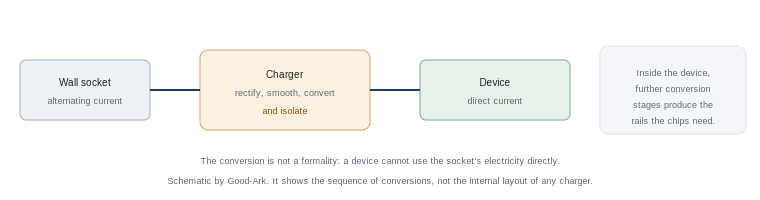
That is the whole reason a charger exists. It is not there to change the voltage, although it does that too. It is there to change the kind of electricity, and to do it safely and in a package you can hold.
The parts between them
In a modern charger the conversion happens in stages. A protection device absorbs incoming spikes, a bridge rectifier turns the alternating current into pulsing direct current, a capacitor smooths it, a switching stage chops it at high frequency to pass it through a small transformer, and a second rectifier and capacitor produce the clean low voltage the device needs.
Older equipment did the same job with a big transformer and a simple rectifier, which is why old power supplies were heavy. The order of the stages is the same; only the frequency and the size of the components have changed. Our article on what a bridge rectifier is follows the current through the first stage in detail.
What the waveform looks like
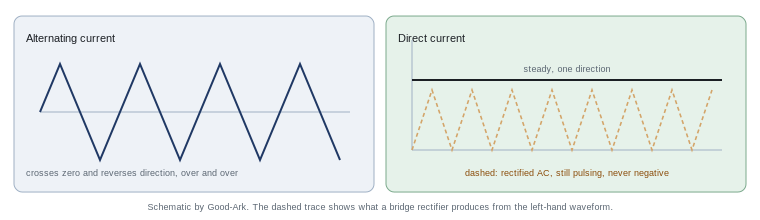
On a graph, alternating current is a wave that crosses zero and reverses; direct current is a line that stays on one side. That is why the two cannot be mixed casually: a rectifier conducts on part of the wave and blocks the rest, and that asymmetry is exactly what turns one into the other.
A rectified output is not the same as a battery’s output. It stays on one side of zero but it still pulses, dropping between peaks. If you have ever seen a cheap direct-current power supply produce a hum in an audio circuit, that ripple is the reason. A capacitor reduces it; a regulator reduces it further; neither removes it entirely, which is why sensitive circuits care about how clean the supply is.
Why frequency matters (50 Hz versus 60 Hz)
Two frequencies are used around the world: 50 hertz in much of Europe, Asia and Africa, and 60 hertz in North America and parts of Asia and South America. The voltage differs too, with roughly 230 volts being common in 50 hertz regions and roughly 120 volts in 60 hertz regions, though the exact values and tolerances vary by country.
Three practical consequences follow. A device designed for one voltage may not work, or may be destroyed, on the other unless it is specified as universal input. The frequency affects components that rely on it: a transformer designed for 50 hertz can saturate at 50 and run hot, and an older motor may run at the wrong speed. And it changes the physics of smoothing, because a 50 hertz supply delivers a hundred rectified pulses per second while a 60 hertz supply delivers a hundred and twenty — which is why the same capacitor gives slightly less ripple on a 60 hertz supply.
| Property | Alternating current | Direct current |
|---|---|---|
| Direction | Reverses periodically | Constant |
| Typical source | A generator, and therefore the grid | A battery, a solar cell, a rectifier |
| Where you meet it | Wall sockets, transmission lines | Inside every electronic device |
| Why it is used | Easy to transform, so efficient to transmit | The only kind that semiconductors can use directly |
| What converts it | An inverter, for direct to alternating | A rectifier, for alternating to direct |
| Typical household value | About 230 V at 50 Hz or 120 V at 60 Hz depending on region | Varies: 5 V for a charger output, 12 V for a car system |
It helps to keep two different electrical hazards separate in your mind, because they have different causes and different precautions. A low-voltage high-current source, such as a battery pack, can deliver enough energy to start a fire or weld metal, and its danger is present whether or not it is connected to anything. A mains supply can drive a dangerous current through a person, and its danger depends on the path the current takes. Understanding which one you are near is the first step in deciding what is safe to touch.
Safety basics for curious readers
The central point about household electricity is that it is not the voltage alone that injures people; it is the current through the body, and that depends on the path and the contact. Household alternating supply is dangerous in a way that a small battery is not, and the danger is not reduced by understanding it better. Treat every mains conductor as live unless you have personally isolated and verified it.
A second point surprises people: a device that is switched off or unplugged can still be dangerous, because the capacitors inside hold charge. That is true of chargers, power supplies and appliances alike, and it is the reason repair instructions begin with discharging rather than with opening the case. Keep curiosity at the low-voltage end of the bench until you have the instruments and the training for the rest.
If you want the two ends of that chain in more detail, the conversion inside the device is covered in our articles on the bridge rectifier package and why a bridge uses four diodes, and the device side in the product family learning centre.
Summary table
The short version: your socket supplies alternating current because the grid transmits it efficiently, your electronics need direct current because semiconductors require a defined direction, and the parts between the two are a rectifier, a capacitor and usually a switching stage. Change the direction and you have changed the problem; that is all a charger is doing.
The related reading on this site covers alternating current, direct current and mains electricity. Electrical installation and safety standards come from the International Electrotechnical Commission, national electrical codes and electrical safety material from NIST, appliance and equipment efficiency programmes from the US Department of Energy, and sector-level context from the Semiconductor Industry Association. Device and assembly background is published by JEDEC and IPC.
Release checklist
- Re-read absolute maximum ratings against worst-case spikes.
- Confirm pinout/package drawing matches the footprint library.
- Capture why this MPN beat the next alternative (loss, cost, lead time, or qualification).
FAQ
What is the practical difference between AC and DC here?
AC reverses polarity periodically; DC holds a single polarity—adapters convert and regulate so loads see usable DC.
Why do adapters still use rectifiers if they are “switching” supplies?
The front end still turns AC into a DC bulk rail before the high-frequency converter stage.
Is this page a design guide?
It explains the concept; use the SMPS and rectifier cluster pages for rating and loss work.
Related hub?
Continue through this engineering topic
- What is a diode explained simply
- What is a TVS diode
- Esd Protection For Beginners
- How A Power Adapter Works
- How Diodes Are Made Simply
- How Surge Protectors Work
Topic hub: How a power adapter works — related selection guides and application notes in this cluster.
Explore the related topic guides
Continue with the related selection, design and verification guides: