Diode vs Capacitor vs Resistor: What Each Part Actually Does
Diode vs capacitor vs resistor: one resists, one stores, one steers. Where each appears in a phone charger, and how to tell them apart on a board.
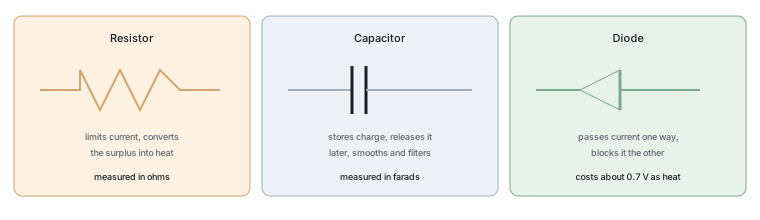
Three components account for most of what a beginner sees on a circuit board, and each does one thing that the other two cannot. A resistor limits current, a capacitor stores charge, and a diode lets current pass one way and not the other. Knowing which is which turns a random scatter of parts into a diagram you can read.
Three parts, three jobs
The cleanest way to hold them apart is by what they do to the current passing through them. A resistor converts some of the electrical energy into heat and, in doing so, limits how much current flows. A capacitor stores energy in an electric field and gives it back later, which is why it smooths and filters. A diode steers current, allowing it in one direction and blocking it in the other.
Two of those three are linear and one is not, which is the difference that matters in practice. A resistor obeys the same relationship in both directions, and so does a capacitor as long as the voltage stays within its rating. A diode treats the two directions completely differently, and that asymmetry is the whole point of the part.
Resistor: the narrow pipe
A resistor is a deliberate restriction. Put one in series with something and less current flows, which is how an LED is protected from burning out and how a transistor’s base or gate is given a defined drive current. The value is measured in ohms, and the relationship to current is the simplest in electronics: voltage equals current multiplied by resistance.
The power rating matters as much as the value, and beginners routinely ignore it. A resistor that dissipates more than its rating allows will drift in value and then fail, usually by going open. Since the power dissipated is current squared multiplied by resistance, a small change in current can be a large change in heat. That is why the same electrical value appears in several physical sizes.
Capacitor: the storage tank
A capacitor stores charge, and the practical consequence is that the voltage across it cannot change instantly. Connect one across a supply and it charges; remove the supply and it holds that charge, which is both its usefulness and its danger. In a power supply it fills the gaps between rectified pulses, and in a signal path it passes changes while blocking steady voltage.
Its value is measured in farads, and practical capacitors are usually in the microfarad, nanofarad or picofarad range. Two ratings decide whether it survives: the voltage it can withstand, and for electrolytic types the polarity it must be connected with. Reverse-connect an electrolytic capacitor and it can vent or burst, which is one of the few component failures that is genuinely unpleasant to be near.
Diode: the one-way valve
A diode conducts in one direction and blocks in the other, which is how alternating current is turned into direct current and how circuits are protected against reverse connection. Its two terminals are distinguished by a band on the package, and it costs about 0.7 volts while conducting — a toll that becomes heat.
The heat is the constraint that most affects how diodes are used. Because the loss is voltage multiplied by current, a diode carrying several amps can dissipate several watts, which is a great deal for a small plastic package. The thermal consequences are covered in our article on why diodes get hot.
How they combine in a phone charger
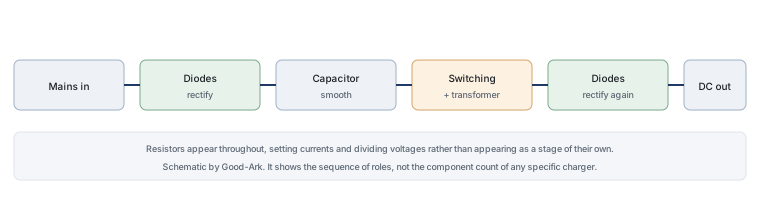
A charger is the shortest complete example. Alternating current enters, and a bridge rectifier — diodes — turns it into a pulsing direct current. A capacitor smooths those pulses into a steadier voltage. A transistor switches that direct current at high frequency through a transformer, and a second set of diodes and capacitors rebuilds a clean low voltage on the output side. Resistors appear along the way to set currents, divide voltages for sensing and discharge capacitors when the supply is switched off.
Reading the circuit as a sequence is the point: rectification, then smoothing, then conversion, then smoothing again, with resistors setting the conditions at each stage. Once you can name the three roles, the schematic stops looking like a list and starts looking like a process.
How to recognise each on a board
Physical appearance gives you most of the answer. Resistors are the small cylindrical or rectangular parts with a printed value or a colour code, often with a matte body. Capacitors are the taller parts for larger values — an electrolytic capacitor looks like a small can with a stripe marking its negative terminal — and the flat, small parts for smaller values. Diodes are the black cylinders with a band near one end, or the small two-terminal surface-mount parts with a band across one end.
Two cautions are worth carrying. First, surface-mount parts are far smaller than their through-hole equivalents and markings can be impossible to read without magnification. Second, some packages are used by more than one component type, so appearance narrows the possibilities rather than confirming one. When it matters, read the silkscreen reference designator: an R is a resistor, a C a capacitor and a D a diode.
One more habit is worth building here, because it applies to all three components. Look at the reference designator printed beside the part on the board rather than at the part itself. A silkscreen letter tells you the component type unambiguously, which is more reliable than judging from a package shape that several device families share. Reading the silkscreen first and the package second is the fastest way to avoid misidentifying a part on a dense board.
Symbols cheat sheet
| Component | Symbol shape | What the symbol says | Unit |
|---|---|---|---|
| Resistor | A zigzag or a plain rectangle | Current is limited in both directions | Ohm |
| Capacitor | Two parallel plates with a gap | Charge is stored across the gap; steady current does not pass | Farad |
| Diode | A triangle pointing at a bar | Current passes in the direction the triangle points | Volts of forward drop |
| Light-emitting diode | A diode symbol with two arrows leaving it | The same one-way behaviour, with light emitted | Volts of forward drop |
Our own articles cover the three parts: resistors, capacitors and diodes. Device test methods come from JEDEC, board assembly and workmanship expectations from IPC, the substance restrictions that appear on component declarations from the EU RoHS Directive, and sector-level context from the Semiconductor Industry Association. Device and assembly background is published by ISO and NIST.
It is also worth knowing what none of the three can do. None of them amplifies a signal, decides anything, or stores information; those jobs belong to active devices and to circuits built from them. The three components described here are the supporting cast, and recognising that distinction is what separates a list of parts from an understanding of a circuit.
Mini quiz for beginners
Four questions, with the answers underneath. Which component would you put in series with an LED to stop it burning out? Which would you put across a supply to smooth a rectified output? Which would you put in series with a battery to stop it being charged backwards? And which would you use to divide a voltage so a measurement circuit can read it?
The answers, in order: a resistor, a capacitor, a diode, and two resistors. If the reasoning behind each is clear, the three parts have done their job as an introduction, and the rest of the component catalogue becomes a set of variations rather than a list of strangers.
FAQ
Can a capacitor act as a diode?
No. A capacitor blocks steady current in both directions and passes changing current in both directions, because its behaviour depends on how the voltage is changing rather than on which way it is applied. A diode does the opposite: it distinguishes direction regardless of how quickly the voltage changes. The two are complementary parts in a filter, not substitutes for each other.
What are the four types of electronics components?
The question has more than one fair answer depending on the level of the taxonomy. If you mean the fundamental passive and non-linear parts a beginner meets first, the usual set is resistors, capacitors, inductors and diodes. If you mean the broad categories used in industry, the split is usually passive components, active devices, electromechanical parts and connectors. Both are reasonable; the useful thing is to know which question you are asking.
Can I use a diode instead of a resistor?
Only in a few narrow cases, and usually as a deliberate trick rather than a substitution. A diode has a roughly fixed voltage drop rather than a fixed resistance, so it does not limit current in the way a resistor does — in fact a diode connected directly across a supply will draw as much current as the supply can provide, which generally destroys it. Designers sometimes use a diode to drop a consistent voltage in a bias circuit, and that is a different purpose.
What kills diodes?
Excessive forward current, reverse voltage beyond the rating, a surge beyond the non-repetitive capability, and thermal fatigue from repeated heating. Manufacturing defects exist but account for a small share of real failures. The process side of that question is covered in our article on how diodes are manufactured.
Which of the three should a beginner learn first?
Resistors, because they set every current in a circuit and the arithmetic is the simplest in the subject. Diodes come second, because their asymmetry is the first genuinely non-linear behaviour you meet. Capacitors are the hardest of the three to reason about intuitively, because their behaviour depends on time rather than on the instantaneous voltage, which is why they are usually taught third.
What to do next
Pick a board you own and identify one of each part by its silkscreen reference designator. Then trace what each one is doing in the circuit around it. That exercise uses nothing but the three roles described here, and it is the fastest way to move from recognising components to reading circuits. The device families themselves are grouped in the product family learning centre.
Tell Good-Ark the voltage, the current and the job the diode is doing, and we can point to the family that fits and the ratings that decide it.
Email sales@goodark.com, or start from the product family learning centre.
This article is published by Good-Ark, a manufacturer of diodes and other discrete devices. Component values and behaviours are described at an introductory level; ratings for any specific part come from its current official datasheet.
Recommended
 Why Do Diodes Get Hot? Conduction and Switching Losses ExplainedInfoStandard, Fast Recovery, and Schottky Diodes: What’s the Difference?Info
 What Is a Fast Recovery Diode? Understanding “Fast Recovery”Info
 What Is a Diode? A Beginner’s Guide to How It WorksInfo
 Automotive Semiconductor Report 2026: Chips Per Car Keep RisingKnowledge