The Good-Ark Product List You Already Own: Ten Everyday Gadgets and the Parts Inside Them
A beginner's tour of the Good-Ark products list through objects you own: which device families sit in a charger, a bulb, an e-bike or a car.
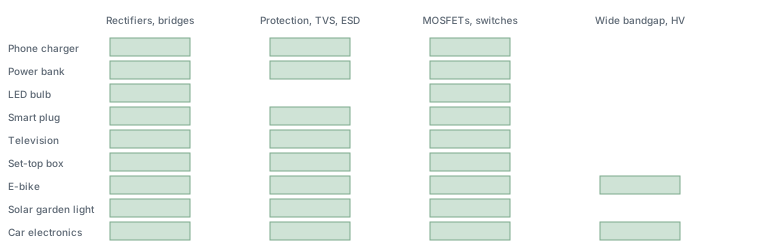
There is no way to see the components inside a sealed product without opening it, and opening it is usually the wrong first step. What you can do is learn the pattern: a small number of everyday objects contain almost the whole discrete device catalogue, each in a predictable place. This tour follows ten of them, and says plainly what can and cannot be concluded from the outside.
Last updated:
How to spot a component without opening the case
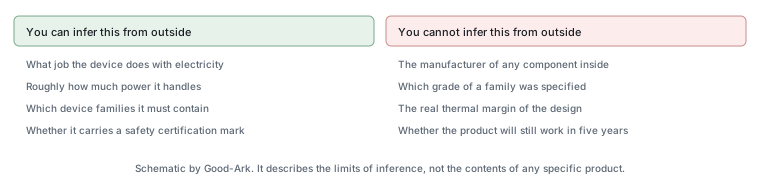
You can infer a great deal from the outside if you know what each object is trying to do with electricity. Anything that plugs into a wall socket must convert alternating current to direct current, so it contains rectification. Anything with a battery must manage current in two directions, so it contains switching. Anything with a cable that a person can touch carries a risk of static damage, so it usually carries protection. And anything with a motor or a heating element needs a switch that can handle real current.
The caveat belongs at the start rather than the end: which manufacturer made any of those parts is decided by the bill of materials, and that is not visible, not printed on the outside, and not something you can safely assume. This article is about the pattern of device families, not about what a particular brand of appliance happens to buy.
Gadget 1–2: charger and power bank
A phone charger is a miniature power conversion system. Alternating current enters, is rectified by a bridge or a set of discrete diodes, is switched at high frequency by a MOSFET, crosses an isolation transformer, and is rectified again on the low-voltage side — usually by a Schottky diode or a synchronous switch. A protection device sits near the input to absorb a surge before the switching stage sees it.
A power bank is the mirror image. It stores direct current in cells, steps it up or down to the voltage the device expects, and must protect the cells against over-current, over-discharge and reverse connection. That means switching devices, protection devices and, at the output, rectification or synchronous switching. The devices are small and cheap, and the design work goes into efficiency, because every wasted milliwatt is battery life.
Gadget 3–4: LED bulb and smart plug
An LED bulb is a constant-current power supply squeezed into a shape that cannot dissipate much heat. It contains rectification at the input, a driver that controls current rather than voltage, and protection against the surges that arrive on a lighting circuit. The light-emitting part has a very long life; the driver, which contains the power components, usually sets the real lifetime of the bulb.
A smart plug adds a small always-on power supply, a radio module and a relay or a semiconductor switch. It combines the same rectification and protection chain with a switching element sized for mains current, plus the isolation that keeps the user away from live parts. This is one of the few consumer products where a fault can be genuinely dangerous, which is why certification marks on the enclosure matter more than any component inside it.
Gadget 5–6: television and set-top box
A television contains several separate conversion stages: a mains input stage, one or more internal rails for the panel and the processor, and a backlight driver. Each stage has its own rectification and switching, and the input stage carries protection against surges and inrush current. Power supplies inside televisions are a common repair subject, and failures cluster around electrolytic capacitors and the rectification stage rather than the panel.
A set-top box or streaming stick is a low-power version of the same architecture: an external adapter does the mains conversion, and the box itself contains a small internal rail, protection at the connectors, and a switching regulator. It is a good example of a product where the visible price is dominated by packaging and software while the components inside are the ordinary ones described here.
Gadget 7–8: e-bike and solar garden light
An e-bike controller is a three-phase motor drive, which means it contains power MOSFETs switching real current, a bridge or synchronous rectification on the supply side, and protection against the transients that a motor creates when it is switched. The battery management system on the pack adds another layer of switching and protection. This is a category where the difference between a well-designed and a marginal product shows up as heat and as battery pack life rather than as an immediate failure.
A solar garden light is the cheapest complete solar system you can buy: a small panel, a blocking diode to stop the battery discharging into the panel at night, a battery, a boost circuit that lifts the low battery voltage enough to light an LED, and a light sensor. Its short life is usually a battery or moisture problem, but the diode and the boost stage are where the design has the least margin.
Gadget 9–10: car electronics and washing machine
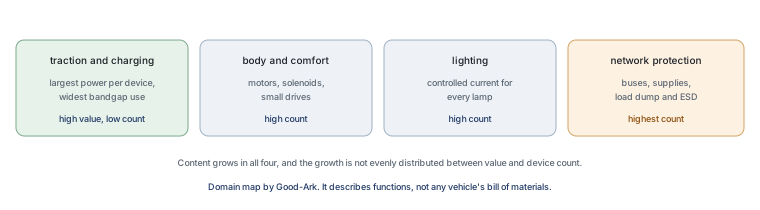
A car is not one product but dozens of small ones, distributed around the vehicle and connected by a wiring harness. Each control unit has its own input protection against transients, its own switching stages and its own rectification where it produces a local rail from the 12 V supply. The parts must be qualified to a harsher standard than consumer parts, which is why the same device family appears at a higher grade and a higher price.
A washing machine is a motor drive plus a mains input stage plus a control board, and it lives with moisture and vibration. Its rectification stage is sized for a real load rather than a few watts, its switching devices drive a motor with high inrush current, and its protection devices have to survive the spikes that come from the motor itself. Appliances are a useful reminder that these families are not only in small electronics.
Two external reference points are worth knowing once you start looking at products this way. Efficiency expectations for adapters and appliances trace back to programmes such as those run by the US Department of Energy, and the substance restrictions that appear on labels and declarations come from frameworks such as the EU RoHS Directive. For the underlying device behaviour, the entries on diodes and rectifiers are a reasonable starting point, the test methods come from JEDEC, and the assembly expectations from IPC. Sector and quality background is published by the Semiconductor Industry Association and ISO.
What the part is doing in each case
Strip the ten examples back and they reduce to four jobs, which is why the same families keep reappearing. Rectification turns alternating current into direct current at the input and often again at the output. Switching controls current flow precisely and quickly, whether that is a motor, an LED string or a battery charger. Protection absorbs the events that the design cannot guarantee will never happen. And high-voltage conversion does the same switching work in the range where ordinary silicon struggles, which is why it appears only in the e-bike and vehicle examples here.
| Product | Families you would expect inside | What this does not tell you |
|---|---|---|
| Phone charger | Bridge rectifier, Schottky or synchronous output, protection device, MOSFET | Which manufacturer supplies any of them |
| Power bank | Boost or buck converter, MOSFETs, cell protection, output rectification | Whether the cells and the electronics came from the same supplier |
| LED bulb | Input rectification, constant-current driver, surge protection | Whether the driver or the LED will fail first |
| Smart plug | Mains rectification, isolation, relay or semiconductor switch, protection | Anything about safety without a certification mark |
| Television | Multiple rectification and switching stages, inrush and surge protection | The expected service life of the capacitors |
| E-bike | Power MOSFETs, motor drive switching, battery management, protection | The thermal design margin of the controller |
| Solar garden light | Blocking diode, boost converter, battery protection | Whether it will survive one winter |
| Car control unit | Qualified protection, switching and rectification devices | The grade actually qualified, without the datasheet |
FAQ
Does my charger contain parts from this manufacturer?
That cannot be determined from the outside, and this article deliberately does not claim it. The device families that appear in a charger are the ones described above, and several manufacturers supply each of them. If you need to know the source of a component in a specific product, the only reliable route is the product’s bill of materials or a confirmation from the equipment maker.
Why do the same families appear in so many different products?
Because the underlying jobs repeat. Converting AC to DC, switching current on and off efficiently, protecting against transient events and stepping voltage up or down are needed in almost every powered product. Once a family does one of those jobs reliably at a given voltage class, packaging it for different products is a variation rather than a reinvention.
Which of these ten devices is worth taking apart to learn?
The safest and most instructive is a dead phone charger or LED bulb that has been unplugged for hours, because the circuit is small enough to trace and the parts are large enough to identify. A power bank is the next step, as long as you treat the cell as a fire risk and never short its terminals. Anything mains-powered with exposed conductors, and any battery pack, is not a beginner teardown.
Do more expensive appliances use better components inside?
Sometimes, but the relationship is weaker than the price difference suggests. Cost is split between materials, manufacturing, marketing and distribution, and a higher price does not automatically buy a higher component grade. What higher prices do often buy is better thermal design, which matters more for product life than the brand printed on the small parts.
Where can I see the actual families side by side?
The product family learning centre groups them by the job they do, which is the same structure used in this article. If you want the application view instead, the application design centre starts from the end product rather than the component.
What to do next
Pick one object from the list that you own and understand what it must do with electricity before you look inside it. Then, if you do open it, try to identify which of the four jobs each part is performing. That single exercise teaches more about this industry than a catalogue of part numbers, because it replaces memorising with recognising.
Describe the application and the conditions, and Good-Ark can point to the family that fits and the documents that go with it. Contact sales@goodark.com, or start from the product family learning centre.
This article is published by Good-Ark, a manufacturer of the device families discussed. It does not claim, and cannot claim, that any particular consumer product contains a part from this manufacturer; the bill of materials of each product decides that.
Continue through this engineering topic
For the complete selection, design, verification, and troubleshooting path, explore the Good-Ark Product and Sourcing Hub.
- Practical guide: Do Semiconductor Brands Actually Matter? An Honest Answer for Beginners
- Practical guide: Is Good-Ark Legit? How to Judge Any Component Brand in Ten Minutes
- Practical guide: Searching by Parameter Instead of by Name: A Beginner’s Guide
- Ask Good-Ark technical support about this application
Recommended
 Why Do Diodes Get Hot? Conduction and Switching Losses ExplainedInfoStandard, Fast Recovery, and Schottky Diodes: What’s the Difference?Info
 What Is a Fast Recovery Diode? Understanding “Fast Recovery”Info
 What Is a Diode? A Beginner’s Guide to How It WorksInfo
 Automotive Semiconductor Report 2026: Chips Per Car Keep RisingKnowledge