Do Semiconductor Brands Actually Matter? An Honest Answer for Beginners
Do semiconductor brands matter? A brand is a proxy for process control and paperwork, not for physics. Where it changes your risk, and where it does not.
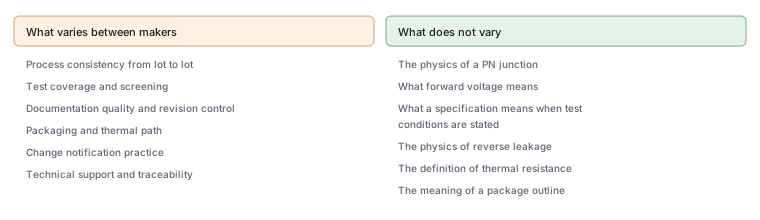
Ask an experienced engineer and you usually get a shrug followed by a question: which part, at what temperature, in what volume? That is not evasion. Brand is a proxy for a set of things that matter in specific situations, and knowing which situations those are is more useful than a general verdict in either direction.
Last updated:
The honest short answer
A brand name is a proxy for process control, documentation and traceability — not for electrical behaviour. Two devices that meet the same specification on the same test conditions really are interchangeable in that circuit, whatever is printed on the package. Brand becomes decisive when the specification is hard to verify, when a small process difference has financial consequences, or when someone else will ask you for paperwork later.
We should state our interest plainly: this article is published by a component manufacturer, including one whose brand appears in the article plan for this site. Everything below is written so that it can be checked against a datasheet rather than taken on trust, and the practical advice is deliberately the same for our parts as for anyone else’s.
When brand is nearly irrelevant
There are situations where paying for a name is close to wasted money. If you are prototyping a low-voltage circuit, running well inside every rating, at room temperature, and you can measure the device before you rely on it, then what matters is whether the part in your hand matches the datasheet — and that is a measurement, not a reputation.
The same holds for commodity parts within a well-defined family. A switching diode used at a fraction of its rated current, or a rectifier running at 50 Hz far below its thermal limit, is unlikely to reveal the differences between manufacturers, because the differences live in region the circuit never visits. Repair work is another case: if you can test the replacement and the load is gentle, a verified generic part is a reasonable choice.
When brand is a real risk factor
Move the operating point and the picture changes. High temperature is the classic example, because leakage, forward drop and thermal resistance all drift with temperature, and a part that measured perfectly on a bench at 25 °C may behave quite differently at 100 °C. High volume is another: a one per cent difference in yield is noise in a prototype and a budget item in a factory.
| Situation | Why the brand starts to matter |
|---|---|
| Safety-related or mains-connected equipment | Failures have consequences beyond cost, and a documented qualification trail is expected |
| Automotive or other regulated markets | Qualification, traceability and change notification are contractual requirements, not preferences |
| Operation near temperature or current limits | Small process differences show up at the edges, where the datasheet curves separate |
| Long-life or hard-to-service products | Field failure costs far more than the component price, so consistency is worth paying for |
| High-volume production | Lot-to-lot variation converts directly into test yield and rework |
| Parts that are widely counterfeited | Brand value attracts copying, so an authorised channel becomes the control point |
| Products with a warranty or audit obligation | Somebody will eventually ask for the documents behind the bill of materials |
What actually varies between makers
If the physics does not change, what does? Six things, and all of them are about control rather than cleverness. Process consistency determines how much a part drifts from batch to batch. Test coverage determines how much of that drift is screened out before shipment. Documentation quality determines whether an engineer can verify the part without a phone call. Packaging and thermal design determine how the device behaves once it is soldered down. Change notification determines whether you find out about a revision before or after it reaches your line. And technical support determines how quickly an unusual question gets an answer.
It is worth separating this from a question people often ask instead: how big is the foundry or the chip designer behind a brand? Scale in the processor and memory industry does not transfer to discrete devices, because the economics are different. A discrete part competes on margin, process consistency and package capability at very high volume, not on transistor density. A large logic foundry is not automatically a better source for a rectifier, and a small specialist is not automatically worse.
How to test a cheap part yourself
Some differences can be measured at a bench with modest equipment, and doing so is a good habit regardless of who made the part. Measure forward voltage at a known current and at two different temperatures; compare the numbers with the datasheet curve rather than the single typical figure. Measure reverse leakage at the rated voltage and note how fast it climbs with temperature. Load the part and watch how quickly its case temperature settles, because a package with a weaker thermal path will show it.
Be equally clear about what a bench test cannot do. It proves that the specific unit in front of you behaves a certain way on that day. It does not prove lot consistency, it does not prove reliability over thousands of thermal cycles, and it does not prove that the next delivery will match. Those are process questions, and process evidence comes from documents rather than from one good measurement.
Reading a datasheet instead of trusting a logo
The most useful skill in this whole subject is reading the conditions attached to a number. A part that claims a certain average current is telling you that under a stated case temperature, mounting condition and waveform it will carry that current. Change any of the three and the number changes. Two manufacturers can publish the same headline figure and behave quite differently in your circuit purely because their test conditions differ.
So the practical translation is this: a brand reduces the amount of verification work you have to do, and it never removes it. The datasheet is still the contract. If you want a worked method for reading one, our guide to finding and verifying official datasheets goes through it in order.
The same reasoning explains why second sourcing is treated as an engineering task rather than a purchasing shortcut. A second source is only a second source if the part has been checked against the same conditions and the qualification has been repeated; otherwise it is a new part with a familiar number. Teams that do this well keep the evidence next to the approved part, so the next engineer inherits the reasoning rather than just the conclusion.
What professionals actually do
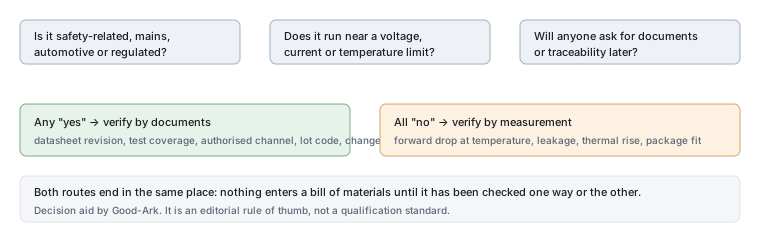
Nothing romantic. They maintain a list of approved sources per part number, so a purchase order cannot route to an unknown seller. They do incoming inspection at a level matched to the risk: a visual and documentation check for benign parts, electrical sampling for critical ones. They qualify second sources properly instead of treating a similar part number as a substitute. And they run change control, so a supplier revision does not silently enter a product that was qualified against the previous revision.
That structure explains the apparent contradiction at the top of this article. Professionals are relaxed about brand in low-risk positions and strict about it in high-risk ones, because the process around the part is what they are actually managing.
The standards behind those documents are public, which is useful when you want to check that a supplier’s claims can be assessed at all. Discrete device test methods come from JEDEC, quality management systems from ISO, and the assembly and workmanship expectations that apply once the part reaches a board from IPC. Restricted substances and their documentation fall under the EU RoHS Directive, chemical-substance duties under REACH as explained by ECHA, and sector-level reporting on the industry is published by the Semiconductor Industry Association.
There is also a practical reason to learn the difference between a specification and a measurement, and it shows up in datasheet vocabulary. Forward voltage, leakage and thermal resistance are defined quantities with stated test conditions, which is what makes two manufacturers comparable at all. When a supplier describes a part using numbers with no conditions attached, the comparison on offer is not a comparison; it is a preference with numbers next to it.
A beginner decision table
| Your situation | Reasonable approach |
|---|---|
| Learning, breadboard, low voltage | Any source is fine if you can measure the part. Treat the datasheet as the reference |
| Repairing a low-voltage consumer device | A verified equivalent from a reputable distributor; check package and ratings, not the logo |
| A prototype that must become a product | Fix the part and its source early, and record the revision you qualified |
| Production, benign conditions | Two qualified sources minimum, with agreed documentation and change notification |
| Production, harsh or regulated conditions | Qualified source with the required grade, traceability and paperwork before the first order |
FAQ
Is a cheap diode dangerous?
Not in itself. The risk is not the price but the unknown: an unverified part may be a different revision, a different die, a refurbished device or a re-marked lower grade. In a low-voltage circuit at a comfortable margin, that risk is small. In mains-connected or safety-related equipment it is not, because the failure mode can be a short circuit rather than a quiet degradation.
If two parts have the same part number, are they identical?
Not necessarily. Registered part numbers are widely second-sourced, and manufacturers may add their own suffixes for grade, package or packing. Two devices can share the same base number and differ in tested limits or in the die revision underneath. Compare the full orderable number and the datasheet revision, not the family name.
Does a bigger manufacturer guarantee a better part?
No, and scale in the logic-chip industry is a poor guide here. What matters for a discrete device is process consistency at the relevant package, the depth of test screening, the quality of documentation and the willingness to notify you about changes. Those are things you can ask about and receive evidence for, regardless of the size of the company.
How do I compare two brands fairly?
Compare on the same conditions: the same test current, the same case temperature, the same mounting condition and the same waveform. Then compare the documentation set and the channel. If a comparison uses different conditions for the two parts, it is not a comparison — it is a preference with numbers attached.
What if I cannot get any documents?
Then treat the parts as untraceable. In hobby work that may still be acceptable if you measure what you have. In any product that ships, leave them out, because there is nothing to fall back on when a batch behaves differently from the sample.
What to do next
Pick one part you buy regularly and write down the four things that decide whether it is interchangeable: voltage, current under temperature, package, and the document revision you qualified. Once that list exists, the brand question answers itself for that part — and the same four-line method transfers to the next one.
Good-Ark can supply the datasheet revision, test-condition explanation and qualification documentation for a part you are evaluating, so the comparison happens on stated conditions. Contact sales@goodark.com, or start from the product family learning centre.
This article is published by Good-Ark, a component manufacturer. It contains no comparison against named competitors and no claim that this brand is superior; the method is written so that readers can apply it to any supplier, including this one.
Continue through this engineering topic
For the complete selection, design, verification, and troubleshooting path, explore the Good-Ark Product and Sourcing Hub.
Recommended
 Why Do Diodes Get Hot? Conduction and Switching Losses ExplainedInfoStandard, Fast Recovery, and Schottky Diodes: What’s the Difference?Info
 What Is a Fast Recovery Diode? Understanding “Fast Recovery”Info
 What Is a Diode? A Beginner’s Guide to How It WorksInfo
 Automotive Semiconductor Report 2026: Chips Per Car Keep RisingKnowledge