Good-Ark Zener Diodes in Plain Language: The Part That Holds a Voltage Steady
A Good-Ark Zener diode is the one device where reverse breakdown is the point rather than the failure: how it holds a voltage, and how to test one.
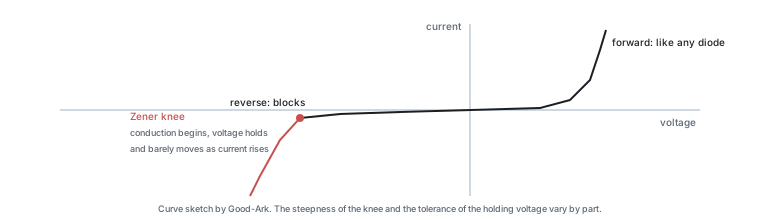
Almost every diode is destroyed if you exceed its reverse voltage rating. A Zener diode is the exception: it is built to spend its working life in exactly that region, holding the voltage across it at a chosen level while current flows through it. That single inversion is what makes it useful, and it is also why beginners find it confusing.
A voltage reference you can hold in your hand
A Zener diode is a two-terminal device that behaves like an ordinary diode in the forward direction and like a voltage clamp in the reverse direction. Apply enough reverse voltage and it begins to conduct heavily, but instead of failing, it holds the voltage close to a designed value, called the Zener voltage or breakdown voltage, across a wide range of currents.
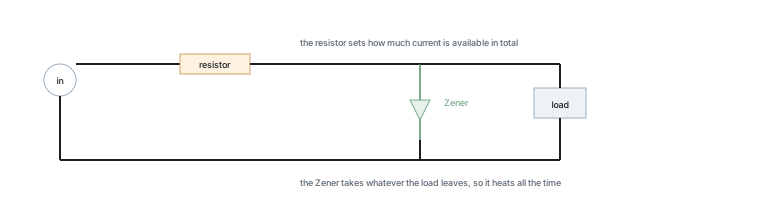
The analogy that works is a relief valve set to a specific pressure. Below that pressure the valve is shut and nothing passes; above it, the valve opens enough to hold the pressure near its setting, dumping whatever extra flow arrives. A Zener does the same with voltage, and like a relief valve it needs somewhere for the excess to go, which is why it always appears with a series resistor or a supply that can absorb the current.
Why reverse breakdown is useful here
Reverse breakdown in a semiconductor means the internal electric field has become strong enough to free charge carriers. In a rectifier that is a failure, because the device was never specified to survive it. In a Zener it is engineered: the junction is doped so that breakdown occurs at a predictable voltage and in a way that does not damage the crystal.
Two mechanisms produce that breakdown, and the distinction explains a quirk in the datasheets. Below roughly five or six volts, breakdown happens by a quantum-mechanical tunnelling effect and the voltage falls slightly as temperature rises. Above that range, it happens by avalanche multiplication and the voltage rises with temperature. In the region around five to six volts the two effects partly cancel, which is why Zeners in that band are the most stable and why the common reference voltages cluster there.
Where Zeners appear in everyday gear
They turn up wherever a simple, cheap voltage limit is needed. A gate protection circuit may use one to stop a transistor gate being driven above its maximum. An input stage may use one to clamp a signal before it reaches a sensitive measurement circuit. A power supply may use one as a crude reference or to generate a bias rail. Older equipment used them extensively as shunt regulators, and they are still common in circuits where a few per cent of accuracy is enough.
They are less common as the main regulator in modern designs, because a linear regulator or a switching converter holds a voltage far more accurately and does not waste the excess current as heat. The Zener survives where simplicity, size or cost matters more than efficiency.
Voltage and wattage: the two numbers
The Zener voltage is the level it holds, and it is specified as a range rather than a single value because manufacturing tolerance and temperature both move it. A five per cent tolerance on a 12 volt part means the actual voltage might be anywhere from about 11.4 to 12.6 volts, which is fine for a clamp and not fine for a measurement reference.
The wattage rating is the second number, and it is the one beginners underestimate. A Zener dissipates power continuously while it is regulating, and that power is the Zener voltage multiplied by the current through it. In a shunt regulator the Zener carries everything the load does not use, so its worst case is usually at the lightest load, when the entire current from the series resistor flows through the diode.
| Parameter | What it means | Why it matters |
|---|---|---|
| Zener voltage and tolerance | The level it holds, given as a range | A wide tolerance makes the part unsuitable as a reference |
| Test current | The current at which that voltage is specified | The voltage moves away from nominal at other currents |
| Dynamic resistance | How much the voltage changes as current changes | Determines how steady the voltage really is |
| Power dissipation | Continuous power the package can handle | Sets how much current the diode can absorb |
| Temperature coefficient | How the voltage drifts with heat | Smallest near five to six volts, larger at the extremes |
What happens when it gets too hot
Because a Zener dissipates power continuously, it is a small heater by design, and its limits are thermal rather than electrical. Exceed the power rating and the junction temperature rises beyond what the package can shed; the failure is usually a short circuit, which then removes the regulation and may load the supply.
The thermal path is therefore part of the design. A small glass-bodied part has a modest power rating and depends on its leads for cooling; a metal-tab package has a much higher rating but only if the tab is actually connected to copper or a heatsink. Choosing a part with a higher power rating and mounting it with no copper under it achieves nothing, which is a common mistake when a circuit keeps failing in the same place.
Zener versus TVS in one table
The two devices share a mechanism and differ in what they are specified to do. The short version is in the table; the full comparison, including which belongs where in a circuit, is in our article on choosing between the two.
| Property | Zener diode | TVS diode |
|---|---|---|
| Designed to conduct | Continuously, in regulation | Briefly, during a surge |
| Specified mainly by | Voltage tolerance and continuous power | Peak pulse power and clamping voltage |
| Typical position | A reference or a bias node | A connector or a cable entry |
| Failure mode | Short circuit after thermal overload | Short circuit after an event beyond its rating |
External references are useful when checking a Zener’s behaviour or its standards context. The device is described under Zener diodes, the breakdown mechanisms under avalanche breakdown, and the alternative voltage-reference approach under voltage references. Component test methods come from JEDEC, assembly expectations from IPC, and sector-level reporting from the Semiconductor Industry Association. Device and assembly background is published by ISO, NIST and IEC.
How repairers test one
In circuit, a Zener looks like a diode that reads lower in the reverse direction than an ordinary one, and that reading is unreliable because other components are in parallel with it. The useful test is out of circuit.
With the part removed, measure in the forward direction first: it should read like a normal diode, with a drop of around 0.7 volts. Then measure in reverse: a good Zener in the five to thirty volt range will read as no conduction on a meter whose diode-mode test voltage is below the Zener voltage, which most handheld meters are. A reading in reverse that looks like a normal diode junction suggests a shorted part; no reading in either direction suggests an open one. To actually measure the Zener voltage you need a supply above the rated voltage and a series resistor to limit current, which is a bench procedure rather than a repair one.
Two cautions belong with that. Substituting a Zener with a different voltage will not do: the whole function is the value. And in a shunt regulator, a Zener that measures correctly out of circuit can still be the wrong part for the position if its power rating is too low, which is why repeat failures in the same place usually point at the design rather than the component.
FAQ
What is a Zener diode in a simple way?
It is a diode that is designed to conduct in the reverse direction at a chosen voltage and to hold that voltage while it does. An ordinary diode blocks in reverse until it is destroyed; a Zener blocks in reverse until its rated voltage, then conducts steadily and keeps the voltage near that level. That makes it a cheap way to create a reference or a clamp.
How do I choose the right Zener voltage?
From the level you actually need your circuit to hold, with two adjustments. Allow for the tolerance, because a five per cent part at twelve volts may sit anywhere in a wide band. And allow for temperature, since the Zener voltage drifts with heat — least in the five to six volt region and more at higher voltages. If you need accuracy, the Zener is the wrong device and a dedicated reference is the right one.
Why do Zeners have a maximum current as well as a voltage?
Because they dissipate power continuously while regulating, and the power is voltage multiplied by current. The package can only shed so much heat, so there is a current above which the junction temperature exceeds its rating. In a shunt regulator this matters most at light load, when the full current from the series resistor flows through the diode rather than into the load.
Can a Zener diode handle AC voltage?
It will conduct in one direction on one half of the cycle and in its Zener region on the other, so it will clamp both halves — but at different voltages, because the forward drop is around 0.7 volts while the Zener voltage is whatever it was specified at. That asymmetry makes it unsuitable for symmetric AC clamping. Two Zeners in series, facing opposite directions, produce a symmetric clamp, which is one of the ways a TVS device is built internally.
Where can I see the Zener families?
The device classes are grouped in the product family learning centre, and the practical build that uses one is in our tutorial on building a simple Zener regulator.
What to do next
If you are choosing a Zener, write down the voltage you need to hold, the current it will carry in the worst case and the accuracy you actually require. If the accuracy requirement is a few per cent, a Zener is fine; if it is a fraction of a per cent, it is not, and knowing that early saves a redesign later. The hands-on version of the same subject is in our beginner regulator tutorial.
Tell Good-Ark the voltage, the worst-case current and the accuracy you need, and we can point to the family and power class that hold it without overheating.
Email sales@goodark.com, or start from the product family learning centre.
This article is published by Good-Ark, a manufacturer of Zener and other discrete devices. Voltage tolerances, temperature behaviour and power ratings vary by part; the figures that apply to a specific device come from its current official datasheet.
Recommended
 Why Do Diodes Get Hot? Conduction and Switching Losses ExplainedInfoStandard, Fast Recovery, and Schottky Diodes: What’s the Difference?Info
 What Is a Fast Recovery Diode? Understanding “Fast Recovery”Info
 What Is a Diode? A Beginner’s Guide to How It WorksInfo
 Automotive Semiconductor Report 2026: Chips Per Car Keep RisingKnowledge