Switch Mode Power Supply: Semiconductor Selection Guide for B2B Buyers
Updated: October 28, 2026 B2B buyers supporting a switch mode power supply program are rarely asked to redesign the converter—they are asked…
Updated: October 28, 2026
B2B buyers supporting a switch mode power supply program are rarely asked to redesign the converter—they are asked to keep the semiconductor BOM available, comparable, and honest to the approved ratings. This guide is a semiconductor selection and sourcing checklist for SMPS boards and modules, distinct from topology tutorials and distinct from full project-validation lab procedures.
What buyers actually own in an SMPS semiconductor shortlist
Buyers own package, second-source, lead-time, and datasheet-match risk for MOSFETs, rectifiers, bridges, and protection diodes on the approved schematic.
Engineering freezes the circuit positions; purchasing freezes which catalog lines may fill those positions without a redesign. Confusion starts when a distributor substitute shares a similar title but not the same voltage, thermal, or recovery conditions used in approval.
Complete AC-DC “box” selection guides—such as Avnet’s SMPS design-engineer guide—help when you buy a finished supply. Here the deliverable is a discrete or module semiconductor line that must drop into a customer PCB or power stage. For a basic definition of switch-mode conversion, see what is a switching power supply.
Separate the BOM into buyer-relevant semiconductor classes
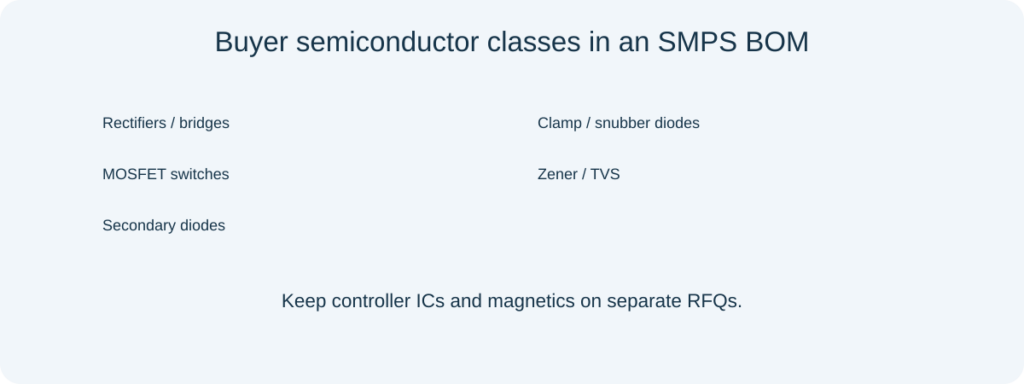
Group line items so RFQs and AVL notes stay specific:
- Input rectifiers and bridge modules
- Primary or synchronous switches (typically Si MOSFETs in many cost-sensitive designs)
- Secondary rectifiers (Schottky, ultrafast, or other as specified)
- Clamp, snubber, and freewheel diodes
- Zener and TVS protection devices
Controller ICs, magnetics, and aluminum capacitors matter, but they follow different qualification paths. Do not mix “SMPS semiconductor” language with a PSU-module matrix meant for choosing an entire brick. Digi-Key’s SMPS matrix webinar materials, for example, orient around finding complete supplies and controllers; use them only if that is truly the purchase category.

Datasheet match points purchasing should refuse to skip
Ask engineering for the approved condition set, then require every alternate to show the same conditions on paper:
| Device class | Must-match fields | Common false friends |
|---|---|---|
| MOSFET | VDSS, RDS(on) at stated VGS and temperature, package, Qg class | Same voltage class, much higher Qg or weaker VGS rating |
| Rectifier / Schottky | VR, IF(AV), VF/IR temperature points, surge | Similar VF at 25 °C with much higher hot leakage |
| Bridge module | VRRM, IO, mounting, pinout, isolation notes | Same outline, different terminal map or thermal pad |
| TVS / Zener | Working standoff / VZ bin, power, unidirectional vs bidirectional | Close voltage with different pulse energy capability |
Efficiency primers such as Analog Devices’ switch-mode efficiency article explain why mismatched switching and conduction parameters show up as heat. Buyers do not recalculate every loss term, but they can refuse alternates that lack comparable tables.
How should a B2B buyer structure an SMPS semiconductor RFQ?
Lead with the circuit role, approved ratings, package, and annual volume—not only a competitor’s orderable part number.
Include the customer’s end-market constraints (industrial, appliance, automotive program, etc.) as documentation requirements, not as marketing adjectives. Request lead time, MOQ, and whether the line is active or scheduled for change notices.
When the approved part is a bridge or rectifier module, attach the mechanical drawing and torque/heatsink notes. When it is a Schottky or ultrafast diode, attach the hot VF/IR comparison points engineering used. Cross-link the rectifier selection guide and Schottky practical selection article so suppliers see the same language.
Second-source rules that protect the program
A second source is not “any diode in the same package.” Define whether form-fit-function requires identical pinout, land pattern, and thermal interface. Require a written delta review covering the match points table above, plus any AEC or industry document the program already filed—without assuming every catalog line carries the same certificates.
For automotive-flavored programs, ask for the exact evidence package the OEM already accepted (PPAP level, qualification report set). Do not invent compliance in the RFQ. If only industrial documentation exists, say so and let engineering decide whether a redesign or requalification is needed.
Topology notes buyers only need at a shallow level
Topology comparisons (buck, boost, flyback, forward, half-bridge) change which semiconductor sees continuous conduction versus pulsed stress. Würth and similar application blogs summarize those families for engineers. Buyers need only enough awareness to ask: “Is this alternate intended for the same stage and switching class?” If the answer is unclear, stop and return the question to design.
Anzer’s multi-step SMPS design outline shows how many decisions sit upstream of purchasing. Use that as a reminder that early BOM freezes should wait until voltage and thermal budgets exist—not as a mandate for buyers to run the full seventeen steps themselves.

Lead time, PCN, and lifecycle signals
Ask suppliers for lifecycle status and how product change notices are distributed. A low quote on a part already marked not-for-new-design can create a shortage six months later. Prefer dual-sourced packages that share a land pattern when the program volume justifies the AVL work.
For global procurement, clarify Incoterms, reel vs tube packaging, dry-pack needs for moisture-sensitive packages, and whether date-code restrictions exist on the OEM drawing. These logistics items do not appear on a topology blog post, but they decide whether the semiconductor shortlist is actually purchasable.
Cost-down without silent electrical drift
Cost-down requests should list the parameters that may not move (voltage, package, hot leakage class, gate charge class) and the parameters open to negotiation (brand, reel size, plating). Silent swaps that only preserve the orderable description string are a common root cause of field thermal returns.
If a supplier proposes a “drop-in” with a different die generation, require the same match-point table plus a brief engineering acknowledgment. Link that rule to the program’s quality procedure so purchasing is not left to invent technical judgment under schedule pressure.
Coordination with quality and engineering change control
Route semiconductor alternates through the same ECO/ECR path used for magnetics or controllers. A purchasing email thread is not a controlled change record. Attach the match-point table and any bench deltas engineering already ran for related SMPS validation workstreams.
Where Good-Ark appears in a sourcing conversation
Good-Ark publicly positions discrete lines—including rectifiers, Schottky products, Zener diodes, and bridge-related offerings—on its product pages, and lists SMPS among application contexts. For buyers, that means datasheets and package information can be checked against the match-point table; it does not mean every SMPS slot is pre-qualified for every end market. Confirm certificates and ratings per line item.
Frequently asked questions
Is a distributor “equivalent” MOSFET safe to buy without engineering?
No. Voltage class similarity is not enough. Gate-drive and thermal conditions must match the approved design or the change needs a formal review.
Should buyers specify SiC by default for new SMPS designs?
Only when engineering’s voltage, frequency, and loss budget require it. Many SMPS stages still use silicon MOSFETs and silicon rectifiers appropriately.
What belongs in an AVL note for a Schottky rectifier?
VR, current rating, package, and the hot VF/IR points used in approval, plus any second-source rule the program adopted.
How is this different from validating an SMPS on the bench?
This page covers sourcing and datasheet match discipline. Bench validation of efficiency, thermal, and EMI is a separate engineering workflow.
Continue through this engineering topic
- What is a switching power supply?
- How to choose the right power rectifier
- Schottky practical selection
- High-voltage MOSFET design checks
Topic hub: What is a switching power supply — related semiconductor and rectifier guides in this cluster.
Recommended
 How to Test a Diode in Circuit: Readings You Can and Cannot TrustKnowledge
 How to Check Diode Positive and Negative When the Band Is WornKnowledge
 Diode Symbol Explained: Schematic Marks vs the Package You HoldKnowledgeGaN Traction Inverters Reach Vehicle Demonstrators: Status Check vs SiC MainstreamKnowledgeSiC Wafer Price Drops Explained: When Silicon Carbide Beats Silicon for Real DesignsKnowledge
 Diode Polarity: Anode, Cathode, Stripe Marks, and How Not to Reverse ItKnowledge