Good-Ark — discrete power semiconductors: rectifiers, Schottky, TVS, MOSFETs, SiC and IGBT
Request a Quote

What Is the GSD Series?
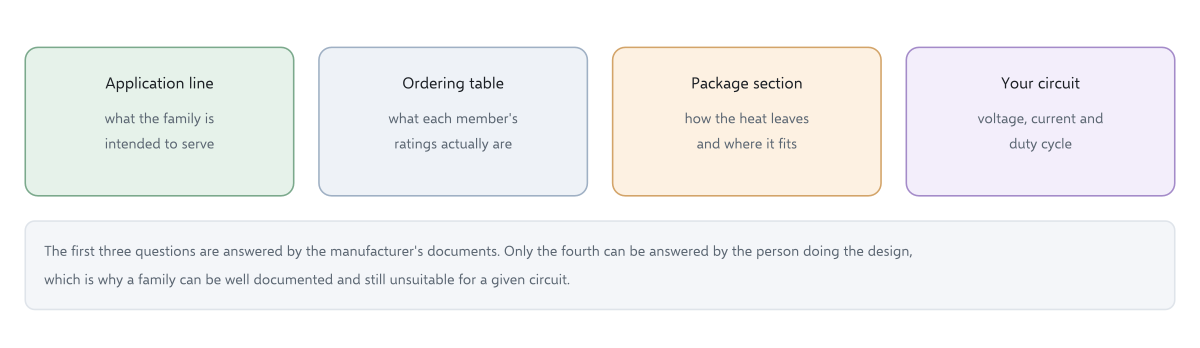
The GSD Series is a family of compact, high-voltage, small-signal switching diodes designed for fast signal steering, voltage isolation, and switching applications. Devices such as dual in-series and common-anode variants combine up to 300 V reverse-voltage capability, low leakage, fast recovery, and space-saving SOT-23 packaging for industrial, consumer, automotive, and power-control circuit designs. Last updated: … Read more
What Is the GSMDJ Series Used For?

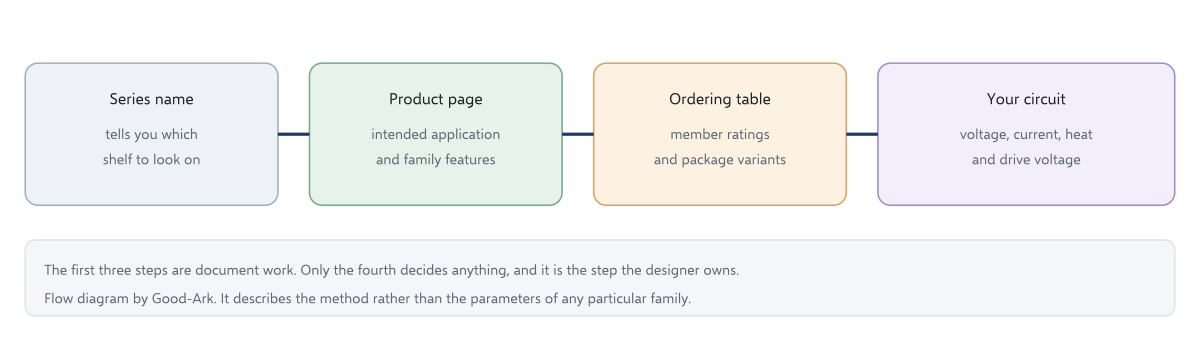
The GSMDJ Series is designed for surge and transient-voltage protection in power and electronic circuits. It helps clamp harmful voltage spikes before they reach sensitive components, supporting dependable operation in industrial equipment, power supplies, automotive electronics, communications hardware, and renewable-energy systems. Correct selection depends on working voltage, clamping voltage, surge capability, package, polarity, and circuit … Read more

What Is a Low Leakage Small Signal Diode?

What Is a Low Leakage Small Signal Diode?

A low leakage small signal diode is a low-current semiconductor device engineered to minimize reverse current while switching, steering, clamping, or protecting sensitive signals. It helps preserve accuracy in battery-powered, high-impedance, analog, and fast digital circuits by reducing unwanted current flow, voltage drift, standby drain, and measurement error. Last updated: October 11, 2026 Key Takeaways … Read more

Discrete Power Devices: Types, Examples and Why They Matter

Updated: October 28, 2026 Discrete power devices are semiconductor components used to switch, rectify or protect the flow of electrical power. Examples include power diodes, MOSFETs, IGBTs and thyristors. They work alongside controller chips and passive components in chargers, motor drives and power supplies, where their losses and operating limits affect heat, efficiency and reliability. … Read more

How Do You Choose a MOSFET for a Switching Power Supply?

How Do You Choose a MOSFET for a Switching Power Supply?

Updated: October 27, 2026 Choose a MOSFET for a switching supply from bus voltage, current waveform, switching frequency, gate-drive voltage, and package thermal path—not from the lowest 25 °C RDS(on) alone. Map voltage class, conduction vs switching loss, gate charge, and package limits. Broader map: power MOSFET selection guide. Polarity: N-channel vs P-channel. Secondary diodes: SMPS … Read more

How Do You Design an EMI Filter?

How Do You Design an EMI Filter?

Updated: November 11, 2026 A switching power supply EMI filter design reduces conducted noise, improves EMC compliance, and protects the power line from switching spikes. The best design starts by identifying whether the noise is differential mode or common mode, then choosing the right LC, pi, or common-mode choke network, and finally validating the result … Read more

SiC Semiconductor Selection: What B2B Buyers Should Verify Before Design-In

SiC Semiconductor Selection: What B2B Buyers Should Verify Before Design-In

Silicon carbide changes the loss equation in one specific place, and that is where a buyer should look first. A 650 V, 10 A SiC Schottky diode is specified with no reverse recovery charge across the application current range, switching behaviour that does not move with temperature, a 175 °C junction limit and a high forward surge capability … Read more

Good-Ark Semiconductor: A Practical Guide to Sourcing Discrete Devices

Updated: October 26, 2026 Good-Ark (Suzhou Good-Ark Electronics) is a listed discrete-device manufacturer you evaluate with the same sourcing discipline as any other power-semiconductor brand: exact MPNs, authorized channels, data sheets, and qualification scope—not forum rumors alone. This practical guide explains how to read Good-Ark discrete offerings for power electronics buyers and engineers, how to … Read more

Schottky Barrier Rectifier Diode: Practical Selection for Efficient Power Design

Schottky Barrier Rectifier Diode: Practical Selection for Efficient Power Design

Updated: October 28, 2026 Selecting a Schottky barrier rectifier is a leakage-and-thermal decision, not a forward-voltage shopping exercise. Two parts from one vendor make the point: a 30 V, 1 A rectifier with a 0.26 V typical forward drop at 1 A, and a 100 V, dual 10 A rectifier with a 0.59 V typical drop at 10 A (both at a 125 °C … Read more

What Is a General Purpose PNP Transistor?

What Is a General Purpose PNP Transistor?

Updated: October 28, 2026 A general-purpose PNP transistor mirrors the NPN structure with opposite polarities. It is common for high-side switches and complementary amplifier stages when currents stay inside small-signal or modest power ratings. Key Takeaways A general purpose PNP transistor is a bipolar junction transistor used for switching and amplification, especially on the high … Read more

What Is a Pre-Biased Transistor?

Updated: October 27, 2026 A pre-biased (digital/BRT) transistor integrates base resistors in one package so a logic-level signal can drive it without external bias resistors. Below is a practical definition, the ratings that matter, and where this part sits among related guides: What Is a General Purpose Npn Transistor, Checking an Npn Transistor With a … Read more

Need a part number checked against your design?

Send the topology, current and voltage class. Good-Ark sales and application engineering will confirm the closest device, package and qualification status.

Copyright Suzhou Good-Ark Electronics Co., Ltd. All Rights Reserved