Why Lead-Free Solder Changed Electronics Manufacturing
Why lead free solder changed manufacturing: removing lead raised every process temperature, created a new reliability question, and changed the repair bench.
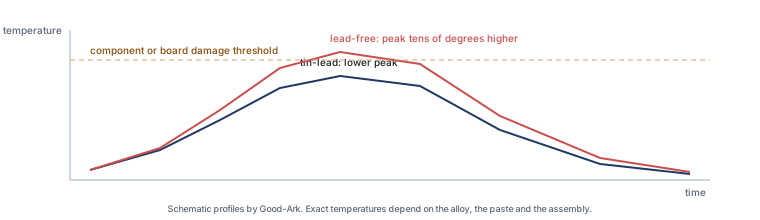
Soldering was one of the parts of electronics that had not changed much in decades, and lead was the reason. Removing lead raised the temperatures every assembly has to survive and introduced a reliability question that had been dormant for most of a century.
Why lead was in solder at all
Tin-lead solder is close to ideal for its purpose. The common eutectic alloy melts at a modest temperature, flows well when molten, wets cleanly to copper, forms a joint that tolerates vibration and thermal cycling, and is forgiving of slightly imperfect process conditions. It was also cheap and had been refined over a very long period.
The analogy that fits is a glue that happens to have the perfect working time, sets reliably on every surface and tolerates being applied slightly wrong. Replacing it with something that flows differently, sets at a higher temperature and behaves differently on contaminated surfaces is a far larger change than the word “substitution” suggests.
What changed on 1 July 2006
That is the date on which the European restriction on hazardous substances took effect for most electrical and electronic equipment, and lead in solder was the substance with the widest application. The rule applies to equipment placed on the European market, and its effect spread worldwide for a commercial reason: manufacturers building one design for global sale tend to build it to the strictest rule they face rather than maintaining separate production lines.
It is worth being precise about scope, because the question of legality comes up often. The European restriction is not a worldwide ban, and other jurisdictions have their own instruments with their own scopes. Certain product categories and certain high-reliability applications have exemptions, and sectors with unusual reliability requirements have moved more slowly. So the accurate statement is that lead-free became the default for most commercial electronics because of a European rule, rather than because lead was banned everywhere for every purpose.
Higher temperatures, new problems
The commonly used lead-free alloys melt somewhere around two hundred and twenty degrees Celsius, against about a hundred and eighty-three for the tin-lead eutectic they replaced. That difference pushes peak reflow temperatures up by roughly thirty to forty degrees, and the consequences propagate through the whole assembly.
Components must survive the higher temperature, which changed moisture sensitivity classifications and handling requirements for plastic packages. Boards must tolerate it, which affected substrate choice for thick or large assemblies. Flux chemistry changed, because formulations that suited leaded solder did not always perform as well at the higher temperature. And the process window narrowed, because a greater temperature rise means less margin between forming a good joint and damaging something. Exact figures depend on the paste and the assembly; the direction of the change does not.
| Area | What changed | Who felt it first |
|---|---|---|
| Process temperature | Peak reflow temperatures rose by tens of degrees | Assembly houses and component makers |
| Component ratings | Parts had to be rated for the higher profile | Package designers and buyers |
| Flux chemistry | Different formulations and cleaning requirements | Process engineers |
| Finish choices | Tin-rich platings replaced tin-lead | Component and connector makers |
| Rework | Higher temperatures and less forgiving windows | Repair and rework technicians |
| Documentation | Composition had to be evidenced rather than assumed | Everyone in the supply chain |
Tin whiskers and reliability
The change in plating brought a phenomenon back into mainstream reliability engineering. Tin-rich finishes can grow thin metallic filaments, known as whiskers, from the surface over months or years. A whisker is conductive, and one that bridges two adjacent contacts creates a short circuit that appears without warning and disappears when the board is disturbed.
The industry responded with mitigations rather than with a return to lead. Matte tin finishes rather than bright, a nickel underlayer beneath the tin, and alloying additions all reduce the tendency, and the subject became a routine part of component qualification in sectors where a stray short is unacceptable. For most consumer electronics the risk is managed and accepted. For aerospace and similar applications it remains a live consideration, and it is one reason those sectors retain exemptions.
What repairers must change
Three practical changes matter at a bench. Iron temperatures typically rise, because a lead-free joint needs more heat to form and to reflow. Tip life shortens, because higher temperatures and more aggressive fluxes wear them faster. And mixing is a consideration: adding leaded solder to a lead-free joint lowers its melting point and can make the joint easier to work, at the cost of changing its composition and potentially its compliance status.
The last point is a judgement rather than a rule. For a repair to a product that will not be sold into a regulated market, mixing is a common and pragmatic technique. For anything that must remain compliant, it is not an option, and the joint has to be reworked with lead-free materials throughout.
How hobbyists are affected
Less than the regulations suggest. Leaded solder remains available in most places for hobby and repair use, and it is easier to work with: it flows at a lower temperature and produces shinier, more forgiving joints. Many hobbyists use it deliberately and understand the ventilation requirement that comes with it.
What has changed for hobbyists is the material they are working on rather than the material they work with. Boards and components are now built for lead-free processes, which means higher temperature tolerance and finishes that behave slightly differently when reworked. That is why a hobbyist’s usual solder sometimes seems to want more heat than it used to: the joint is lead-free even if the solder added is not.
What came next: low-temperature solders
The most recent development runs in the opposite direction. Alloys based on tin and bismuth melt well below the lead-free standard, and they are being adopted for assemblies that cannot tolerate the higher profile: thin boards that would warp, components with limited thermal ratings, and products where the energy cost of a hotter process matters.
The trade is mechanical rather than thermal. Low-temperature joints have different fatigue behaviour, and their suitability depends on the application, which is why the choice is becoming a design decision rather than a default. After two decades of moving to a hotter process, part of the industry is now moving to a cooler one for reasons that have nothing to do with regulation.
External references are useful for the regulatory and materials background. The restriction itself is published by the European Commission, which describes the RoHS Directive and its exemptions. Materials and assembly expectations come from IPC, component test methods from JEDEC, quality management requirements from ISO, and general materials background from our article on solder. Regulatory and quality background is published by ECHA and NIST.

Summary
Lead was removed because of a European restriction on substances in electrical equipment, and it was the most consequential substance on that list because it was in the solder holding everything together. The replacement alloys melt higher, which raised process temperatures and narrowed the process window, and it brought a plating-related reliability question back into mainstream engineering in the form of tin whiskers. Two decades later the industry is experimenting with lower-temperature alloys for reasons of its own, which is a reminder that process decisions outlive the rules that prompted them.
FAQ
Is it better to use lead-free solder?
It depends on what you are doing. Lead-free is required for products placed on the European market and is the default in commercial manufacturing. For hobby and repair work, leaded solder is easier to use, flows at a lower temperature and produces more forgiving joints, and it is still available in most places for those purposes. Ventilation matters either way, because the flux is a respiratory consideration regardless of the alloy.
Is lead solder banned in the United States?
There is no single federal restriction equivalent to the European one, and the position is a patchwork: some applications and some states have their own requirements, some sectors rely on exemptions, and in practice most commercial electronics are built lead-free because the same products are sold worldwide. The accurate answer is that lead-free became the commercial default through the European rule rather than through a general ban.
Why is lead no longer used in solder?
Because lead is a restricted substance under the European rule on hazardous substances in electrical and electronic equipment, on the reasoning that removing it from products prevents it escaping during disposal and informal recycling. Solder was the largest single use of lead in electronics, so it was the change that made the rule consequential.
Do I need special flux for lead-free solder?
Not always, but often. Many fluxes are formulated for a specific temperature range and alloy, and one that works well with leaded solder at a lower temperature may not perform as well at a lead-free peak. Most solder wire and paste sold for lead-free work is formulated with a compatible flux, which is why the practical advice is to use a matched combination rather than buying flux separately.
What are tin whiskers and should I worry about them?
They are thin metallic filaments that can grow from tin-rich platings over time and bridge adjacent contacts, creating an intermittent short circuit. The industry uses matte tin finishes, nickel underlayers and alloying additions to reduce the tendency, so the risk in consumer electronics is managed. In applications where a stray short is unacceptable it remains a live reliability consideration, and it is part of why those sectors have retained exemptions.
What to do next
If you are working on modern boards, expect the joints to need more heat than older ones did and expect the flux behaviour to differ. If you are specifying an assembly, the process window is the thing to check first, because the higher peak and the narrower margin between a good joint and damage is where most lead-free problems come from. The compliance side of the same subject is covered in our article on what RoHS is.
Tell Good-Ark the reflow profile and the assembly constraints, and we can confirm which package and finish options suit the process.
Email sales@goodark.com, or start from the quality knowledge section.
This article is published by Good-Ark, a manufacturer of discrete semiconductor devices. Melting and process temperatures are approximate values for the common alloys; the profile a specific assembly requires comes from its own process engineering.
Recommended
 Why Do Diodes Get Hot? Conduction and Switching Losses ExplainedInfoStandard, Fast Recovery, and Schottky Diodes: What’s the Difference?Info
 What Is a Fast Recovery Diode? Understanding “Fast Recovery”Info
 What Is a Diode? A Beginner’s Guide to How It WorksInfo
 Automotive Semiconductor Report 2026: Chips Per Car Keep RisingKnowledge