RoHS vs REACH: Two Compliance Words Everyone Mixes Up
Good-Ark REACH and RoHS are not alternatives: one restricts substances in electrical equipment, the other regulates chemicals. Which one an order needs.
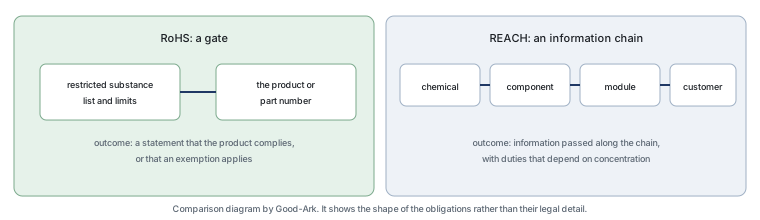
RoHS and REACH are two European regulations that appear side by side on almost every component declaration, and they are not two versions of the same thing. One restricts specific substances in electrical equipment; the other regulates chemicals generally, including those used in any product. Understanding the difference answers the practical question of which one your order needs.
Two regulations, two goals
RoHS is about what may be present in electrical and electronic equipment, and it works by banning a short list of substances above defined limits. REACH is about chemicals as such, across every industry, and it works by requiring registration, authorisation and communication rather than by banning most things outright.
The analogy that fits is two rules about food. One says a particular ingredient may not be in a particular product above a threshold; the other says that anything in the product must be declared and that some ingredients need approval. Both affect what is on the shelf, and neither substitutes for the other.
RoHS in one paragraph
RoHS restricts lead, mercury, cadmium, hexavalent chromium, two classes of brominated flame retardants and four phthalates in electrical and electronic equipment, with exemptions where no substitute is technically available. Compliance is demonstrated by a declaration against the restriction, covering a defined scope of products or part numbers. Its focus is a closed list and a product category.
REACH in one paragraph
REACH covers chemicals manufactured, imported or used in the European Union, and its obligations apply across all product types rather than to electronics specifically. The part that matters most to component buyers is the candidate list of substances of very high concern: if an article contains one of those above a defined concentration, the supplier has a duty to communicate that information to the customer, and the customer may in turn have duties of their own. There is also provision for authorisation for certain uses.
The key difference in practice is the direction of the obligation. RoHS asks whether a banned substance is present. REACH asks whether a listed substance is present and, if so, whether it has been communicated. One is a prohibition; the other is largely a disclosure duty.
Why the confusion happens
Four reasons. They appear together on the same declaration, which makes them look like two parts of one requirement. Both are European. Both are usually satisfied by the same document, so buyers stop distinguishing them. And both are often referred to in the same breath as “compliance”, which is a word that carries no information on its own.
The practical harm is small for a buyer who just needs the documents, and larger for someone designing a compliance programme, because the two impose different obligations at different points in the supply chain. A component supplier’s REACH duty may be to communicate, while its customer’s duty may be to pass that communication further down or to notify a regulator.
| Dimension | RoHS | REACH |
|---|---|---|
| What it covers | Electrical and electronic equipment | Chemicals across all industries |
| Mechanism | A short list of restricted substances with limits | Registration, authorisation and disclosure across a much larger list |
| Typical supplier obligation | Declare that the product complies | Communicate the presence of listed substances above the threshold |
| Typical buyer obligation | Keep the declaration and pass it on when asked | Pass the information down the chain, and consider notification duties |
| Exemptions | Yes, where no substitute exists | Authorisation route for certain uses |
| What a declaration looks like | A statement of compliance against the restriction | A statement, often a declaration of non-presence of listed substances |
The SVHC list and threshold
The candidate list of substances of very high concern is maintained and updated over time, which is why a declaration that was accurate last year may need reissuing. The relevant concentration threshold for the disclosure duty is a small percentage by weight in an article, and the technical difficulty lies in establishing that figure with confidence when a component is assembled from several materials.
Two practical consequences follow. A REACH statement should carry a date, because the list it was assessed against changes. And the answer to “does my product contain a listed substance” is a supply-chain question rather than a materials-science one, because the information has to come from each supplier in turn.
What a supplier must provide
For RoHS, a declaration of compliance covering the part numbers being supplied, dated and issued by the manufacturer. For REACH, a statement about the presence of listed substances in the article, ideally with the concentration bands used, also dated and issued by the manufacturer or an authorised representative.
Both documents should name the scope. A statement that covers a product family is a starting point; for a regulated purchase you want the specific part number, because that is what will be shipped and what an auditor will ask about. Where a supplier can only provide a family-level statement, that limitation is worth recording with the order.
Which one applies to your order
Both, if the product is placed on the European market. They are not alternatives, and a supplier who offers one instead of the other has answered a different question from the one you asked.
The practical checklist for a purchase is therefore short: a RoHS declaration covering the part number, a REACH statement covering the same part number, both dated recently enough to reflect current composition and current chemical lists, and both from the manufacturer rather than from a reseller. Anything less is a document gap that will surface at the wrong moment.
How the two are asked for in practice
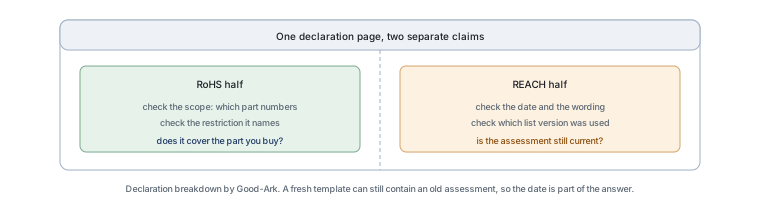
Most component makers answer both questions on one page, which is convenient and slightly misleading. The RoHS half is a statement of compliance against a list; the REACH half is a statement about the presence of substances on a list that is revised. Those two halves age differently, so a single document can be current for one purpose and out of date for the other.
The habit that avoids the problem is to treat the page as two documents and check each on its own terms. For the compliance half, check the scope and the restriction it names. For the chemical half, check the date and which version of the list was used. If one half is stale, ask for that half to be reissued rather than accepting a fresh-looking template with an old assessment behind it.
There is also a wording trap. A statement that a product “contains no SVHC above 0.1 per cent” is not the same as a statement that it contains none at all, and it is not the same as a statement that no SVHC is present. The threshold, the units and the concentration basis all change what has been claimed, so the safe approach is to ask what was assessed and how, rather than to accept a sentence that sounds stronger than the test behind it.
None of this requires a legal background. It requires reading two lists of questions and checking whether the answer addresses the one you asked. A supplier with a working compliance process will recognise the questions immediately, because they are the same ones its own customers ask.
External references are the right place to take this further, because both regimes change. The European Commission publishes the RoHS Directive and its exemptions, and the European Chemicals Agency publishes and explains REACH and the candidate list. Component test methods come from JEDEC, materials and assembly expectations from IPC, and quality management requirements from ISO. Regulatory and quality background is published by NIST.
Side-by-side table
| If your question is… | The regulation that answers it | What you should ask for |
|---|---|---|
| Is a banned substance present above the limit? | RoHS | A compliance declaration naming your part number |
| Does the part contain a listed chemical? | REACH | A statement covering the candidate list, with a date |
| Can I sell this into Europe at all? | Both | Both documents, covering the same scope |
| My customer sent a compliance questionnaire | Usually both | The two documents, plus any customer-specific format they require |
| Has anything changed since last year? | Both, and especially REACH | Current-dated versions, because the lists and exemptions move |
FAQ
What is the difference between RoHS and REACH in one sentence?
RoHS bans a short list of substances in electrical and electronic equipment, while REACH regulates chemicals across all industries and, for articles, mainly requires that the presence of substances of very high concern above a threshold be communicated to customers. One is a prohibition with exceptions; the other is largely a disclosure duty.
Do I need both, or is one enough?
For equipment placed on the European market you need both, because they impose different obligations and neither satisfies the other. A supplier offering one instead of the other has answered a different question, and the gap will typically surface when a customer’s compliance questionnaire arrives.
What is an SVHC, and why does it matter to a component buyer?
A substance of very high concern is one that has been added to a candidate list maintained under REACH. If an article contains one above the relevant concentration, the supplier has a duty to communicate that to the customer, which is why components come with statements about those substances rather than with a simple pass or fail. The list changes over time, which is why the statements carry dates.
Why do searches for this topic return irrelevant results?
Because one of the words involved is also the name of other things, including a video game, so a search can drift into an entirely different subject. The same thing happens with other short technical words. If a result looks as though it belongs to a different domain, it does — and the useful sources for this subject are the two regulators rather than general search results.
Does a distributor’s compliance statement count?
It is a useful indication and it is not the same as the manufacturer’s declaration. For a regulated purchase, the document that carries weight is the one issued by the organisation that controls the composition of the part and can be held to the claim. A distributor’s copy can lose detail, scope or date information in the process of being passed along.
What to do next
Before your next regulated purchase, ask for both documents and check that each names the part number you are buying and carries a recent date. That request takes one email and answers the question a compliance questionnaire will eventually ask. The adjacent manufacturing consequence of the substance restrictions is covered in our article on why lead-free solder changed manufacturing.
Ask Good-Ark which declarations apply to a specific part number, and for the versions that reflect the composition currently being shipped.
Email sales@goodark.com, or start from the quality knowledge section.
This article is published by Good-Ark, a manufacturer of discrete semiconductor devices. It describes two regulatory frameworks at a summary level; thresholds, scope, exemptions and the current substance lists belong to the official texts, and no product-specific compliance claim is made here.
Recommended
 Why Do Diodes Get Hot? Conduction and Switching Losses ExplainedInfoStandard, Fast Recovery, and Schottky Diodes: What’s the Difference?Info
 What Is a Fast Recovery Diode? Understanding “Fast Recovery”Info
 What Is a Diode? A Beginner’s Guide to How It WorksInfo
 Automotive Semiconductor Report 2026: Chips Per Car Keep RisingKnowledge