Good-Ark Schottky Diodes in Plain Language: What They Are and Where They Hide
Why a Good-Ark Schottky diode drops less voltage than an ordinary one, where you meet these parts, and the two cases where they are the wrong choice.
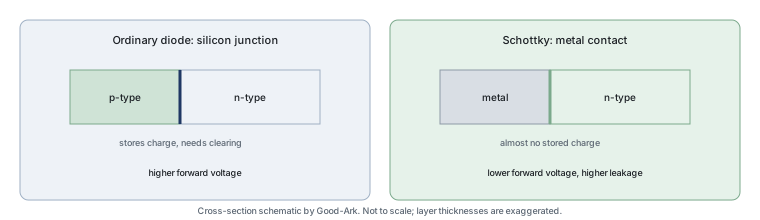
A Schottky diode does the same job as any other diode — it lets current through in one direction and blocks it in the other — and it does that job with less voltage lost and almost no delay when it stops conducting. That combination is why it turns up wherever a small voltage difference is worth money.
What makes Schottky different in one paragraph
An ordinary diode is built from two differently treated regions of silicon, and its behaviour comes from the junction between them. A Schottky diode replaces one of those regions with a metal contact, forming what is called a Schottky barrier. That change removes the stored charge that makes an ordinary diode slow to stop conducting, and it lowers the voltage needed to push current through.
Everything else about the device follows from those two consequences. Lower forward voltage means less heat at the same current, which is why these parts dominate low-voltage outputs. No stored charge means no reverse-recovery spike, which is why they suit high-frequency switching. And a metal contact brings its own weaknesses — more reverse leakage, and a lower maximum blocking voltage — which is why they do not replace ordinary diodes everywhere.
The low forward drop, in everyday terms
Forward voltage is the toll a diode charges on every amp that passes. An ordinary silicon diode charges roughly 0.7 volts; a Schottky charges somewhere around a third to a half of a volt, depending on the part and the current. At one amp that difference is a few tenths of a watt, which sounds trivial until you consider that the diode sits in a sealed plastic box with no airflow.
The comparison that makes it concrete is a low-voltage output stage. In a five-volt supply delivering two amps, the diode carries that current for a large fraction of the time. An ordinary diode would dissipate about 1.4 watts; a Schottky at 0.4 volts would dissipate 0.8. That reduction may be the difference between needing a heatsink and not, and it improves the efficiency figure the product is sold on.
Where you meet these parts daily
The most common hiding place is the low-voltage output of any switching supply. Phone chargers, laptop adapters, USB power blocks and the internal supplies of televisions all rectify on the secondary side, and that is where a Schottky is usually found. The second is DC-DC converters, where the diode freewheels between switching cycles and its forward drop is paid on every cycle.
Three further places are worth knowing. Solar panels use bypass diodes to give current an alternative path around a shaded cell, and those are often Schottky parts because their lower forward drop wastes less of the panel’s output. Battery circuits use them to combine sources or to stop a pack discharging backwards, where the drop matters because it is subtracted from the available voltage. And reverse-polarity protection on an input can use one, though the drop is a real cost there and designers often choose a different approach.
Voltage classes without the maths
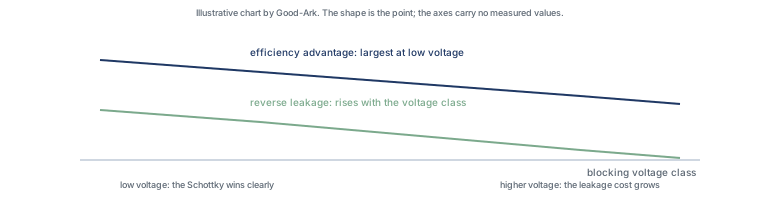
Silicon Schottky diodes are normally found in the low-voltage range, and the reason is physical rather than commercial: the metal contact that gives them their advantages also limits how much reverse voltage they can block. Pushing the design to higher voltages raises the leakage and softens the blocking, so the technology becomes a poor trade.
The exception worth knowing is silicon carbide Schottky diodes, which use the same metal-contact idea on a wide-bandgap material and reach blocking voltages in the hundreds of volts. That is why two device families with similar names live in different parts of a catalogue, and why the low-voltage silicon Schottky has not simply been replaced.
| Family | Typical territory | Why it is chosen |
|---|---|---|
| Small-signal Schottky | Signal and low-current paths | Low forward drop at small currents, fast |
| Low-voltage power Schottky | Output rectification in supplies up to a few tens of volts | Efficiency, where the drop is a large fraction of the output |
| Higher-voltage silicon Schottky | The upper end of the silicon range | Still lower drop than an ordinary diode, but leakage rises |
| Silicon carbide Schottky | Hundreds of volts and above | Fast switching without reverse recovery at high voltage |
Common packages you can recognise
In through-hole work you will see axial packages for small parts and a metal-tab package for high-current ones, where the tab exists to carry heat into a heatsink. In surface-mount work the range runs from tiny two-terminal packages on dense boards up to larger tabbed packages, and the family also appears in leadless packages where the thermal path is through a pad on the underside.
The package tells you what the designer was worried about. A large tabbed part indicates current and heat; a tiny two-terminal part indicates a signal or a low-current path; a leadless package with a thermal pad indicates a compact design where the board itself is the heatsink. Reading that intent from the package is often faster than reading the part number.
Two practical notes before the list of exceptions. The first is that these parts are usually chosen for efficiency in a position where efficiency is measurable: a diode drop of a few hundred millivolts in a five-volt system is a several per cent difference in delivered power, and that is worth paying for. The second is that the choice is made against the worst conditions the position will see, not the average ones, which usually means the highest ambient temperature and the largest transient.
If you want to check the material and device claims against an external source, three references are useful. The general device behaviour is described under Schottky diodes, the switching-supply context that creates most of the demand under switched-mode power supplies, and the solar application under bypass diodes. Device test methods come from JEDEC, board-level assembly and thermal expectations from IPC, the substance restrictions that appear on component declarations from the EU RoHS Directive, and sector-level reporting from the Semiconductor Industry Association. Device and assembly background is published by ISO and NIST.
When a Schottky is the wrong choice
Two situations reliably rule it out. The first is high reverse voltage: if the diode has to block more than the silicon Schottky range allows, a different family is required, and forcing a Schottky into that position produces leakage and eventual failure. The second is a hot environment combined with a duty cycle that keeps the diode in reverse for most of the time. In that case the reverse leakage becomes a heat source that grows with temperature, and the mechanism can reinforce itself.
A third, softer case is precision. If a circuit depends on a stable voltage reference or on very low leakage, the Schottky’s temperature-dependent leakage makes it a poor choice. The right answer there is usually an ordinary silicon junction device with a known behaviour rather than the part with the better headline number.
How to read a Schottky datasheet line
Five entries tell you most of what matters. The reverse voltage rating sets the class. The forward voltage, quoted at a specific current and temperature, tells you the toll. The reverse leakage, usually quoted at the rated voltage and often at an elevated temperature, tells you what the diode does while blocking. The average forward current tells you what it can carry continuously under stated conditions. And the surge current tells you what it survives in a single event.
The one that catches people out is leakage at temperature. A figure measured at room temperature can look acceptable while the same part at an elevated junction temperature leaks an order of magnitude more. Since leakage multiplies with voltage and rises steeply with heat, the number to look for is the one quoted at the temperature your design will actually reach.
FAQ
Is a Schottky diode faster than an ordinary diode?
In the sense that matters for switching, yes. An ordinary junction diode stores charge while conducting, and that charge has to be cleared when the current reverses, which produces the reverse-recovery current and its associated loss. A Schottky has almost no stored charge, so it stops conducting almost immediately. That is why the family dominates high-frequency, low-voltage rectification.
Why do Schottky diodes leak more?
Because the metal contact that gives them a low forward voltage also allows a small reverse current more easily than a well-formed silicon junction does. That leakage is temperature sensitive, roughly doubling for every ten degrees of junction temperature in the region of interest, which is why a figure measured cold can be misleading in a warm enclosure.
Can I use a Schottky diode anywhere an ordinary diode works?
Not everywhere. It is a good substitute in low-voltage rectification and freewheeling roles, where its lower drop is a benefit. It is a poor substitute where the reverse voltage is high, where the circuit demands low leakage, or where the device will run hot while blocking. In those positions the advantages are irrelevant and the weaknesses are the ones that decide the outcome.
How do I know which Schottky a design needs?
From the circuit rather than the catalogue. The reverse voltage the position must block, including margin for transients, sets the class. The current it carries sets the package. The switching frequency decides whether the recovery behaviour matters. And the ambient temperature decides how much leakage you can tolerate. Those four answers narrow the choice to a handful of candidates, and the datasheet settles the rest.
Where can I see the families side by side?
The Schottky portfolio overview groups them from small-signal parts up to power rectifiers, and the product family learning centre puts them in the context of the other device classes.
What to do next
If you are choosing a part, start from the four circuit answers above and then compare two candidates on the same conditions. If you are trying to understand why a design uses a Schottky rather than something cheaper, look at the voltage on the position: if it is low, the answer is usually efficiency, and if it is high, the part is more likely to be a silicon carbide device with a similar name.
Give Good-Ark the voltage, the current, the switching frequency and the ambient temperature, and we can point to the family and package that fit.
Email sales@goodark.com, or start from the Schottky portfolio page.
This article is published by Good-Ark, a manufacturer of Schottky rectifiers and other discrete devices. Typical figures are given for orientation; ratings, leakage and thermal behaviour for any specific part belong to its current official datasheet.
Continue reading
Browse the Schottky Diode Selection Hub for related guides.
Recommended
 Why Do Diodes Get Hot? Conduction and Switching Losses ExplainedInfoStandard, Fast Recovery, and Schottky Diodes: What’s the Difference?Info
 What Is a Fast Recovery Diode? Understanding “Fast Recovery”Info
 What Is a Diode? A Beginner’s Guide to How It WorksInfo
 Automotive Semiconductor Report 2026: Chips Per Car Keep RisingKnowledge